


- Translated with AI
Paul Jochem
The 2nd Technology Forum Cleanroom
Saarland expertise increased by 50%
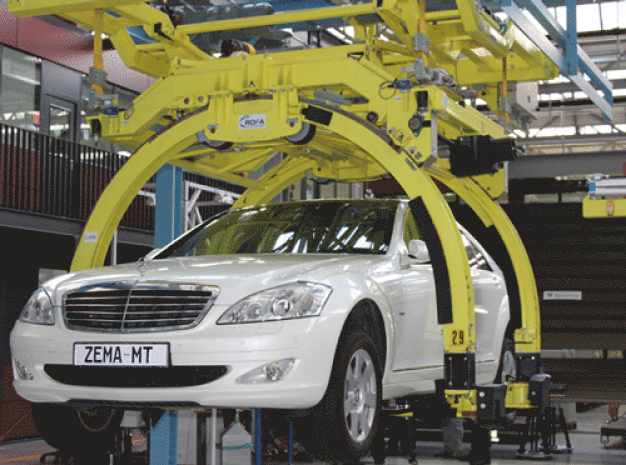
ZeMA
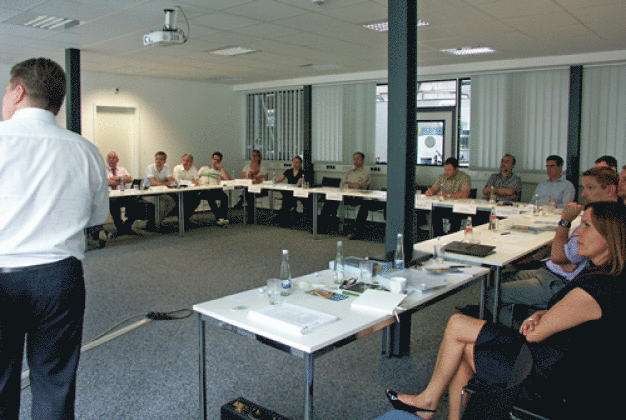
Forum participants during the knowledge exchange through the network partners CleanRoomNet.
With the second event, the organizers of the 2nd Saarland Technology Forum - Cleanroom exceeded their expectations. As one might suspect, word-of-mouth propaganda had left its mark.
The host of ZeMA (Center for Mechatronics and Automation Technology Saarbrücken), Mr. Jochen Flackus, in whose premises the event took place, was just as enthusiastic as the forum organizers.
Why the enthusiasm was so great can be described in a few words: The participants of the forum are cleanroom managers from Saarland companies, which produce their portfolios under clean or controlled conditions. Through the participants of the events, a competence team has developed that harmonizes perfectly with the know-how of the "CleanRoomNet" network. The resulting expertise will be discussed in working groups to explore their possibilities.
In sectors of the life sciences industry, such as pharmaceuticals, medical technology, and medical biotechnology, the highest safety and hygiene standards apply, subject to strict controls. At the same time, these manufacturers are experiencing increasing demand for their products. This requires that the necessary cleanrooms, processes, and continuously rising quality requirements pose a challenge for every company. At the same time, company processes must not be impaired, so that deadlines, costs, and quality are not to be assured to the highest degree.
Component cleanliness has now also established itself as an indispensable process step in manufacturing. Here, too, the defined particulate and film residual dirt requirements, as well as economic and ecological aspects, must be considered.
The Cleanroom Technology Forum addressed all these topics at its second event.
During the welcome, Jürgen Luckas informed the guests about the rebranding of ZPT to saar.is. New name, new strengths: ZPT becomes saar.is saarland.innovation & location e.V. (saar.is). Saar.is supports companies in Saarland's economy with comprehensive services to improve their competitiveness and innovation capacity, as well as to open up new markets. Research, development, and industry benefit from numerous funding programs such as events, individual consulting on founding or funding, trade fairs, and public relations.
At the same time, Mr. Luckas reiterated for the new participants that the 2014 Cleanroom Technology Forum aims to pursue the following ideas and benefits for each individual:
- Learning from practitioners and experts
- Forum and opportunity to present/classify own innovations
- Manageable participant circle
- Implementing insights in one's own operation
- Questions about own planning/implementation can be discussed
- Experience exchange among companies (across industries) in the areas of cleanroom technology, continuous improvement processes (KVP), and quality management
- Assistance in finding suitable cooperation partners (industry or science)
- Employees with high expertise are more satisfied, confident, and motivated
- ...
At around 3:15 pm, the head of the Center for Mechatronics and Automation Technology provided an overview of his institute. Mr. Flackus focused on three key topics:
Numbers and Facts about ZeMA:
- Founded: 2009
- Shareholders: Saarland with 60%, University of Saarland with 20%, University of Technology and Economics with 20%
- Employees: in 2012 = 53 persons, in 2013/14 = 82 persons.
The mission of ZeMA for the Saarbrücken site is:
- Establishment of an institute to promote application-oriented research
- Training of engineering students
- Technology transfer through cooperation with industry
- Center for Mechatronics and Automation Technology
- Its self-understanding: ZeMA sees itself as a partner for application-oriented research and industry-near development in the field of mechatronics and automation technology.
The focus:
- Research: From product to production process to manufacturing equipment
- Development: Conducted in close cooperation with the shareholders of Saarland University (UdS) and the University of Technology and Economics (HTW).
Mr. Steil from Becker Cleanroom Technology discussed the topic: Cleanliness / "Purity" in Production
In his presentation, Mr. Steil focused on the advantages of "everything from a single source." From planning through project development to the construction of cleanrooms and ISO 14644-1 compliant cleanrooms.
The differences between cleanroom and controlled environment were clearly defined and discussed. Through his abstract representations, everyone could imagine the described situation. The balancing act regarding the use of individual rooms was also extensively described within the short time frame.
Mr. Giesbert Klaus, Technical Manager at Variopack GmbH & Co.KG, discussed: Component Cleanliness in the Automotive Industry
- Regulations and application cases
- Executed examples
Mr. Klaus's areas of activity include: industrial part cleaning and responsibility for logistics services. In his presentation, Mr. Klaus first addressed the company's development in cleaning technology.
1994: Single-bath washing systems
1998: Throughput washing systems (cleaning and rinsing)
2007: Introduction of filter systems
2008: Four-stage washing systems
2010: Energy-efficient drying technology
2011: Maximum reduction of residual dirt particles through cleanroom technology
He defined the customer requirement for cleanliness: washing all individual parts in the same washing system, inspection immediately before delivery, with a cleanliness test procedure qualified according to VDA 19 (with minimum requirement specifications). Variopack is a service provider in this area. Using the example of a reusable packaging, Mr. Klaus explained the material flow in his company.
In the further agenda, Paul Jochem (Reinraumtechnik Jochem) raised the topic: Recognizing and Avoiding Contaminants
- What are sources of contamination, who or what are the causes?
- How can invisible phenomena be avoided?
He posed the fundamental question: What we cannot see or feel, how can we understand it? This question was related to particle sources in the cleanroom, which we cannot see (as they move in the nano range), but which are measurable. How can we plausibly explain this to cleanroom staff? The sense of touch is one of the most important human perception systems for obtaining, classifying, and processing environmental information over the long term. Through the skin, the largest sensory organ of humans, physical stimuli such as pressure, vibration, and temperature are perceived continuously.
Some properties of objects cannot be determined without our sense of touch. Hardness, weight, roughness, moisture, softness, elasticity, etc., are all features that we cannot see, hear, smell, or taste; we must feel them.
The skin is the outer boundary of our body, where much of the contact with the environment and other people takes place. When actively touching, we usually do so with our hands. In the cleanroom, we wear gloves to avoid additional particle sources. These facts do not necessarily make cleanroom training easier for employees.
Ms. Gitte Hansen addressed the topic: Consumables in the Cleanroom
- What types are there? ... Selection of the "right" ones for specific applications
- Cost-effectiveness considerations
Ms. Hansen first introduced the forum participants to her company and then to the full range of consumables for cleanrooms and their application possibilities. Her over 25 years of experience in this field was like hitting the jackpot for the participants. From her long-standing experience with her cleanroom clients, she was able to showcase a multitude of different application possibilities for consumables, and the balance between cost-effectiveness and practicality was well received by the forum participants.
At around 5:00 pm, Mr. Steil presented the sluice concept developed by the CleanRoomNet network for GMP applications – a practical guide.
He mainly explained the content of the brochure covering the following topics:
- Arrangement and concept of personnel sluices
- Proper entry and exit of personnel with correct clothing
- Furnishing, monitoring, and cleaning of sluices
- This brochure can also be downloaded at www.cleanroomnet.de
This forum will create a network that consolidates expert knowledge from various companies, combined with the expertise of the CleanRoomNet network, and can be used for ongoing knowledge and technology transfer.
The dialogue within this topic-specific network aims to bundle Saarland's expert knowledge to develop solutions.
Synergy effects, which are targeted and properly channeled, are indispensable in the fast-paced cleanroom environment.
At the end of the event, all participants of the Cleanroom Technology Forum were invited to tour the cleanroom at the ZeMA Center for Mechatronics and Automation Technology. Mr. Steffen Hau, Institute for Unconventional Actuators at Saarland University, accompanied the tour and was available for questions and answers.
During the subsequent get-together with drinks, participants were again given the opportunity to exchange professional insights with the speakers. This knowledge transfer was actively utilized.
ReinraumTechnik-Jochem
66538 Neunkirchen
Germany