



- R+D & Community of Interest
- Translated with AI
Thanks to AI, robots learn to assemble
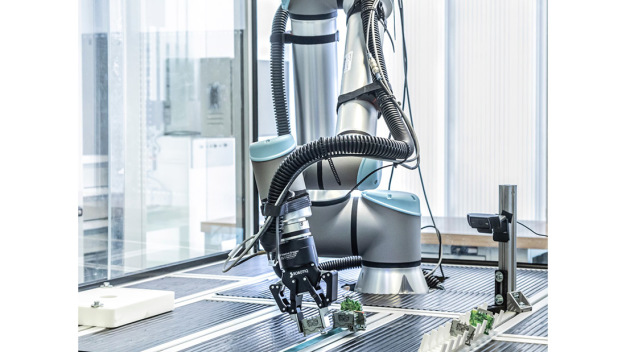
The research project "Rob-aKademI" aims to significantly simplify robot programming for assembly tasks. (Source: Fraunhofer IPA/Photo: Rainer Bez)
For assembly tasks, flexible robot programming has so far been complex. Improving this is the goal of the research project »Rob-aKademI«, which started on July 1, 2020. The technologies used within, especially machine learning, are intended to make programming easier and more autonomous.
The partners in the »Rob-aKademI« research project, including Fraunhofer IPA and the Institute for Industrial Manufacturing and Factory Operation IFF at the University of Stuttgart, are developing technologies to simplify robot programming for assembly tasks and to automate more. The basis for this is a purely digital replica, i.e., a digital twin, of the production environment. This replica, connected with a special programming system, is used in a physical simulation environment so that robots can learn skills for flexible assembly. They autonomously explore their environment in the simulation, plan their behavior based on this, and optimize or continuously learn it.
Three Learning Modules for Practice
Artificial intelligence (AI), specifically machine learning and its subset called »Reinforcement Learning« (RL), are used for this purpose. This means that an algorithm learns through trial and error, similar to humans. It receives a reward signal for successful actions to improve step by step.
Three application-oriented learning modules are being developed in the project, encapsulating expert knowledge about robot programming and the assembly operations to be performed: the »Perception Module« for object recognition, the learning module »Force-Controlled Joining« for robust joining strategies, and the learning module »Snap Connections« with a detailed physical joining model. These technologies will enable the creation of robust robot programs for transferring simulation results into reality. The project partners validate their results using three practical application cases: control cabinet, switch, and circuit board assembly. The modules for force-controlled joining and snap connections build on the already available IPA software »pitasc« for force-controlled assembly tasks and will expand its capabilities.
Added Value of Automation
»Rob-aKademI« addresses the needs of increasingly personalized production with its project goals. Assembly applications currently still pose high demands on robot programming. These include complex and demanding, often force-controlled processes, a high number of variants, and short cycle times. For many companies, especially small and medium-sized enterprises with custom products, it is often not yet worthwhile to use robots for assembly, especially since only an expert can perform the programming.
Robots offer advantages such as taking over non-ergonomic, dangerous, or monotonous tasks and providing consistent quality in task execution. Moreover, they can be a decisive competitive factor, especially in high-wage countries like Germany. Thanks to numerous automation potential analyses already conducted worldwide by Fraunhofer IPA, the researchers know the needs of companies precisely and bring this expertise into the project.
AI Advances Robotics
The »Rob-aKademI« project is part of the large funding initiative »AI01 AI in Practice« by the Federal Ministry of Education and Research. Another research project from Fraunhofer IPA within the same funding initiative is »Deep Picking«, which uses AI to optimize robot-based pick-in-the-box. Additionally, the project »AI-based Robot Calibration« (KIRK) from IFF is involved.
FACT SHEET
Full Project Title:
Collaborative Project Rob-aKademI – Generation of Robust Control Algorithms for Robots from Physics Simulation Using Methods of Artificial Intelligence for Highly Flexible, Variant-Rich Assembly in »Batch Size 1«
Duration:
01.07.2020 to 30.06.2022
Funding:
The project is part of the funding initiative »AI01 AI in Practice« by the Federal Ministry of Education and Research (BMBF). The funding code is 01IS20009.
Project Sponsor:
German Aerospace Center (DLR)
Project Partners and Their Contributions:
– Project Management & Development Partner: micropsi industries GmbH
– Development Partners: TruPhysics GmbH, elprotek GmbH
– Research Partners: Fraunhofer Institute for Production Technology and Automation IPA, University of Stuttgart
– End Users: dresden elektronik ingenieurtechnik GmbH, Käpple Qualitätsleister e.K., Walter Meile GmbH

Fraunhofer-Institut für Produktionstechnik und Automatisierung IPA
Nobelstraße 12
70569 Stuttgart
Germany
Phone: +49 711 970 1667
email: joerg-dieter.walz@ipa.fraunhofer.de
Internet: http://www.ipa.fraunhofer.de