



- R+D & Community of Interest
- Translated with AI
Take a deep breath, despite Corona
Ventilation systems in test
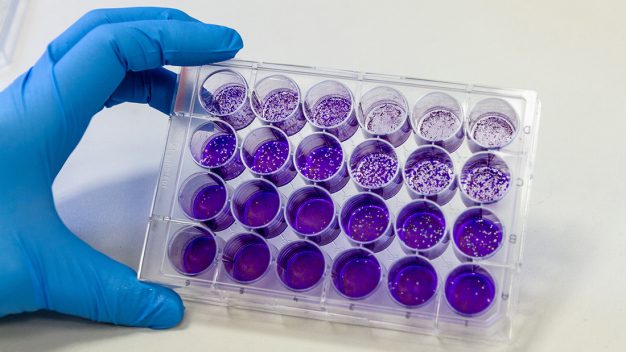
Using a virus activity test, the Fraunhofer scientists examine whether air filtered through ventilation systems still contains infectious and thus transmissible viruses. © Fraunhofer IGB
Can ventilation and air purification systems protect against Covid-19? How must they be designed for this purpose? And how should hygiene and ventilation concepts be structured to reduce virus transmission via aerosols? Answers to these questions are provided by a research team from the Fraunhofer Institutes IBP, IGB, and IPA in a new advisory center for healthy indoor air.
In December 2020, the Ministry for Economic Affairs, Labour and Housing Baden-Württemberg decided on the Healthy Air Initiative, an integrated advisory and research program. "Especially small and medium-sized enterprises have a high need for advice on aerosol prevention in the current pandemic situation. With the Healthy Air Initiative, we want to quickly and practically provide our companies with scientifically based solutions for indoor air ventilation to prevent aerosols," said Minister Dr. Nicole Hoffmeister-Kraut.
The three Stuttgart-based Fraunhofer Institutes IBP, IGB, and IPA are therefore establishing the joint Advisory Center for Healthy Indoor Air. They assist small and medium-sized enterprises in Baden-Württemberg in implementing ventilation concepts. Together with manufacturers, they operate test environments and conduct efficacy tests of air purification technologies. Additionally, a study will examine how mobile and fixed ventilation systems influence the spread of infectious SARS-CoV-2 aerosols.
Investigations into the Retrofit and New Construction of Ventilation Systems
Originally, ventilation and air purification systems were developed to filter dust and stale air from indoor spaces and to draw fresh air from outside. How they affect the spread of viruses was hardly of interest for a long time. Then came Covid-19, and it became clear: ventilation systems, in combination with climate control technology, can facilitate the spread of SARS-CoV-2 in enclosed spaces. "The colder and drier the air, the easier the virus can spread," says Dr. Udo Gommel, Head of Automation and Cleanliness Technology at the Fraunhofer Institute for Production Technology and Automation IPA. "Because then the tiny water droplets that may contain the virus evaporate faster, and the virus remains airborne longer," adds Professor Dr. Gunnar Grün, Deputy Director of the Fraunhofer Institute for Building Physics IBP.
Since continuous or frequent ventilation is hardly an alternative, especially in the cold season, existing ventilation and air purification systems need to be retrofitted and newly installed systems need to be designed differently. But how differently? And how exactly do existing systems without climate control technology influence the spread of SARS-CoV-2? A research team now aims to find out through a joint study.
Decontamination of Filters
The scientists want to get an overview: Which fixed or mobile ventilation devices are available on the market? How do they affect virus load, particles, noise development, and comfort in enclosed spaces? "Of course, our focus is also on sustainable aspects, such as practical application, maintenance, and energy consumption of the devices," says Professor Grün. The theoretical considerations will initially lead to simulations and then to practical tests. The research team plans to conduct experiments with the systems in the cleanroom of the Fraunhofer IPA, in the laboratories of Fraunhofer IBP and IGB, or simply where they are already installed, such as in conference rooms or workplaces. There, they will simulate and evaluate various scenarios together with manufacturers of ventilation and air purification systems to see how they affect aerosol distribution in the room. This allows for quickly obtaining reliable insights.
In the end, concrete recommendations will be made on how ventilation systems need to be improved or retrofitted to best prevent the spread of SARS-CoV-2. But one thing is already clear: "When ventilation systems filter pathogens from indoor spaces, their filters are contaminated with viruses," notes study leader Gommel. "For example, the filters can be irradiated with ultraviolet light to inactivate the viruses. Since this UV radiation is harmful to the human eye and skin, the irradiation must be shielded and conducted in a specially designed housing or area."
Tests with Model Viruses Demonstrate Effectiveness of Air Cleaning Technologies
Alongside the study, Gommel, Grün, and their colleague Professor Dr. Susanne Bailer from the Fraunhofer Institute for Interfacial Engineering and Biotechnology IGB are establishing the Advisory Center for Healthy Indoor Air. It serves small and medium-sized companies in Baden-Württemberg as a point of contact for all questions regarding indoor air ventilation during the pandemic. Special test setups will be established for manufacturers to examine the effectiveness of air purification technologies. "To make as reliable statements as possible, we work with so-called surrogate viruses. These model viruses used in practical tests are very similar to novel coronaviruses but are harmless to humans and the environment," explains virus expert Bailer. "By analyzing the activity and quantity of the viruses before and after measures to purify the air, we can draw conclusions about necessary adjustments to ventilation systems or inactivation steps." To also address the information needs of providers and manufacturers of ventilation and air purification systems, the researchers share their practical experience with these companies.
Aerosols Are Also a Serious Problem in Other Areas of Life
The Healthy Air Initiative runs for one year and is funded with 2.7 million euros. An initial free online event titled "Meet (y)our experts" on the topic of air purification will take place on March 3, 2021 (see info box). During this event, the participating scientists will inform about their advisory center and explain how companies can participate. In subsequent similar webinars, the research team will report on new findings.
The study results, expected in early 2022, could serve as a foundation for further investigations. Aerosols are also a serious problem as carriers of other infectious viruses and in other areas of life: starting with air pollution caused by fine dust and nitrogen oxides in many German cities, toxic fumes in airplane cabins, and material emissions in buildings, to toxic or conductive particles that disrupt battery cell manufacturing. Based on further studies, industry could in the future develop effective and cost-efficient ventilation and air purification systems for broad applications.

Fraunhofer-Institut für Produktionstechnik und Automatisierung IPA
Nobelstraße 12
70569 Stuttgart
Germany
Phone: +49 711 970 1667
email: joerg-dieter.walz@ipa.fraunhofer.de
Internet: http://www.ipa.fraunhofer.de