




- Translated with AI
Tailored for research
New modular construction laboratory at the II. Physical Institute of the University of Cologne
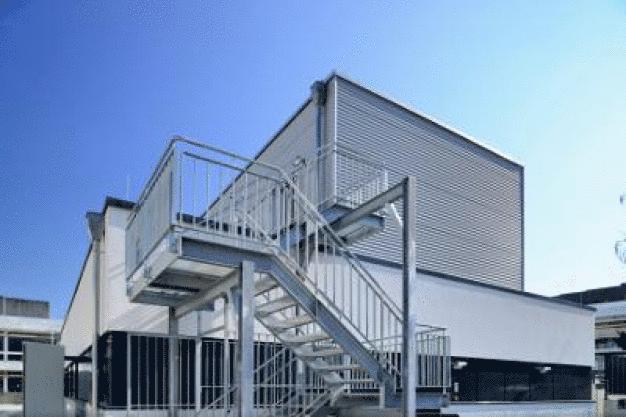
Labor new construction in ALHO modular construction
The Best for the Best
In 2015, the University of Cologne succeeded in recruiting one of the most brilliant representatives of international bulk material research, Prof. Dr. Yoichi Ando, as the new head of a chair in the field of experimental physics. In the "battle" of universities for the best minds, the architecture of the available research buildings also plays an important role. This is impressively demonstrated by the example of the new physics laboratory building, which was specifically constructed for the new physics research group on campus: During the planning and outfitting of the high-quality modular building, the professor from Japan had more than a say.
The physicist Yoichi Ando, born in Tokyo in 1964, is one of the world's leading scientists in the field of topological materials. His groundbreaking research in high-temperature superconductors has been awarded multiple times. Recruiting him for teaching and research is a great success for the University of Cologne. However, due to his appointment—especially because of the upcoming renovation of the physics institute building—there were not enough building spaces available for research. To quickly create high-quality space, the University of Cologne decided to commission a modular laboratory construction. ALHO competed against several other bidders and, in June 2015, based on the preliminary design from Cologne's Forstbach Consulting Baumanagement GmbH, began detailed work and execution planning of the exceptional building.
"Clarification" Regarding Modular Construction - or: Morsbach Gets a Visit
However, beforehand, ALHO received a high-profile visit at the Morsbach plant: The professor from overseas wanted to see firsthand the manufacturing conditions and the quality of the modules, but above all, the differences from conventional "container" construction. Because: a "container system" was not at all what the physicist envisioned for his research work.
However, he was interested in modular construction, prefabrication of the elements, and their efficient assembly—since this method bears some parallels to traditional Japanese architecture, which combines lines, surfaces, and bodies, implying the assembly of simpler, standardized elements.
On site, it quickly became clear what ALHO modular construction means: solid as "stone upon stone," but much faster and more flexible, the adaptable buildings are high-quality building solutions for permanent use and thus a sustainable and clever alternative to massive construction. Modular buildings are constructionally mature, energy-optimized, architecturally demanding, and indistinguishable from conventionally built structures. Clients and users appreciate the advantages of quick construction: planning certainty with guaranteed deadlines and fixed prices, high quality through controlled industrial prefabrication, rapid construction times thanks to parallel processes in the factory and on-site, quiet and clean assembly and expansion, as well as proven details and standards.
"In the new laboratory building, only research work by students within their bachelor or master theses, as well as during and after their doctoral studies, will be conducted. Due to computer-controlled operation and data acquisition, usually no more than 10 people will be present simultaneously in the modular building," explains Dr. Harald Kierspel from the II. Physical Institute of the University of Cologne.
From the perspective of users and researchers, however, there were very specific requirements for the building, such as the layout of the spaces and the height of the rooms. For example, floor depressions had to be integrated to create installation surfaces for equipment that require more than a standard room height. Non-magnetic areas, vibration-minimized floor behavior, and increased demands on climate control and ventilation of the rooms also had to be guaranteed. Dr. Kierspel confirms: "All these requirements could be quickly and high-quality implemented with modular construction, so we are very satisfied with the realized building and look forward to starting the research work there."
Room Program of Superlatives
With a laboratory for measurements at extremely low temperatures close to absolute zero, an oven room, a cleanroom with an airlock and air shower, where thin layers of novel compounds are produced and structured at the nanometer scale using electron beam lithography, as well as various measurement and sample preparation rooms, Prof. Ando provided the planners with an extraordinary room program. The 20 precisely prefabricated room modules, arranged over a gross area of around 630 square meters, form a clearly defined sequence that follows the logical workflow. The technical control center, designed as a mezzanine, with ventilation elements, sits on top.
The building is not basemented. In the area of the measurement room for extremely low temperatures and the cleanroom, the floor had to be cut out at several points for separate, vibration-isolated foundations. Structurally, the free-standing frame construction of the modules also had to withstand certain loads: For example, the floor in the GHV room had to be reinforced to accommodate a transformer weighing around 1,000 kg, and the ceilings of the low-temperature laboratory had to be strengthened to support three manual hoists with a load capacity of 250 kg each.
The physical experiments conducted in the building required special lighting conditions in some rooms or extensive power and gas connections. For example, the glass doors of the airlock and cleanroom are equipped with special glass for yellow light. All lines, such as compressed air, helium, oxygen, and nitrogen, are surface-mounted; ceilings were neither suspended nor clad, so that in case of leaks, quick intervention is possible, and changes in supply can be immediately adjusted. The PVC floors are conductive. Emergency exit doors lead outside from most rooms.
All rooms can be completely darkened. In rooms that had to remain windowless, such as the cleanroom, window openings were also prepared in the modular structure for potential future use changes, but instead of glass panes, aluminum flat sheet cassettes were used. This creates a uniform appearance around the facade.
Top-Class Equipment for World-Class Research
During the "furnishing" phase, the interior of the building presented a curious sight: rooms and corridors were full of boxes from overseas, often as high as a man and labeled with Japanese characters. Because Prof. Ando had the highly modern equipment needed for his new lab—such as crystal growth systems, He3He4 mixture cryostats with superconducting magnets, various magnetometers, X-ray analysis devices, raster and optical microscopes—shipped from his previous laboratories in his home country to Cologne and reassembled there.
This allows world-class research in Cologne to continue quickly. The ALHO construction schedule is also record-breaking: from order to commissioning, only half a year passed. The production of the modules took three weeks, and the onsite assembly only two days. The facade installation, with a construction time of six weeks, already exceeds this timeframe significantly. However, the building ensemble demonstrates a successful mix of what is possible in modular construction. In a dynamic sequence, the planners arranged plastered insulated facade, insulated aluminum cassette panels, ventilated panels, and corrugated sheet cladding. The building clearly stands out from the existing structures but still harmoniously integrates into the campus architecture without dominating it.
ALHO Systembau GmbH
51598 Friesenhagen
Germany