
- Trade fair
- Translated with AI
Successfully implementing the automation of tomorrow today
In four steps from idea to application
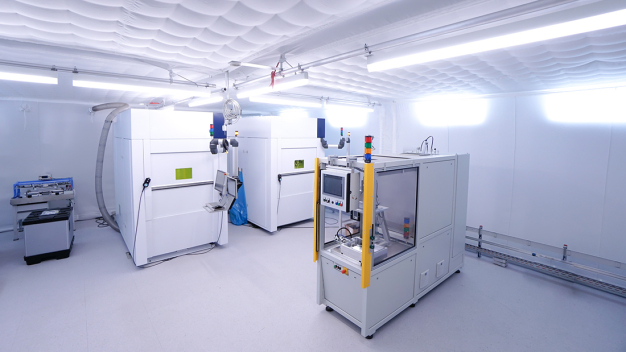
The DryClean-CAPE® dry-cleaning tent not only creates a pure production environment but also one with very low humidity. © Fraunhofer IPA
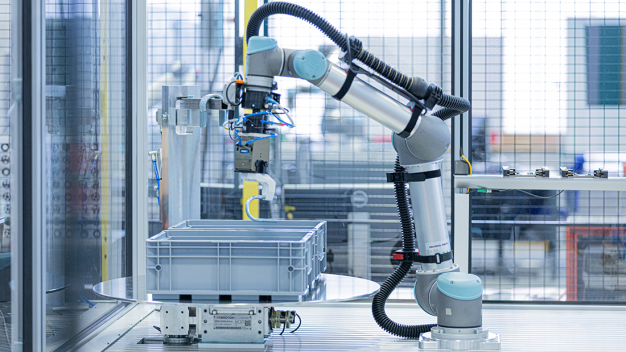
Machine learning makes the grab-in-the-box more autonomous, faster, and more robust. © Fraunhofer IPA / Photo: Rainer Bez
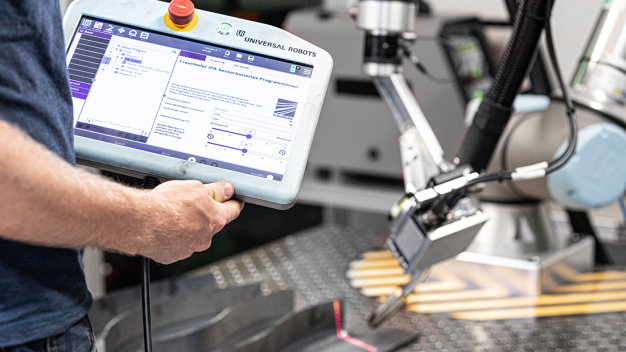
The "Automation Potential Analysis" (APA) is now available for welding processes. © Fraunhofer IPA/Photo: Rainer Bez
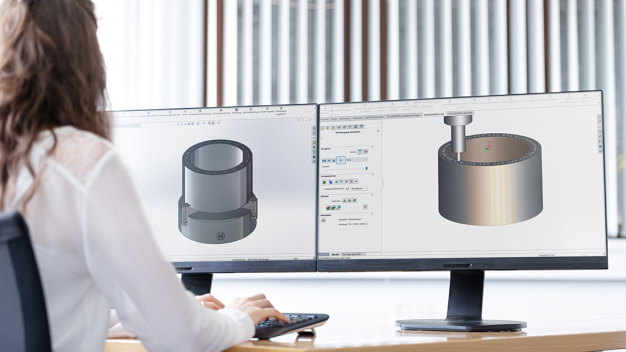
"DesignChain" is the continuous digitalization and automation of technical order processing – from the order to the finished product. © Fraunhofer IPA/Photo: Rainer Bez
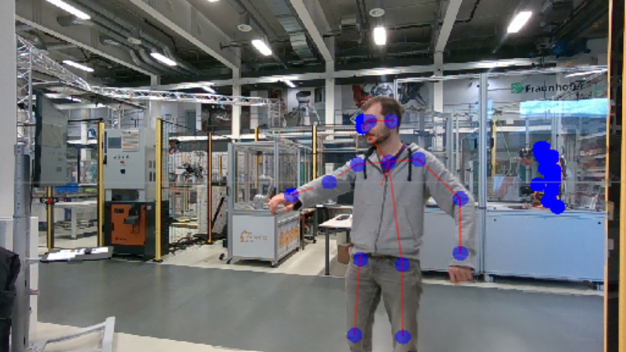
The "Robo-Dashcam" securely records safety-relevant data and persons in compliance with data protection regulations while the robot cell is in operation. This allows the safety concept to be adjusted even afterwards. © Fraunhofer IPA
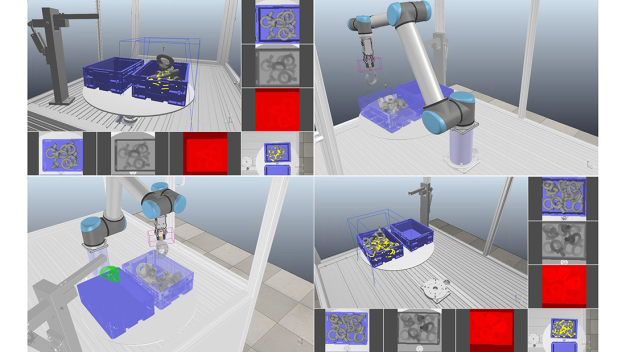
With virtual feasibility studies, companies can quickly assess the feasibility of a "grab-in-the-box" application without investments in material. © Fraunhofer IPA
Providing companies with a clear competitive advantage and preparing them for the challenges surrounding the production of the future: With this promise of performance, Fraunhofer IPA will present itself from June 27 to 30, 2023, at the automatica trade fair. Visitors will experience applications related to robotics, automation, artificial intelligence, as well as cleanroom technologies and gain new insights through regular expert sessions and the interview format "Interactive Live".
The Fraunhofer Institute for Production Technology and Automation IPA will showcase eleven exhibits at this year's automatica, demonstrating how companies can implement automation solutions at the highest level. The offerings are diverse: They target companies with existing applications looking to optimize them, as well as those aiming to realize entirely new applications. For each project phase, there are exhibits that enable the successful implementation of that particular phase.
Step 1: Assess technical and economic feasibility
Many companies want to automate but fear technical and economic misjudgments. For this, Fraunhofer IPA has been offering the "Automation Potential Analysis" (APA) for years. The APA development team goes directly into companies for this compact project format, analyzes the current status, and determines an objective "Fitness for Automation" of the examined production processes. The APA has already been used at over 500 customers worldwide for various automation projects around assembly. It is now also available for welding processes. "Companies thus receive a systematic decision basis that significantly reduces investment risk," explains Lorenz Halt, group leader at Fraunhofer IPA.
Until now, the APA was linked to the expertise of specialists at Fraunhofer IPA. For the trade fair, it is also available as an app through the licensing partner Evia. Companies can thus analyze an application they might want to automate themselves. In addition to assembly and welding applications, the team is currently developing an APA for machine loading and logistics.
And outside production halls, more automation is often desired. Therefore, a group at Fraunhofer IPA is developing a robust, autonomous outdoor navigation system for the challenges of typical outdoor environments. Examples include outdoor intralogistics, agriculture, or forestry. A key challenge in this navigation is the varying light and weather conditions, as well as terrain navigability and obstacles. For example, obstacles like cable bridges, grating, potholes, or steps and ledges can pose difficulties for autonomous systems in intralogistics processes between factories. At the trade fair booth, the prototype outdoor robot CURT_mini will demonstrate how such difficulties can be solved through coordinated hardware and software, and how intralogistics can also be successfully implemented outdoors.
The exhibit is complemented by extensive consulting services on the meaningful use of autonomous mobile robots (AMR) indoors and outdoors. Fraunhofer IPA's navigation software has a long track record of success. An example is in the production of an automobile manufacturer. In 2014, the first autonomous guided vehicles (AGVs) using the institute's software were deployed here. At the booth, such an AGV with a car on it will be noticeable to visitors — as evidence and symbol of successful technology transfer, which also led to a spin-off.
From field to back into production halls, the "DesignChain" exhibit addresses the current requirement that industry increasingly needs to produce customer-specific products cost-effectively and in ever shorter times. To remain competitive globally, the so-called "DesignChain" is recommended. "This means that the technical order processing from order to finished product is fully digitized," explains Jonas Krebs, co-developer of the exhibit. This halves the effort for manufacturing preparation. Visitors at the Fraunhofer booth can configure a custom product with the exhibit, which is then generated as a CAD model, simulated for manufacturing, and planned for 3D printing.
Step 2: Develop viable concepts
Successful technology transfer requires thorough planning and conception. Because if this project phase is not executed properly, it often results in unexpected costs and additional efforts later in the project. To specifically support this project phase, Fraunhofer IPA presents a solution focused on functional safety (Safety) and the planned spin-off "IntRAC" for the implementation of assembly cells with robots.
Safety concepts can negatively impact the cycle time of a robot application. The "Robo-Dashcam" exhibit can improve this. A camera securely and data-protectively captures safety-relevant data and people while the robot cell is in operation. Based on this data, the safety concept can be adjusted afterward to increase performance or cycle time. "We measure the optimized robot performance and can reduce safety distances. This demonstrates the success of the project and the effectiveness of our Robo-Dashcam," says Aulon Bajrami from Fraunhofer IPA, who co-developed the application. Up to ten percent higher productivity and a 54 percent reduction in risk assessment time are possible.
The Robo-Dashcam is part of CARA, the "Computer-Aided Risk Assessment," which helps companies systematically and semi-automatically create safety concepts and enable performance improvements. Having been active in international standardization for 15 years, the institute incorporates the latest insights from this work into all its developments.
With the planned spin-off "intRAC" (intelligent Robotic Assembly Cell), Fraunhofer IPA offers a modular automation solution especially for cost-effective cable and connector assembly, even for small batch sizes. "Our offering addresses the needs of small and medium-sized enterprises by making the modular robot cell flexible and quick to adapt to different products. This allows companies to produce multiple variants with a single system and make predictable investment decisions," explains Arik Lämmle from the founding team. intRAC is aimed directly at companies that often lack robot expertise and are particularly affected by skilled labor shortages and high labor costs. The spin-off incorporates expert knowledge from 15 years of experience in assembly automation and software development for this sector.
Step 3: Experimentally or simulatively verify technical feasibility
Once the basic idea is secured and a concept for application realization exists, the focus is on verifying feasibility. Fraunhofer IPA also offers exemplary exhibits at the booth for this project step.
One of these is "AI Picking," the AI-based pick-in-the-box. The Fraunhofer IPA development team addresses the technical hurdles that still hinder the widespread use of pick-in-the-box despite its high economic potential. "The use of AI, or more precisely machine learning, makes the application autonomous, faster, and more robust," describes co-developer Marius Moosmann from Fraunhofer IPA. The two-part exhibit demonstrates how this works. One part shows traditional pick-in-the-box, reliably recognizing and grasping objects from boxes with mixed contents. It also automatically detects jams and plans the robot's removal path to release the jam. The other part shows how different packages are recognized and grasped on a sorted pallet. A robot stacks the packages accordingly.
The offering around reliable object grasping also includes virtual feasibility studies. Companies can quickly and without material investments check the feasibility of a pick-in-the-box application. They receive information about the suitable cell layout, hardware, graspability of various workpiece geometries, and additional data such as possible cycle times, availability, and grips per hour. This provides a comprehensive basis for decision-making.
In addition to grasping from a box, questions about placing objects into a box are increasingly addressed by experts at Fraunhofer IPA. This process is becoming especially important due to the booming online retail. The "Bin Packing" exhibit demonstrates how this can also be fully automated. Tim Nickel, co-developer of the application, explains its advantages: "Without prior learning data on objects, the robot system can efficiently grasp freeform shapes without packing patterns or pre-commissioning and neatly place them into a carton. This achieves a five percent higher packing density with significantly reduced preparation effort." Visitors can interact with the robot at the booth by handing it an object, which it then grasps and packs without prior setup. Feasibility studies for bin packing in simulations are also possible.
Step 4: Implement concepts in production
Finally, Fraunhofer offers extensive options for the final realization of an application. The Fraunhofer IPA exemplifies this with three exhibits.
For example, the software "pitasc" addresses a common hurdle in assembly automation: the variety of variants, which has traditionally involved high programming effort. These efforts quickly make robotics uneconomical. pitasc addresses this: With the software, an assembly task no longer needs to be programmed point by point. Instead, programming is structured and modular based on data provided by sensors on the robot, relative to the workpiece. Pre-made, reusable program modules help implement particularly tricky, force-controlled assembly applications faster than before and enable efficient adaptation to new variants. "For example, the robot's position, fixtures, and even the end effector can be changed without reprogramming," explains Anwar Al Assadi, group leader at Fraunhofer IPA, highlighting the benefits of the pitasc solution.
Another approach for better planning and execution of assembly is a spin-off from Fraunhofer IPA. The startup is developing the AI-based software "Assemblio" Assembly Suite, which analyzes and evaluates CAD-STEP files. Any CAD system can generate these information-rich files. They provide all necessary information for the "3D Analysis AI" to derive structured assembly information precisely. A second component, the "Assembly Composer," reads the extracted assembly data and feeds it into a tool for assembly planning. The tool simplifies graphical display of relevant information, making assembly planning straightforward and error-free. The AI assembly assistant "KIM" automatically and cost-effectively creates assembly aids for interactive personnel support. The assistant is flexible and can be 2D- or 3D-based. Alexander Neb, CEO of the spin-off, states: "Initial user studies show a time savings of up to 92 percent when using Assemblio." The software will be commercially available from July this year.
A third example of successful application realization is the cleanroom system CAPE®. This is a flexible cleanroom system that achieves air cleanliness classes 1 to 9 according to ISO. Similar to tents, the CAPE® system can be assembled and put into operation within a few hours or days. Over recent years, researchers have expanded the CAPE® into a whole product family. "The latest member is our DryClean-CAPE®, which we will showcase at automatica. It not only creates a pure production environment but also one with very low humidity, for example, a dew point of -50°C," explains Frank Bürger, group leader at Fraunhofer IPA. In industrial battery cell production, the DryClean-CAPE® is already in use, but the technology is also crucial for automotive manufacturing and aerospace.
Successful technology transfer: "50 Years of Robotics at Fraunhofer IPA"
Many of the exhibits described are results and evidence of successful technology transfer and profitable application developments around robotics at Fraunhofer IPA. The department of robotics and assistance systems can look back on a 50-year success story in this context. And this will be celebrated: To mark this occasion, there will be a celebration week from September 26 to 29, 2023. It is themed #whatsnextrobotics — because although looking back and celebrating achievements is important, looking into the future is much more decisive to show how Fraunhofer IPA is shaping tomorrow's robotics today and making it ready for practical use.
Various program points are planned during the celebration week, and all interested parties are warmly invited:
– September 26 and 27, 2023: International Symposium on Robotics (ISR)
– September 27, 2023: Technology Forum on Driverless Transport Systems and Mobile Robots
– September 28, 2023: Application Day — Targeted events on human-robot collaboration, welding cobots in application, robotic assistance systems for care, technology seminar on robots in warehouses, experience exchange on automation potential analysis
– September 29, 2023: Public tours of the test fields, followed by "Long Night of Robotics" from 5 p.m.
All information about the 50th-anniversary celebration can be found at: ipa.fraunhofer.de/50y_de
The Fraunhofer IPA team will also be available at automatica for any questions regarding the celebrations.
And by the way: Earlier this year, researchers from the department of robotics and assistance systems at Fraunhofer IPA uncovered a secret. They revealed what robots get up to at night: https://youtu.be/a8ymTUOJuZc
More Information
Expert Sessions:
From Tuesday to Thursday (June 27 to 29, 2023), Fraunhofer IPA offers expert sessions, guided thematic tours at the booth. Interested visitors can register in advance or simply come spontaneously. The tentative schedule (valid for all three days) can be found at the registration link: https://s.fhg.de/3hG
Interactive Live:
Twice daily from June 27 to 29, 2023, there will be a live interview with an expert at the trade fair booth, also streamed on LinkedIn. The conversations with various company representatives and customers will focus on successful technology transfer with Fraunhofer. The scheduled times (valid for all three days) are: 10:30 to 11:00 and 14:00 to 14:30.

Fraunhofer-Institut für Produktionstechnik und Automatisierung IPA
Nobelstraße 12
70569 Stuttgart
Germany
Phone: +49 711 970 1667
email: joerg-dieter.walz@ipa.fraunhofer.de
Internet: http://www.ipa.fraunhofer.de