- Robot
- Translated with AI
Successful research project on autonomous measurement robots
Measurement robots independently find their way to the measurement object and autonomously execute measurement plans
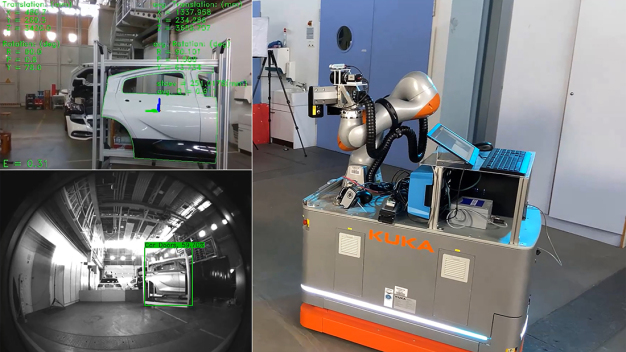
The autonomous measurement robot independently detects its target using cameras and aligns itself with the body to inspect gaps and flushness at the desired positions without human interaction.
– The trend towards more modularity and a higher variety of options in production requires more flexible quality assurance
– A consortium of ZEISS, the Institute for Laser Technologies in Medicine and Measurement Technology (ILM), the Institute for Measurement, Control, and Microtechnology (MRM) at the University of Ulm, and BMW has successfully researched a future-proof solution
As a leading provider of innovative inline measurement solutions, ZEISS combines real-time process monitoring with ZEISS AICell trace and metrologically traceable inline measurement technology in a single cell. Through exchanges with its customers, ZEISS understands their requirements and strategies. With funding from the Federal Ministry of Education and Research (BMBF), ZEISS, in a consortium with partners BMW, the Institute for Measurement, Control, and Microtechnology (MRM) at the University of Ulm, and the Institute for Laser Technologies in Medicine and Measurement Technology (ILM), has researched and developed the concept of an autonomous measuring robot (AuMeRo) as a response to these developments. A fully functional prototype has already demonstrated this year that AuMeRo can handle tasks such as inspecting gaps and bonding on unpainted or painted body parts in full.
“A rigid production line for a standard product, on which as many units as possible are produced – this established concept could soon be a thing of the past,” said Manuel Schmid, Product Manager at ZEISS IQS. Increasingly individual customer demands lead to a growing variety of product options and thus a necessary modularization in their manufacturing. Especially industries affected by this, such as automotive manufacturing, are planning to dissolve sequential manufacturing processes with highly specialized stations in the long term and replace them with flexible manufacturing islands.
Combined expertise for an intelligent, autonomous system
AuMeRo is a rectangular platform with wheels at the bottom and a robotic arm with an optical measurement sensor at the top. “This hardware aspect is, of course, not revolutionary in itself,” explains Dr. Matthias Karl from ZEISS Group Research. “The main task was to create the necessary intelligence on the software side for autonomous movement to the object, its measurement, and data processing.” To master this challenge in the research project, the partners combined their respective areas of expertise.
The Institute for Measurement, Control, and Microtechnology at the University of Ulm focuses on autonomous driving in collaboration with several automotive manufacturers. It developed and implemented the navigation solution for the mobile measurement platform, enabling it to move autonomously to the target object and safely circumvent obstacles. The Institute for Laser Technologies in Medicine and Measurement Technology has long-standing experience in optical measurement technology. It researched and developed a method for simultaneous measurement of raw, colored, and painted body parts with non-cooperative surfaces using the same measuring device. ZEISS, as the consortium coordinator, was represented by ZEISS Industrial Quality Solutions (IQS) and corporate research with two specialized departments: ZEISS IQS contributed application-oriented optical measurement technology, while ZEISS corporate research ensured the movement of the robotic arm, object recognition, and measurement position control through optical image recognition combined with machine learning. The application partner BMW, as one of the leading premium automakers, provided the project with a tangible practical context.
Fulfilling individual customer wishes while increasing efficiency
“The user selects an object via software, for example a vehicle door, its approximate location, and then the relevant measurement plan. From this point, AuMeRo operates fully autonomously,” explains Manuel Schmid. Object recognition is performed via camera and is based on a digital twin of the object. For the actual measurement, the mobile platform is equipped with additional optical sensors: a special measuring device was developed at ILM with advantages for short measurement times and robust environmental influences, utilizing multi-wavelength digital holography. This allows the collection of topographical data of an entire surface for diffuse and/or reflective surfaces in a single snapshot. After the platform has located and approached the object, the robotic arm moves the measurement head according to the requirements of the measurement program, considering the current spatial conditions. “Thanks to its ability for autonomous mobility and object recognition, AuMeRo is ready for a future where mobile, modular manufacturing islands are the norm, enabling measurements to be taken exactly where and when needed,” says Schmid. “But it can already fully demonstrate its advantages for manufacturers today, for example in product audits, where measurement and documentation are currently done manually in the measurement room. With AuMeRo, this can be done much more efficiently, automatically, and reproducibly, with consistently high quality and reliability of the measurement results.”
“We have demonstrated with this research project that the concept works without restrictions and can be easily adapted to new objects and measurement plans. This opens the door wide for this technology,” says overall project coordinator Dr. Matthias Karl. Jan-Klaus Dziergwa, project manager for body construction and quality management at BMW Group, is enthusiastic about the results: “At BMW, we are highly interested in fulfilling individual customer wishes while continuously increasing our efficiency during production and quality assurance. This requires innovative methods and technologies, and AuMeRo is an excellent example of this.”
Carl Zeiss IQS Deutschland GmbH
73447 Oberkochen
Germany