



- Corona
- Translated with AI
Study: Single-celled green algae produce the complete spike protein of the coronavirus for the first time
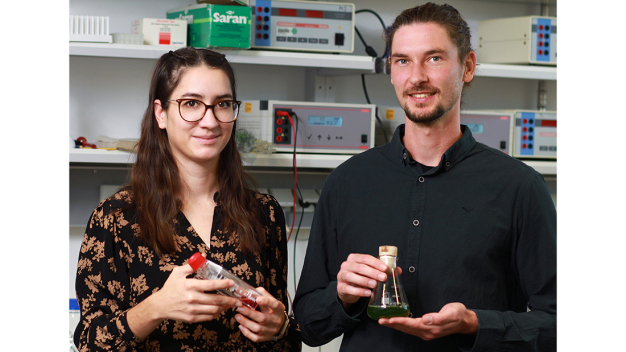
The team around Anna Kiefer and Justus Niemeyer relies on the green alga Chlamydomonas reinhardtii to produce the spike protein. (Photo: Koziel/TUK)
To produce medicinal active ingredients, microorganisms such as bacteria are often used. However, especially with complex molecules, they reach their limits because they are unable to synthesize them. An alternative is the unicellular green algae species Chlamydomonas reinhardtii. Researchers at the Technical University of Kaiserslautern (TUK) have, for the first time, been able to produce the complete spike protein of the coronavirus, which docks onto human cells. This was not previously possible. The work demonstrates the potential role the algae could play in future drug production. The study was published in the renowned journal Frontiers in Plant Science.
Microorganisms such as bacteria and yeasts are used as microfactories because certain proteins can be produced on an industrial scale relatively easily with them. This is also of interest for pharmaceutical research, for example, to develop therapeutic proteins. Other methods are often laborious and more expensive.
However, bacteria reach their limits with complex molecules. "They are not capable of glycosylating proteins," explains Justus Niemeyer, a doctoral student in the Molecular Biotechnology and Systems Biology working group led by Professor Dr. Michael Schroda at TU Kaiserslautern. This means attaching sugar chains to these molecules. "Each organism has its own characteristic pattern," he continues. "This signature is necessary for the proteins to be functional."
Therefore, the unicellular green algae Chlamydomonas reinhardtii is increasingly coming into focus of research. "It can synthesize complex molecules," says doctoral student Anna Kiefer, the first author of the current study. Like humans, the algae belong to the eukaryotes. Unlike prokaryotes, which include bacteria, they have a cell nucleus.
The team around the two researchers has now used the algae to produce the spike protein of the coronavirus. This protein allows the virus to dock onto human cells. It is therefore of interest for research, as it represents a potential target for drug production.
"The algae also attach a sugar signature to the protein. In our experiments, we found that it is active and performs its function. It docks onto human cells in the cell culture, binding to the ACE2 protein on the cell," explains the Kaiserslautern biologist further.
For the first time, the researchers have succeeded in producing this protein with the help of algae. "Another research group has produced parts of the spike protein, but no one has yet been able to synthesize the entire molecule with algae," says Niemeyer. To adapt the genetic information for the production of the spike protein to the algae, the scientists used a so-called modular system. With its help, they quickly and efficiently created DNA templates for the protein from standardized genetic elements.
The work shows that green algae could be used for drug production in the near future. "They can be cultivated cost-effectively, quickly, and sustainably, and are easy to maintain," summarizes Kiefer.
The team plans to continue their research. Among other things, they want to work on purifying the spike protein from the other proteins produced by the algae. They also want to fundamentally investigate the glycosylation patterns used by the algae. "So far, little is known about this," says Kiefer. "Are there similarities to patterns in humans? Where are the differences? We want to explore this further."
The study was published in the renowned journal Frontiers in Plant Science. "Production and secretion of functional SARS-CoV-2 spike protein in Chlamydomonas reinhardtii"
DOI 10.3389/fpls.2022.988870
Technische Universität Kaiserslautern
67663 Kaiserslautern
Germany