- Translated with AI
Study: Single atom as a measurement probe uses quantum information for the first time
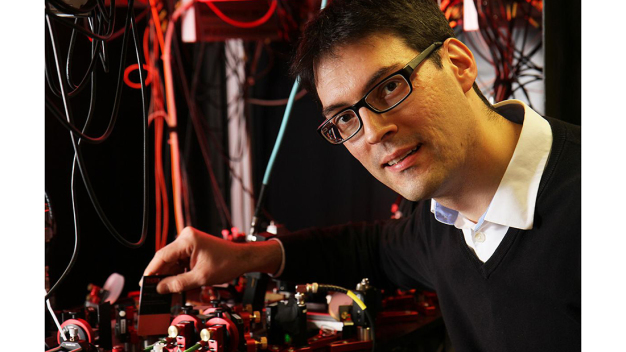
Professor Dr. Artur Widera. (Photo: Koziel/TUK)
Sensors detect specific parameters such as temperature and air pressure in their environment. Physicists from Kaiserslautern have, for the first time, succeeded with a colleague from Hanover in using a single cesium atom as a sensor for ultracold temperatures. To determine the measurement data, they utilize the quantum states, the spin, or also called the intrinsic angular momentum of the atom. With this, they have measured the temperature of an ultracold gas and the magnetic field. The system is characterized by particularly high sensitivity. Such sensors could potentially be used in the future to investigate quantum systems without disturbance. The work was published in the renowned journal "Physical Review X".
In their experiments, the scientists around Professor Dr. Artur Widera, who researches quantum systems, observe individual cesium atoms in a rubidium gas cooled close to absolute zero—the temperature here is only a billionth of a degree above this zero point. In their current study, they investigated whether the spin states of the cesium atom can be used to gain information. "The term spin refers to the intrinsic angular momentum of an atom," says Professor Widera from the Technical University of Kaiserslautern (TUK). "For cesium, there are seven different possibilities for this spin." The focus of the experiments was the temperature of the gas.
When the individual cesium atom is introduced into the rubidium gas, the rubidium atoms collide with it. "During this, angular momentum can be exchanged between the atoms until a spin equilibrium is established," explains Dr. Quentin Bouton, the leading scientist and first author of the study. The researchers measure the spin of the individual atom and can thus determine the temperature. The fact that this method works is demonstrated by a comparison with conventional measurement methods, where physicists obtain the same temperature value.
The special aspect of the study was the high sensitivity of the measurement. In a typical measurement, the sensor is brought into contact with the cold gas and waited until equilibrium is reached. "For quantum sensors, there is actually a fundamental limit of sensitivity in equilibrium. But we have already incorporated information about the interactions between cesium and rubidium beforehand, so we didn't have to wait until the atom was in equilibrium with the rubidium gas," Bouton continues. As a result, the measurement system of the Kaiserslautern researchers has about ten times higher sensitivity than the fundamental quantum limit demands. "We only need three spin rotations, i.e., three atomic collisions, to reach a result," Bouton further explains. Thus, the disturbance of the rubidium gas is limited to just three quanta. This is an important step toward minimally disturbing measurements of sensitive quantum systems, which are of interest for future applications in quantum technology.
"We have used a single atom as a sensor that utilizes quantum information and is significantly better than a classical sensor," emphasizes Widera. The physicists also conducted this experiment with magnetic fields and recorded the magnetic states. Their system, as a sensitive sensor, is suitable, for example, to investigate fragile quantum systems almost without destruction.
In addition to Professor Widera's research group, Professor Dr. Eberhard Tiemann from Hanover was involved in the work. The study was published in the renowned journal Physical Review X: "Single-Atom Quantum Probes for Ultracold Gases Boosted by Nonequilibrium Spin Dynamics"
DOI: 10.1103/PhysRevX.10.011018
Questions answered by:
Prof. Dr. Artur Widera
Research Group on Individual Quantum Systems
Email: widera(at)physik.uni-kl.de
Phone: 0631 205-4130
Technische Universität Kaiserslautern
67663 Kaiserslautern
Germany