




- R+D & Community of Interest
- Translated with AI
Study on sustainable industrial energy storage published
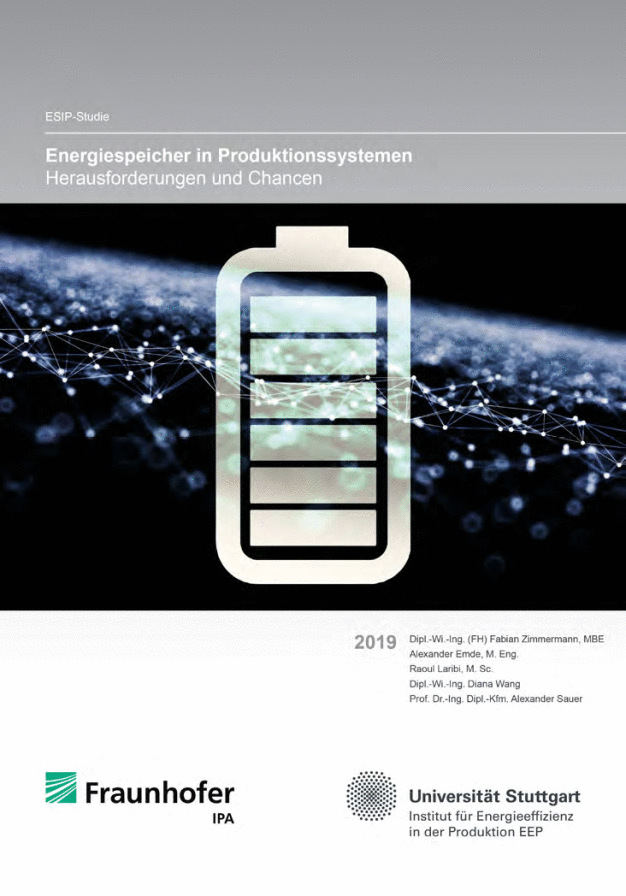
As electromobility continues to advance, the ongoing development of sustainable energy storage technologies is essential. Many manufacturing companies also integrate energy storage systems, for example, to guarantee uninterruptible power supply (UPS) for sensitive processes. Additional application options arise through the integration of renewable energies and their volatile generation. These include, among others, reducing power consumption from the grid or optimizing self-consumption.
Against this background, Fraunhofer IPA and the Institute for Energy Efficiency in Production (EEP) at the University of Stuttgart, funded by the Ministry for Environment, Climate and Energy Baden-Württemberg, conducted and now published the ESIP study "Energy Storage in Production Systems." It identifies possible application options for energy storage in production systems and describes the current state of energy storage technologies as well as their current challenges and opportunities.
To assess the potential for energy storage, expert interviews and an online survey were conducted. Between August 1 and October 18, 2018, 269 people participated in the study, with 136 data sets ultimately included in the analysis. The survey asked about technical integration possibilities, deployable energy storage technologies, competition, challenges, motivation, and economic viability. Additionally, eight expert interviews were conducted. Most of the companies represented by the selected experts already use energy storage systems.
Options for Deployment
There are numerous application options for energy storage in an industrial environment. Basically, a distinction can be made between options for securing production, optimizing energy procurement, and providing system services. The options for securing production are already established, while the options for optimizing energy procurement are becoming increasingly interesting for manufacturing companies. The deployment options through system services are seen only as a side effect to increase economic efficiency.
Available Technologies
Cost Reduction
All energy storage technologies have high manufacturing costs due to low batch sizes. A reduction in investment costs could be achieved for almost all considered energy storage technologies through mass production. Another way to reduce the high investment costs of energy storage systems is the use of second-life batteries from electric vehicles, as reusing used batteries from EVs for stationary applications can generate positive economic and ecological effects.
Removing Barriers
Besides economic viability, regulations also pose a challenge for integrating energy storage systems. Furthermore, the industry lacks experience, know-how, and practical demonstrators. The biggest driver for energy storage integration is the need for efficiency improvements from both a business and an energy perspective.
Conclusion
Currently, electrical or electrochemical energy storage systems are most commonly used for stationary applications. These energy storage technologies will continue to dominate the market, at least for short- and medium-term deployment options. Thermal energy storage will gain importance. Lithium batteries also have significant potential for stationary applications, and still-undeveloped energy storage technologies such as redox flow batteries could become interesting for stationary use in the future, according to survey participants. A major opportunity for companies lies in developing and building hybrid energy storage systems.
These consist of electrical and electrochemical or electrical and thermal energy storage systems. The integration of energy storage to optimize energy procurement is becoming increasingly attractive for companies, but economic viability remains the biggest challenge. Companies tend to prefer large central energy storage systems to decouple energetically from the grid. Central large-scale storage allows for multifunctional use, improving utilization and economic efficiency. Cost reduction driven by technological advancement and the increasing development of mass production remains the most important factor for economic viability.
At a Glance
The "Energy Storage in Production Systems" study identifies various application options for stationary energy storage in the industrial environment. It also presents current energy storage technologies and describes the current opportunities and challenges.
Funded by: Ministry for Environment, Climate and Energy, Baden-Württemberg
Authors: Fabian Zimmerman, Alexander Emde
Fraunhofer Institute for Production Technology and Automation IPA
Raoul Laribi, Diana Wang, Alexander Sauer
Institute for Energy Efficiency in Production (EEP)
Fraunhofer Institute for Production Technology and Automation IPA, Stuttgart
Fraunhofer Institute for Industrial Engineering and Organization (IAO), Stuttgart
Year: 2019

Fraunhofer-Institut für Produktionstechnik und Automatisierung IPA
Nobelstraße 12
70569 Stuttgart
Germany
Phone: +49 711 970 1667
email: joerg-dieter.walz@ipa.fraunhofer.de
Internet: http://www.ipa.fraunhofer.de



