




- Translated with AI
Study on Microbe DNA: Artificial Intelligence helps monitor the environment
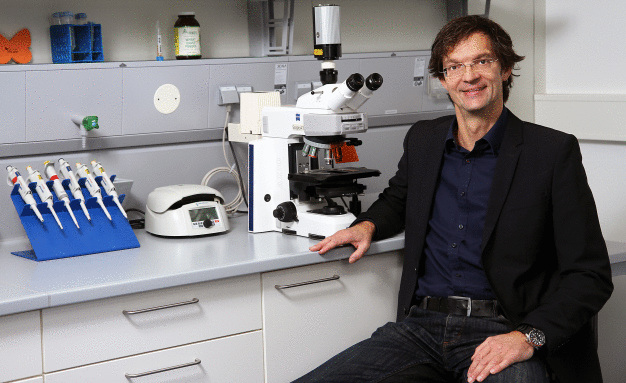
Prof. Dr. Thorsten Stoeck (Photo: Koziel/TUK)
Microorganisms play a key role in ecosystems: they quickly indicate when changes occur in their environment. However, because they are difficult to identify, they have so far played a subordinate role in environmental monitoring. Together with researchers from the University of Geneva, Kaiserslautern biologist Professor Dr. Thorsten Stoeck has developed a new technique that uses the genome of microbes. With the help of artificial intelligence, an algorithm can utilize the genetic material of unknown organisms to make statements about the state of the environment. The work has been published in the renowned journal "Trends in Microbiology".
Too much nitrate in our waters or the acidification of the oceans, which affects coral reefs, are just two examples showing how humans alter the environment. To counteract damage as early as possible, it is important to monitor the condition of ecosystems. "Microorganisms are suitable as indicators because they react very sensitively to such changes," says Professor Dr. Thorsten Stoeck, who researches ecology at TUK. However, identifying them previously required time and expertise.
Last year, Stoeck, together with his colleagues from Geneva, developed a method that makes it easier to monitor water quality near Norwegian and Scottish salmon farms. "We rely on DNA sequences of microorganisms," explains Stoeck. "Their genetic material is like a fingerprint that can be assigned to only one individual. The results are already available after a short time." The biologists are building a database in which the genetic fingerprints of these tiny organisms are stored.
However, when they analyze their samples, scientists still encounter DNA sequences that cannot be assigned to any previously known species. "We still know nothing about their role in the ecosystem. Therefore, it was difficult to use them as indicators," says Professor Stoeck.
With the team led by Tristan Cordier, the first author of the current study, and Professor Jan Pawlowski from the University of Geneva, Stoeck developed an algorithm that learns with the help of artificial intelligence. To feed the computational process with information, the biologists used DNA samples from various known microbes. "We know their roles in the ecosystem and whether they tend to serve as indicators of good or poor conditions," Stoeck continues. With this data, the researchers created a reference system. "This enabled the algorithm to develop a predictive model into which the sequence data of unknown microbes also flow."
"The method allows us to monitor an ecosystem without first identifying the microbial species present," summarizes Stoeck. Furthermore, the technique can be used to discover new species. Gradually, the scientists will also incorporate values from new samples to refine and improve their model.
The study was published in the journal "Trends in Microbiology": "Embracing Environmental Genomics and Machine Learning for Routine Biomonitoring".
Technische Universität Kaiserslautern
67663 Kaiserslautern
Germany