




- Translated with AI
Study on Material Testing: Detecting Damage in Non-Magnetic Steel Using Magnetism
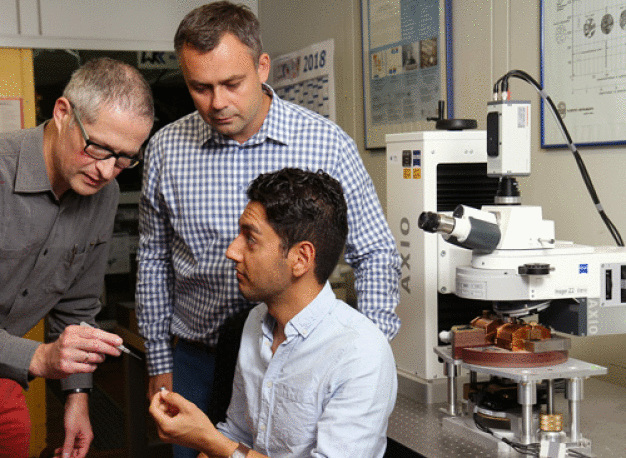
The Kaiserslautern engineers Professor Tilmann Beck (left), doctoral student Shayan Deldar (front in the picture), and Dr. Marek Smaga developed the process together with colleagues from Mainz. (Photo: TUK/Koziel)
Wear, corrosion, material fatigue – these signs of wear are common to most materials. It is all the more important to detect damage early, preferably at the micro level. To do this, magnetic testing methods are often used. With non-magnetic steel, this has so far been impossible. Researchers from Kaiserslautern and Mainz have now developed a method in which they apply a thin magnetic layer to steel. Changes in the microstructure can thus be detected through alterations in magnetic effects. Materials such as aluminum can also be tested in this way. The study was published in the journal Journal of Magnetism and Magnetic Materials.
Steel is among the most widely used materials. It is used in many variants, such as stainless steel, high-strength alloy steel, or inexpensive construction steel. Steels can be magnetic or non-magnetic. They are used in cutlery, vehicle components, or in steel beams for buildings and bridges. Sometimes, steel is exposed to high temperatures or stresses. "This can lead to microstructural changes, cracks, or component failure," says Dr. Marek Smaga, who conducts research at the Department of Materials Science at Professor Dr. Tilmann Beck at the Technical University of Kaiserslautern (TUK). Experts refer to this in connection with material fatigue. Such damage is initially only visible at the micro level. However, magnetic testing methods so far have not been able to detect changes in this area early in non-magnetic steel.
Precisely this is what engineers from TUK and physicists from Johannes Gutenberg University Mainz (JGU) are working on, and they present a solution in their current study. The special aspect: they utilize magnetic effects despite the material being non-magnetic. "In magnetic steel, this way, early changes in the structure can be detected," explains Kaiserslautern doctoral student Shayan Deldar. "Even tiny deformations alter the magnetic properties. This can be measured with special sensor technology."
The researchers coated a non-magnetic steel with different magnetic films, each about 20 nanometers thick, made of Terfenol-D, an alloy of the chemical elements terbium, iron, and dysprosium, or from Permalloy, an nickel-iron compound. To subsequently verify whether deformations of the steel can be detected on a microscopic level, the researchers used a so-called Kerr microscope. "This involves the Kerr effect," explains Smaga, "which allows the magnetic microstructures, called domains, to be visualized through the rotation of the light's polarization direction."
The scientists examined small steel plates a few millimeters in size that had previously been subjected to mechanical stress. "We observed that a characteristic change occurs in the magnetic domain structure," explains Privatdozent Dr. Martin Jourdan from the Institute of Physics at Johannes Gutenberg University Mainz. "Microscopic deformations in the non-magnetic steel cause the magnetization direction of the thin layer to change."
Compared to conventional testing methods, this approach offers the advantage of detecting signs of fatigue much earlier at the micro level. The researchers' method could potentially be used in new testing techniques in the future. Furthermore, it is not only interesting for non-magnetic steel; other materials such as aluminum, titanium, and certain composites could also be coated with such a layer.
The work was conducted within the framework of the Collaborative Research Center "Spin+X – Spin in its Collective Environment", which is based at TU Kaiserslautern and JGU. Here, research teams from chemistry, physics, mechanical engineering, and process engineering work interdisciplinarily on magnetic effects that are to be transferred into applications. The focus is on the spin. In physics terminology, spin describes the quantum mechanical intrinsic angular momentum of a particle, such as an electron or proton. It forms the basis for many magnetic phenomena.
The study was published in the renowned journal Journal of Magnetism and Magnetic Materials: "Strain detection in non-magnetic steel by Kerr-microscopy of magnetic tracer layers". M. Jourdan, M.M.B. Krämer, M. Kläui, H.-J. Elmers, S. Deldar, M. Smaga, T. Beck.
Technische Universität Kaiserslautern
67663 Kaiserslautern
Germany