




- Translated with AI
Study: Atomic contamination similar to gemstones serves as a quantum information storage
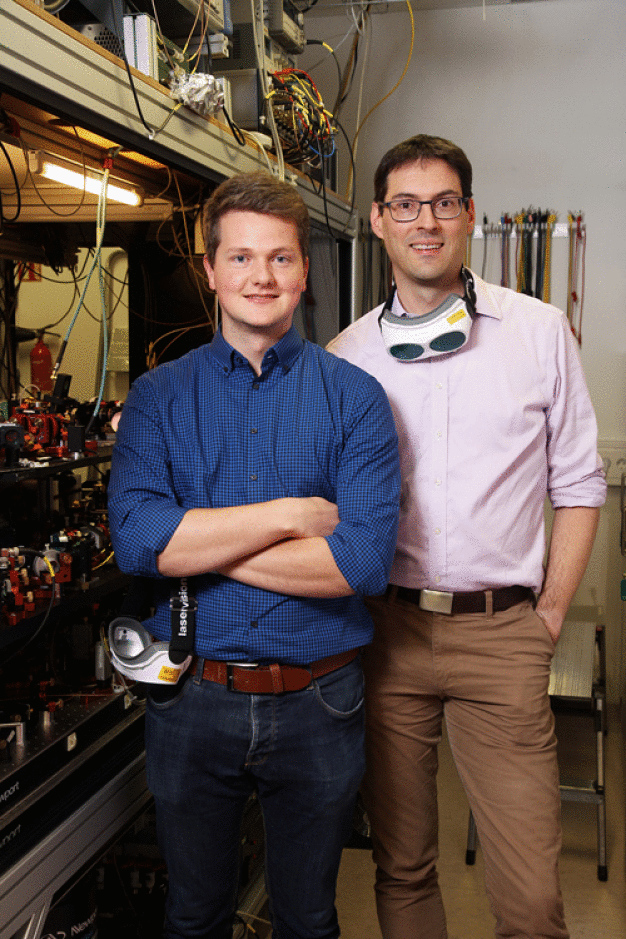
The two physicists Professor Dr. Artur Widera (right) and his doctoral student Felix Schmidt are researching ... (Photo: TUK/Koziel)
Impurities in materials are responsible for the colors of gemstones or the performance capabilities of modern semiconductors. Similar effects are observed in quantum systems, where research is still in its early stages. For the first time, physicists from Kaiserslautern have been able to controllably introduce individual impurities from cesium atoms into an ultracold quantum gas composed of rubidium atoms. They observed how these impurities exchanged quantum excitations (spin) with the gas. Additionally, they demonstrated that cesium atoms can store quantum information, which was not possible before. The study has been published in the renowned journal Physical Review Letters.
Impurities from individual atoms, like those in gemstones, also occur in other materials and substances. In quantum physics, they are responsible for various effects and are therefore of interest for experiments. At TUK, physicists led by Professor Dr. Artur Widera and his doctoral student Felix Schmidt have now, for the first time, observed how such impurities behave in a Bose-Einstein condensate of rubidium atoms. “In physics, this refers to a state of matter comparable to liquid and gaseous states. However, such a condensate is a perfect quantum mechanical state that behaves like a wave,” explains Professor Widera, who heads the department of Individual Quantum Systems. For physicists, the Bose-Einstein condensate is a popular model for studying quantum effects—similar to how the fruit fly Drosophila is used in biology and medicine as a model organism to answer genetic questions.
In their current study, the Kaiserslautern physicists examined such an impurity in a quantum gas. They cooled it to temperatures near absolute zero (-273.15°C). “This way, we can control a quantum mechanical system,” says first author Felix Schmidt. The impurities used by the researchers were cesium atoms. About five to ten cesium atoms were introduced into approximately 10,000 rubidium atoms. “The system can be examined under a microscope. The ultracold gas has a size of ten micrometers,” continues the doctoral student. Using this approach, the researchers localized individual impurities and observed changes in their structure, known as spins, through interactions with the quantum gas. “Until now, it was not possible to observe individual atoms in such a gas. We are pleased that we succeeded in doing so experimentally,” says Schmidt.
Furthermore, the researchers tested whether cesium atoms could be used as information storage and simultaneously cooled within the quantum gas. “For atoms to store information, their electronic state must be preserved,” explains Widera. “However, interactions with other atoms in the condensate pose a risk of losing this sensitive information due to disturbances.” The researchers have now, for the first time, managed to cool the atoms strongly within the quantum gas without losing quantum information.
“The model of individual impurities in an ultracold gas realizes a paradigm of quantum physics,” says Professor Widera. “It can serve as a starting point for many other quantum experiments.” In particular, the findings of the Kaiserslautern scientists help to better understand what happens at the quantum level. This could, for example, play a role in understanding superconductors and developing new materials in the future. Superconductors could transport electricity over long distances without significant energy loss at normal ambient temperatures. So far, this has only been possible at temperatures well below freezing point.
The study was published in the renowned journal Physical Review Letters: “Quantum spin dynamics of individual neutral impurities coupled to a Bose-Einstein condensate.” Felix Schmidt, Daniel Mayer, Quentin Bouton, Daniel Adam, Tobias Lausch, Nicolas Spethmann, and Artur Widera. Phys. Rev. Lett. 121, 130403
DOI: 10.1103/PhysRevLett.121.130403
Widera and his doctoral student Felix Schmidt conduct research on quantum systems. The physicists also collaborate interdisciplinarily at the State Research Center for Optics and Material Sciences (OPTIMAS) with groups from chemistry, mechanical engineering and process engineering, as well as electrical engineering and information technology, to translate fundamental research into applications.
Technische Universität Kaiserslautern
67663 Kaiserslautern
Germany