

- Buildings & Rooms
- Translated with AI
Dr. Ing. Dietmar Malcherek
Student project for the further development of a filter regeneration system for ultra-pure water
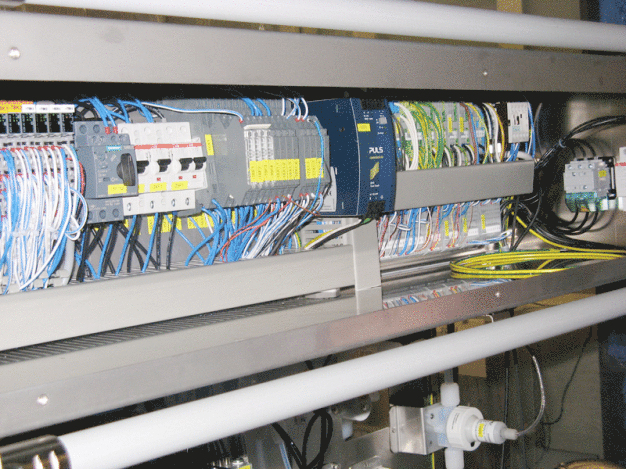
Electronic module
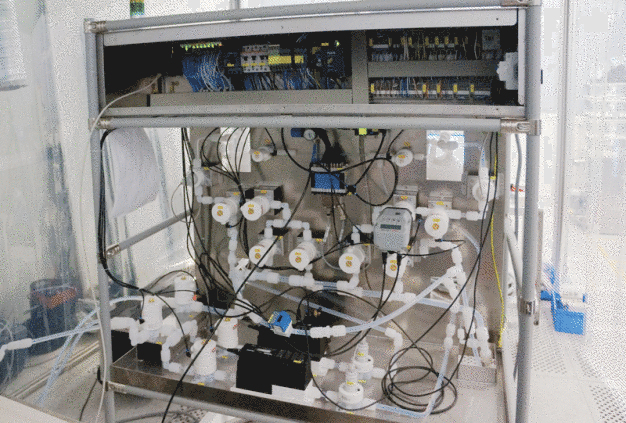
Rear view with pneumatic hydraulic components for controlling the regeneration processes
The M+W Products, a company of the M+W Group, has collaborated with the TheoPrax Center of the Fraunhofer ICT (www.theoprax.de) at their production site in Stuttgart to carry out a practical project over nearly one school year with four students (11th grade) from Reuchlin Gymnasium in Pforzheim. The goal of this student project was to assign the students a practical task outside of traditional classroom instruction and to solve it together as a team. During the school year, the student team maintained regular contact with M+W. For example, during visits to M+W approximately every 8 weeks, a device for automatic filter regeneration of ultra-pure water (technical term: UPW filter regeneration status) was built. Ultra-pure water is used in the manufacturing of microchips for wafer exposure and must be regenerated regularly.
The increasing demands on microchips, such as those used in smartphones, tablets, etc., put manufacturers under constant pressure to further miniaturize the circuits. Currently, microchips are produced with conductor widths of 1xnm (nanometers), and further reduction into the single-digit nm range (1nm = 10-9m) is within reach with new techniques.
To manufacture microchips according to the current standard, immersion technology is used in optical lithography. The use of ultra-pure water (UPW) causes the laser light used to expose the wafers to be refracted, which benefits the structure widths and depth of focus on the microchip. It is understandable that the water quality must meet the highest purity requirements. This is achieved by passing the water through several filters with different filtration properties before it is introduced into the exposure process.
Like all filters, these UPW filters also become contaminated with foreign substances after a certain period of use and must be replaced or cleaned. To do this, the filters are rinsed with the purest water in a multi-hour cleaning process (depending on the level of contamination, this takes 8-10 hours) to remove deposits and dirt from the filtration fabric. In this process, the process water serves as a regeneration parameter and is continuously analyzed for TOC (Total Organic Components) and particles during regeneration. Once a defined threshold for TOC and particles in the process water is undershot, the filter is free of deposits and can be used further in the UPW system.
Until now, the UPW filters at M+W Products were regenerated manually and with high time expenditure. Due to the increasing number of filters that need regeneration and the very long processing times for the regeneration process, the “Filter Regeneration Status UPW” was revised and automated as part of the mentioned student project.
The student team worked together with the company to develop a solution for an extended UPW filter regeneration status, which, in addition to an automated regeneration process, also allows for the assembly of a second filter. Once the first filter has successfully completed the regeneration process, the regeneration status automatically switches to initiate the regeneration process for the second filter while the process for the first filter is simultaneously closed.
With this project, M+W Products, with the help of the highly dedicated students, has taken another successful step toward automated service solutions. The students, working closely with M+W employees, were able to realize an innovative project and at the same time gained deep insights into modern microsystem technology – possibly also inspiring their choice of future field of study.
For any questions, please contact Mr. Dr.-Ing. Dietmar Malcherek, e-mail: dietmar.malcherek@mwgroup.net, phone: +49 711 88041624.
Exyte Technology GmbH
71272 Renningen
Germany