

- Universities
- Translated with AI
Strengthening research for the circular economy at Pforzheim University
German Research Foundation and State of Baden-Württemberg approve the expansion of a research facility
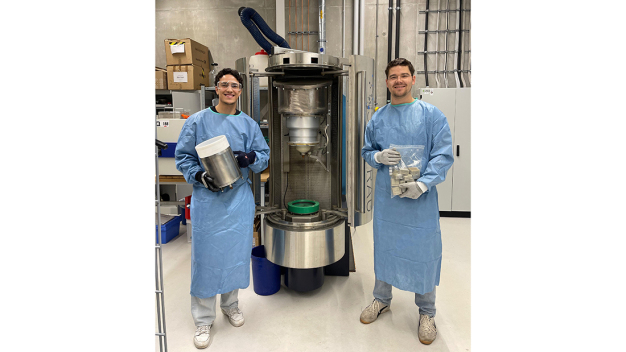
The students Younes Lhousni and Paul Steiner are working with the Electrodynamic Fragmentation System. (Copyright: Prof. Dr.-Ing. Jörg Woidasky; Publisher: Pforzheim University)
Old solar modules on the roof, worn rotor blades from wind turbines, single-use electrical devices from the operating room: All these products contain valuable raw materials – metals, rare earths, or high-quality fibers. However, they are often embedded in composite materials, making them difficult to economically recover. The consequence: raw materials are destroyed and must be produced again – with high environmental costs.
This is exactly where research at Pforzheim University comes in. Using targeted high-voltage sparks, material composites are literally torn apart – gently, precisely, and without aggressive chemicals. What sounds like science fiction is already a reality in the laboratory: photovoltaic panels, wind turbine components, electrical devices – all of these can be separated in such a way that the contained valuable materials can re-enter the cycle. Since 2014, an electrodynamic fragmentation system (EDF) has been used in Pforzheim for this purpose.
Now there is good news for the "Sustainable Product Development" research group, which is working with the device for the circular economy: The university's system can be renewed and upgraded for over 200,000 euros. It is unique at a German university of applied sciences, and its continued operation is now secured with support from the state of Baden-Württemberg and the German Research Foundation, the largest German research funding organization.
The EDF technology uses high-voltage discharges between 90 and 200 kV to selectively break down solids in a liquid medium. This allows material composites to be separated at their internal interfaces, enabling a high-quality circular economy. Future research priorities after the system upgrade include fundamental research with compressed gases as treatment media, as well as application-oriented projects for recovering metal components, e.g., from high-quality, electrically operated single-use medical devices. The overarching goal is to expand the application possibilities of EDF beyond mere size reduction effects, exploring a field that has been little researched so far.
How do teachers and students use the EDF technology?
The "Sustainable Product Development" research group at Pforzheim University has been researching environmentally friendly products and processes since 2012 – especially improving recycling methods for energy plants, packaging, or medical devices. These projects are fully funded by third-party grants. So far, five doctoral theses have been completed within this group, and one of the graduates has since become a professor at the university. Students in bachelor's and master's programs at the Faculty of Engineering work on theses related to the circular economy – also using the EDF system, always focusing on current, company-relevant questions.
Pforzheim University demonstrates: Sustainable technology begins in the laboratory – and impacts everyday life.
Prof. Dr. Jörg Woidasky, the project leader, explains: "The funding from the DFG and the state is an acknowledgment of our previous scientific achievements with the electropulse technology in Pforzheim. At the same time, we see it as an incentive to continue addressing the circular economy challenges of our society together with students and scientific staff, and to solve them with innovative approaches."
Hochschule Pforzheim
75175 Pforzheim
Germany