



- Floor
- Translated with AI
Stairs that show a clear edge
Aesthetic and barrier-free – the new nora stair edge T 5055 complies with the requirements of DIN 18040-1 and combines safe design with aesthetic appeal.
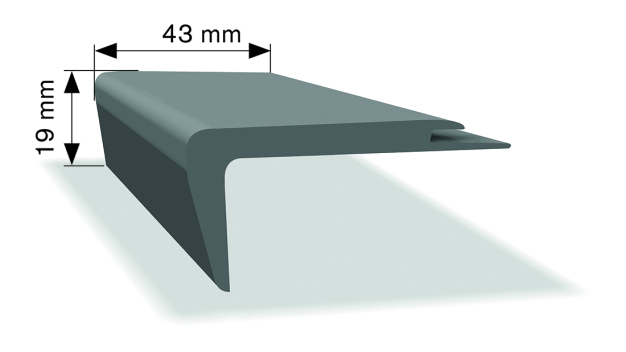
Accessible stair edge © nora
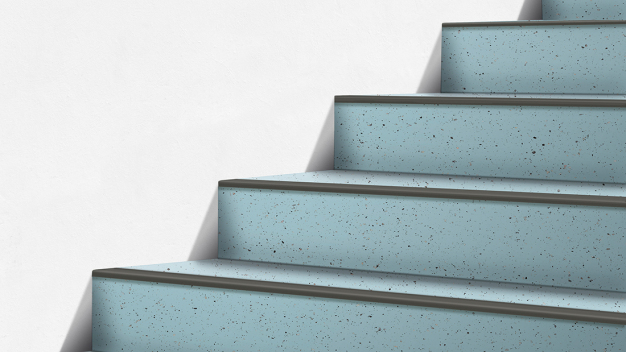
Accessible stair edge © iStock/eugenesergeev
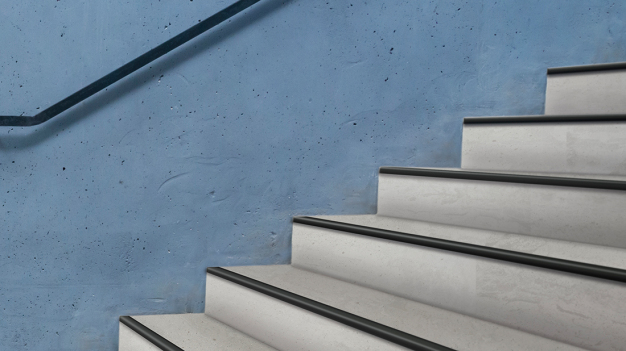
Accessible stair edge © iStock/kamisoka
The barrier-free design is an important component of inclusion: Public buildings in particular should also be accessible for independent use by people with disabilities. This is specified in DIN 18040-1 (Barrier-Free Construction, Planning Fundamentals), which also applies to stairs. However, the search for a standard-compliant stair edge marking for elastic floor coverings often posed challenges for planners: Because until now, there were no stair edge profiles that could be integrated directly with the flooring and did not have to be applied retroactively. For installation with nora flooring, nora systems now offers an ideal solution with the new stair edge T 5055, which precisely meets the requirements of DIN 18040-1 in its dimensions. The barrier-free stair edge marking can be installed on all types of stairs and is particularly impact- and shock-resistant as well as slip-resistant. Thanks to the insertion lip that secures the stair covering, an almost seamless transition is created between the edge and the surface. Its straight-line design supports the aesthetic appearance of stairs. With a color palette of six shades in various brightness levels, the required luminance contrasts between the stair covering and the stair edge marking can be realized.
Not applied retroactively, but firmly integrated
For visually impaired people, according to DIN 18040-1, all elements of a staircase in public buildings must be easily recognizable: For up to three individual steps and stairs that begin or end freely in space, each step must be marked. In stairwells, at least the first and last steps must be marked. This is achieved through stair markings made of continuous strips. On the treads, they start at the front edges and are four to five centimeters wide; on the upper edge of the risers, the width ranges between one and two centimeters. "The market demanded a stair edge profile that complies with DIN 18040-1," explains Martina Hoock, nora market segment specialist for education and healthcare. "Furthermore, the requirement was that the stair marking should not be applied retroactively to the surface but, as with the new stair edge T 5055, should be integrated as seamlessly as possible through the insertion lip."
Luminance contrast for increased safety
Regarding luminance contrast, there are also specifications for stair design in public buildings: Luminance contrast refers to the brightness difference perceived by the human eye between an object and its surroundings. According to DIN 32975, which deals with the design of visual information for barrier-free use of public spaces, stair markings must contrastively stand out against both the treads and risers as well as the adjacent landings below. The luminance contrast must be at least 0.4. "Here, the T 5055 stair edge profile offers options for every application with its six shades in different brightness levels," Hoock continues. The different shades — three warmer and three cooler neutral colors — can be combined well and thus give planners design freedom. The color spectrum ranges from black through gray and taupe to light beige. The barrier-free stair edge, which expands the nora stair edge range, scores not only with functionality but also with its modern, minimalist design.
Durably attractive and functionally secure: The new nora stair edge is the optimal solution for barrier-free stair design with a design claim

nora systems GmbH
Höhnerweg 2-4
69469 Weinheim
Germany
Phone: +49 6201 2743934
Mobile radio: +49 172 6330484
email: frank.baehr@nora.com
Internet: http://www.nora.com



