
- Conference
- Translated with AI
Solutions and know-how for current and future requirements in component cleaning
31st Conference on Industrial Component Cleaning, June 22-23, 2023, Esslingen
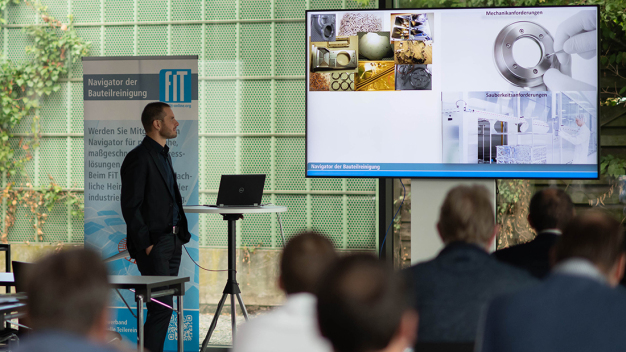
The 31st Conference on Industrial Part Cleaning provides information on innovative solutions and offers know-how and best practice applications as well as insights into research and development for current and future challenges. (Image source: fairXperts)
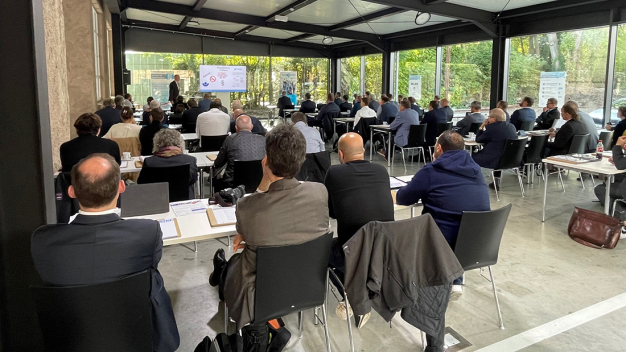
The specialist conference with accompanying exhibition enables first-class knowledge transfer and information exchange between industry experts and component manufacturers. (Image source: fairXperts)
The technology and energy transition requires companies from all sectors of the manufacturing industry to adapt their processes. This also affects the quality-critical step of component cleaning. To meet current and future requirements for the technical cleanliness of components in a stable, efficient, and sustainable manner, the 31st Industrial Component Cleaning Conference presents innovative solutions, know-how, and best practice applications, as well as insights into research and development. The event, organized by the Professional Association for Industrial Part Cleaning e. V. (FiT), will be held on June 22 and 23, 2023, at the Neckar Forum Esslingen.
The technological transformation, energy transition, increased demands on resource efficiency, and skilled labor shortages are changing manufacturing processes across practically all industries. As a result, new requirements for industrial component cleaning are emerging, which is increasingly gaining importance as a quality-critical step in the production chain. Current and future demands for technical cleanliness require task-specific cleaning solutions that ensure stable, sustainable, and cost-efficient processes more than ever.
What matters in this context will be addressed by fairXperts during the 31st Industrial Component Cleaning Conference of FiT, held on June 22 and 23, 2023, with an accompanying exhibition at the Neckar Forum Esslingen. The event, established as a knowledge platform in the German-speaking region, provides information on fundamentals, new process engineering solutions and products, state-of-the-art methods for process control, research and development trends, as well as best practice applications.
Fundamentals, Innovations, and Practical Reports
The two-day event begins with a presentation on the new FiT guidelines "Process Solutions for Industrial Component Cleaning," which will provide concrete practical guidance for designing, shaping, sizing, and optimizing tailored cleaning processes through consolidated expert knowledge. The following two presentations will discuss savings opportunities in chemicals and energy through clever combinations of cleaning, corrosion protection, and packaging, as well as what a requirement for "particle sizes < 400 μm for manufacturing cleaning" entails. It will be explained what is feasible and to be considered in a "normal" manufacturing environment and where the limits lie. The next session addresses the question: "Solvents – Better Their Reputation," covering the requirements for surfactant chemistry in the use of new cleaning methods such as cyclic nucleation (CnP) and pulsated pressure cleaning (PPC), as well as the introduction of a new multi-chamber ultrasonic cleaning system into manufacturing. Further presentations deal with developments and trends in industrial part cleaning using laser technology, the possibilities and limitations of UV blacklight inspection for identifying fluorescent particles and organic stains before and after cleaning, as well as the challenges and approaches in high purity cleaning tasks. The first day concludes with the expert forum "Part Cleaning Process Chain," featuring a discussion on current topics in component cleaning, involving all participants.
Research, Development, and Digitalization
The two thematic blocks on the second day focus entirely on research and development for the future of component cleaning. The first session presents a compact, robot-guided laser scanner for fluorescence imaging to reliably assess cleanliness on large surfaces and geometrically complex components. Topics also include chemical surface analysis for process development and quality assurance in component cleaning, as well as a standard developed based on a industry-specific OPC UA Companion Specification for digitalizing the process chain of component cleaning. Information will also be provided on the procedural and product-related requirements for the technical cleanliness of bipolar plates for fuel cells. The second session begins with a presentation on the specification and design of packaging for technically clean components. Also featured are self-organizing, fluorescent polymer layer systems that imitate real contamination, and a geometry-independent coating process for reproducible layers. These enable both scientifically based cleaning investigations with fluorescence-based residual dirt detection and optimization of systems. Further contributions address the advantages of lasers as tools for cleaning and structuring, and an adaptation of the vacuum-suction jet method for partial cleaning of sensitive surfaces.
An accompanying exhibition completes the program. It offers participants the opportunity to learn about new products and developments in industrial cleaning technology and to exchange experiences directly with experts.
The conference is aimed at specialists and managers, engineers, and technicians from development and design, technology, process engineering, work preparation, manufacturing, production planning, and quality assurance across various industries.
Additional information and the full program, including the registration form, are available at www.industrielle-reinigung.de or from fairXperts GmbH & Co. KG, phone +49 7025 8434-0.
fairXperts GmbH & Co. KG
72639 Neuffen
Germany