- Cleaning | procedures, devices, agents, media (Wipers, Swaps,...)
- Translated with AI
Snow jet cleaning in battery production
acp systems at the parts2clean 2021 (05-07 October 2021)
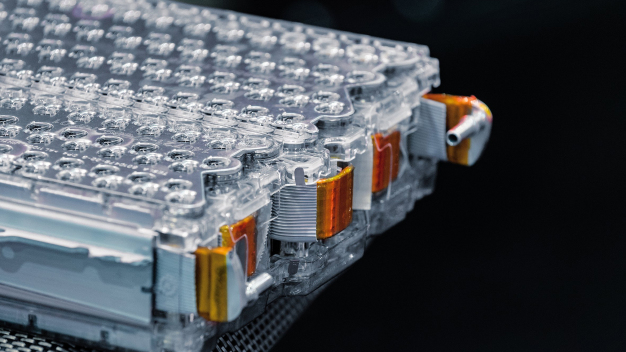
Clean contact points are crucial for the electrical connection of the battery cells with the conductor, here a leadframe, for high energy density and the safe operation of the battery. Image source: Shutterstock/Sergii Chernov
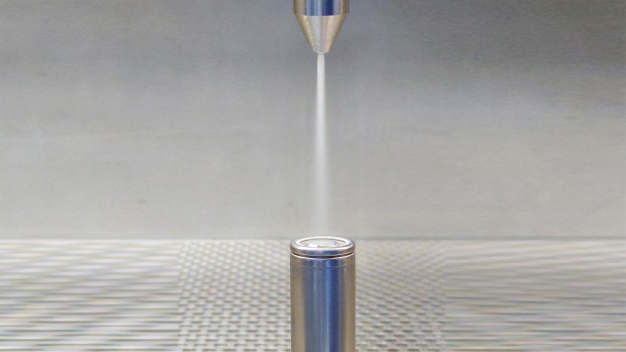
Through the interplay of four cleaning mechanisms, the quattroClean jet removes particulate contamination down to the submicrometer range and filmic contaminants in a process-safe and reproducible manner. Image source: acp systems AG
At this year's parts2clean, acp systems AG (Hall 4, Stand B 04) presents the quattroClean snow jet technology, a dry and sustainable cleaning solution for various tasks in the production of lithium-ion batteries and fuel cells. The process, which is easy to integrate into automated manufacturing environments, is already used in various serial applications, such as cleaning the contact points of battery cells before connecting them.
Whether electrically powered vehicles or stationary energy storage, a significant part of the value creation is attributed to the lithium-ion battery. During its manufacturing, new and modified tasks arise for component cleaning.
CO2 Snow – Dry, Effective, and Climate-Neutral
For this purpose, acp systems AG presents at this year's parts2clean the quattroClean snow jet technology, which can be easily integrated into the automated production of batteries and fuel cells, offering a dry, effective, and comparatively cost-efficient cleaning solution. It enables the removal of particulate contaminants down to the submicrometer range and film-chemical contaminants both across the entire surface and partially, in a process-safe and reproducible manner. The cleaning medium is liquid, non-corrosive carbon dioxide, which is produced in chemical processes and biomass energy generation, making it climate-neutral.
The process is already used in various applications in the serial production of lithium-ion batteries. These include cleaning the contact surfaces of battery cells – prismatic, cylindrical (round), or pouch cells – and lead frames or bonding surfaces on circuit boards. Since even minimal contamination on connection surfaces can lead to inadequate contact, the reliable removal of particulate and filmic contaminants under performance and safety aspects is essential.
The dry process is also used in the production of hydrogen-air oxygen fuel cells. One application is cleaning bipolar plates made from stainless steel alloys after laser processing. Traces of slag remain on the surfaces, which impair efficiency and must therefore be completely removed. The dry and residue-free cleaning of particulate and filmic contamination from pre-processes such as stamping is also part of the process’s application areas.
The excellent cleaning performance of the quattroClean system is based on the special design of the wear-free dual-material ring nozzle. This directs the liquid carbon dioxide and relaxes it upon exit into fine CO2 particles. These are bundled by a separate compressed air mantle jet and accelerated to supersonic speeds. When the precisely focused cleaning jet hits the surface to be cleaned, the four mechanisms of action (thermal, mechanical, solvent, and sublimation effects) ensure that contaminants are reliably removed. They are blown away from the surface by the aerodynamic force of the compressed air and carried out of the cleaning module by the integrated suction. Since the crystalline carbon dioxide sublimates completely during cleaning, the surfaces/parts are dry and can be directly fed into the next step of the manufacturing chain.
Flexible Integration into Manufacturing
The scalability and low space requirements of the quattroClean cleaning system make it possible to integrate it into almost any area of automated battery or fuel cell manufacturing. Process validation and design are carried out customer- and application-specific through trials in acp’s technical center. To ensure consistent high process stability, a sensor system monitors the consistency of each nozzle’s jet. Monitoring of the nozzles regarding CO2 and compressed air supply as well as jet duration is also performed. The measured values are automatically stored and can be transmitted via standard interfaces to a higher-level system for recording all production data.

acp systems AG
Berblingerstraße 8
71254 Ditzingen
Germany
Phone: +49 7156 480140
email: info@acp-systems.com
Internet: http://acp-systems.com