




- Pressure
- Translated with AI
Smart sensor detects leaks
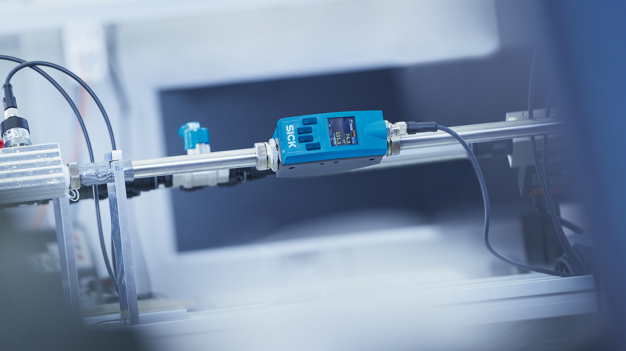
A researcher from Fraunhofer IPA, together with SICK AG, is developing a leakage additional service for this flow sensor. © SICK AG
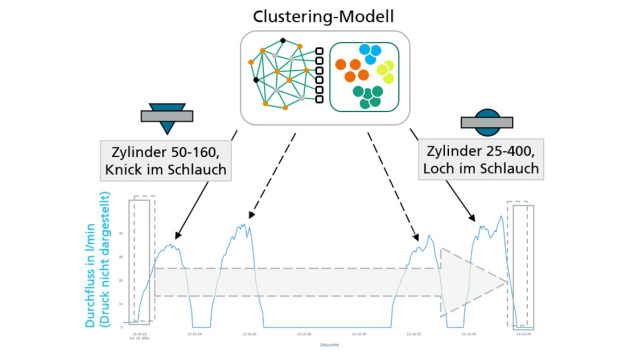
The key feature of the leakage add-on service is the so-called clustering: leaks are reflected in characteristic curve patterns. An intelligent algorithm detects them and triggers an alarm. © Fraunhofer IPA/Photo: Rainer Bez
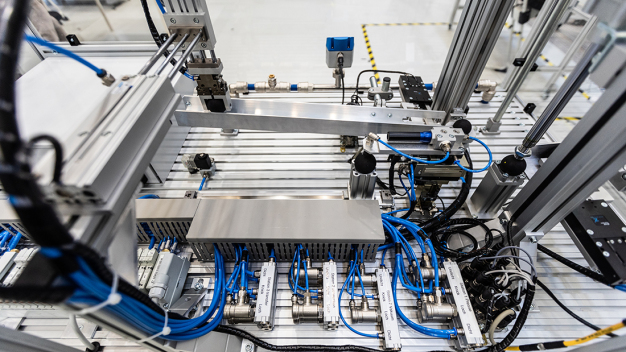
So far, the intelligent flow sensor is still a prototype. It is being tested and further developed on a compressed air demonstration system. © Fraunhofer IPA/Photo: Rainer Bez
The tedious search for leaks in compressed air systems could soon become much easier: Fraunhofer IPA is developing, together with SICK AG, an additional leak detection service for an intelligent flow sensor. Self-learning algorithms analyze the measurement data and thus identify leak points.
The ISO 50001 standard obliges companies to save energy. They must set themselves a target for how much energy they want to save in the coming years—and then achieve it. Significant savings potentials exist, for example, with compressed air, one of the most widespread and expensive forms of energy in German industry. Around 60,000 compressed air systems are in operation in this country. Together, they consume 16.6 terawatt-hours annually, which accounts for seven percent of the total electricity consumption of domestic industry.
Up to 30 percent of the energy used escapes unused through tiny leaks. Detecting these holes, kinks, or leaking connection pieces has so far been associated with great effort. "The products and methods available on the market for detecting leaks are not cost-effective for many users," says Christian Dierolf from the Department of Industrial Energy Systems at the Fraunhofer Institute for Production Technology and Automation IPA. "To use them, you either have to repeatedly detect leaks with an ultrasound device or retrofit new valves for individual monitoring of the pneumatic actuators." Therefore, many companies are forced to live with the waste.
Flow sensor learns itself
However, in the future, there will be no reason to let compressed air unnecessarily escape and to forego energy-saving potentials. Because researcher Dierolf is developing, in close collaboration with SICK AG, an additional leak detection service for their intelligent flow sensor. It continuously records pressure, temperature, and flow rate, generating seamless curve profiles. A self-learning algorithm is supposed to evaluate these curves. "The key is the so-called clustering: leaks manifest themselves in characteristic curve profiles. The algorithm recognizes these and issues an alarm," explains Dierolf.
The implementation is intended to be as simple as possible: The sensor, which Fraunhofer IPA and SICK are jointly developing from concept to series maturity, does not need to be connected to the machine control of the compressed air system or to an industrial PC. Instead, the flow sensor itself has a small display and additional interfaces such as MQTT and OPC-UA, which allow automated notification of the user. Additionally, the user can access the sensor via a web interface. Furthermore, the algorithm will learn independently. In this so-called unsupervised machine learning, a human only needs to verify at the end whether the algorithm has drawn the correct conclusions from the available information.
Clustering to become standard
"For us, the results from the joint development project are sufficient reason to make clustering available as an intelligent service in future generations of flow sensors as a standard feature for our customers," says Thomas Weber, Head of Development of the "Industrial Instrumentation" division at SICK.
However, it will still take some time before that happens. So far, the leak detection service for the intelligent flow sensor is still a prototype. Recently, a compressed air demonstration system was built at the company headquarters in Waldkirch and delivered to Fraunhofer IPA in Stuttgart. It contains the sensor prototype, which is now being tested and further developed.

Fraunhofer-Institut für Produktionstechnik und Automatisierung IPA
Nobelstraße 12
70569 Stuttgart
Germany
Phone: +49 711 970 1667
email: joerg-dieter.walz@ipa.fraunhofer.de
Internet: http://www.ipa.fraunhofer.de