




- Translated with AI
Slide valve controls excel in handling toxic chemicals: Chemiepark Bad Köstritz relies on Schubert & Salzer for SO₂ regulation
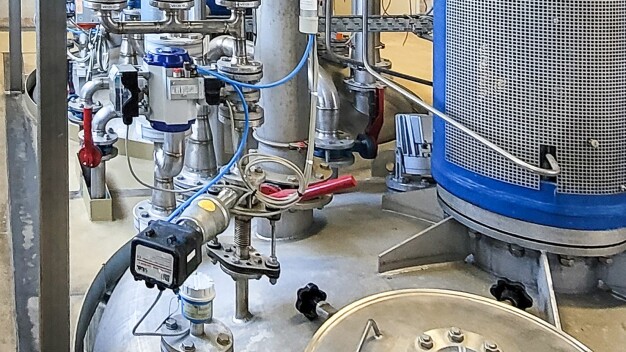
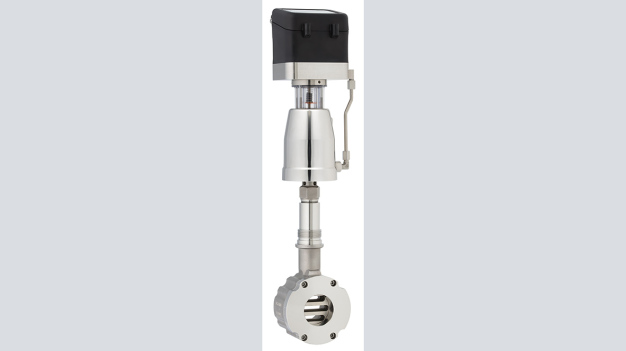
A slide gate valve type 8043 from Schubert & Salzer controls the flow of liquid and gaseous sulfur dioxide into the reaction vessel. (Copyright: Chemiewerk Bad Köstritz GmbH / Schubert & Salzer Control Systems GmbH)
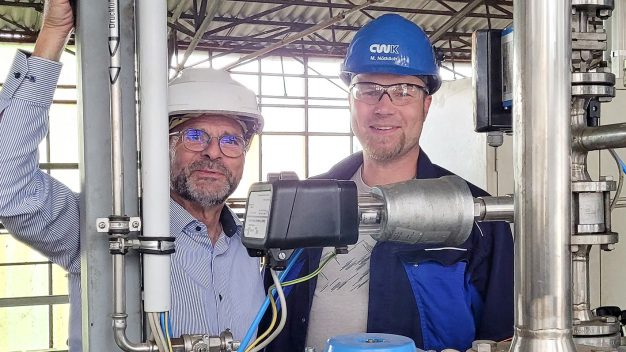
Dipl.-Ing. (FH) Marcus Nöthlich, Operations Engineer in the Sulfur Compounds Business Unit at CWK (right), and Rainer Weigelt, Technical Sales at Schubert & Salzer, inspecting the valves used at the Bad Köstritz Chemical Plant. (Copyright: Chemiewerk Bad Köstritz GmbH / Schubert & Salzer Control Systems GmbH)
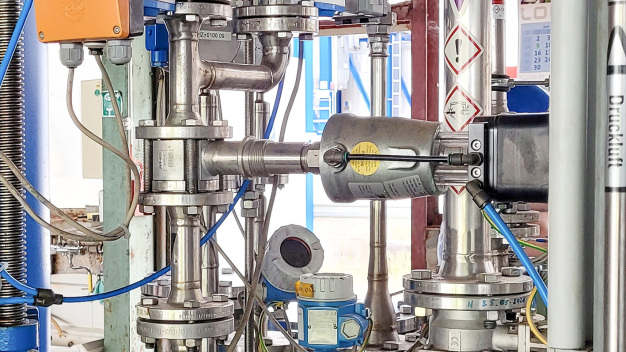
In addition to sulfur dioxide for thiosulfate production, slide gate valves at CWK also control steam, liquid sulfur, and other liquid and gaseous media in a variety of applications. (Copyright: Chemiewerk Bad Köstritz GmbH / Schubert & Salzer Control Systems GmbH)
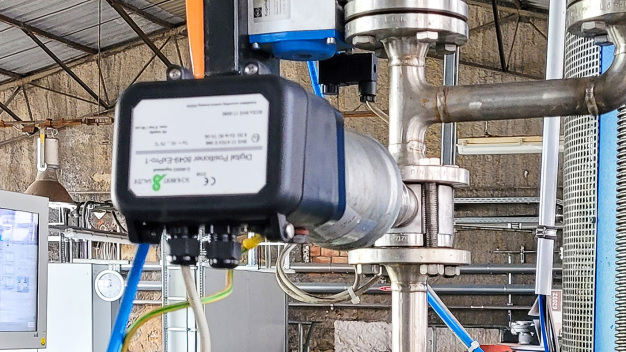
In addition to sulfur dioxide for thiosulfate production, slide gate valves at CWK also control steam, liquid sulfur, and other liquid and gaseous media in a variety of applications. (Copyright: Chemiewerk Bad Köstritz GmbH / Schubert & Salzer Control Systems GmbH)
(Copyright: Chemiewerk Bad Köstritz GmbH / Schubert & Salzer Control Systems GmbH)
Sulfur dioxide is a highly toxic medium. Handling it is therefore subject to the Major Accident Ordinance and places the highest demands on the safety and reliability of the fittings used. At the Bad Köstritz Chemical Plant, slide gate valves from Schubert & Salzer are used to regulate liquid and gaseous sulfur dioxide, achieving exceptional results in terms of service life and control precision.
"Because the chemistry is right." is the slogan of the Bad Köstritz Chemical Plant – short CWK. The manufacturer of inorganic specialty chemicals from Thuringia has a history of over 195 years, beginning with the opening of the Heinrichshall saline in 1831. Today, CWK presents itself as a medium-sized chemical company with a historically developed specialization, e.g., in sulfur compounds. Thiosulfates are one of these groups, with CWK being one of the few suppliers worldwide capable of providing customers with them on a commercial scale. For many years, the company has relied on slide gate valves from Schubert & Salzer for production.
Thiosulfates – Versatile Sulfur Compounds
Thiosulfates are chemical compounds composed of sulfur, oxygen, and a positively charged partner ion such as sodium or potassium. They are used, for example, as "anti-chlor" in wastewater and exhaust gas cleaning, are valuable fertilizer additives, important reducing agents in chemistry, and have a long and significant history as fixing salts in analog photography.
Dipl.-Ing. (FH) Marcus Nöthlich, operations engineer in the sulfur compounds business unit at CWK, describes the production process using sodium thiosulfate as an example of a two-stage batch process: First, caustic soda and sulfur are exothermically converted into sodium polysulfide solution in a cooled stirred tank. Then, this solution is combined in a reaction vessel with caustic soda, water, and a mother liquor of sodium thiosulfate in a stoichiometric (exact ratio) manner. In the second process step, liquid sulfur dioxide (SO2) is introduced into this mixture. The precise flow regulation is achieved with a Schubert & Salzer Type 8043 slide gate valve. The liquid SO2 relaxes in the reaction vessel and turns gaseous. Under constant stirring, the gaseous SO2 and other reactants convert in an exothermic reaction with controlled cooling into sodium thiosulfate solution.
Slide Gate Valves – Safe Handling of Toxic SO2
A particularly critical point in this process is handling sulfur dioxide. "The chemical is dangerous and highly toxic," explains Marcus Nöthlich. "Because we store and process it in large quantities, we are subject to the Major Accident Ordinance. Continuous monitoring of the ambient air for its exact SO2 content is essential. Even the smallest leaks in the system trigger an alarm within seconds via existing gas sensors. Just a few breaths can then cause severe breathing difficulties. At higher concentrations, there is an immediate life-threatening risk."
For this reason, the tightness and reliability of the valves used to regulate sulfur dioxide are of central importance for CWK. With the flange-mounted slide gate valves from Schubert & Salzer, a solution has been found that more than meets these high demands. The flange connections are designed as tongue-and-groove seals according to DIN EN 1092-1. The external tightness of the valve stem is ensured by an additional metal bellows seal for the packing. The entire valve complies with the requirements of TA-Luft according to ISO 15848-1.
Maximum Service Life and Control Quality
"Besides the excellent tightness, what convinced us most was the reliability of the slide gate valves," explains Nöthlich. "The valves we previously used had to be completely replaced twice a year due to wear. This incurs costs, downtime, and poses a safety risk for our technicians due to SO2 residues in the lines, requiring additional effort. With the slide gate valves, we only replace individual wear parts even after several years of operation. Thanks to practical training with Schubert & Salzer here at the chemical plant, our technicians can even perform these maintenance tasks themselves without any issues."
These exceptionally long service lives are made possible by the fundamental operating principle of slide gate valves: Two slotted sealing discs arranged perpendicular to the flow direction are shifted against each other, changing the flow cross-section. Due to the design, the valve lift is very short – only 6 to 9 mm depending on the nominal size. In slide gate valves, the packing and metal bellows are subjected to significantly lower mechanical stresses, resulting in less wear and longer service life.
In addition to service life, control accuracy has also been significantly improved through the use of slide gate valves. "To adjust the pH value of our thiosulfate solution, we also introduce gaseous SO2 after the liquid SO2. The large control range of the slide gate valve used in this process allows us to precisely regulate the masses and produce a product that meets both our and our customers' quality standards," explains Nöthlich.
Broad Range of Applications for Slide Gate Valves
Based on these and similar experiences, slide gate valves have long been a standard component in various processes and systems at the Bad Köstritz Chemical Plant. They help increase operational safety, improve precision, and reduce maintenance costs. "Whether regulating sulfur dioxide, steam, or other liquid or gaseous media – Schubert & Salzer slide gate valves have proven themselves very well with us. Therefore, we can only say: The chemistry is right here," concludes Marcus Nöthlich.
Schubert & Salzer Control Systems GmbH
85009 Ingolstadt
Germany