




- Translated with AI
Simulation: Novel two-dimensional circuit operates with magnetic quantum particles

PhD student Qi Wang, first author of the current study Photo: TUK/Koziel
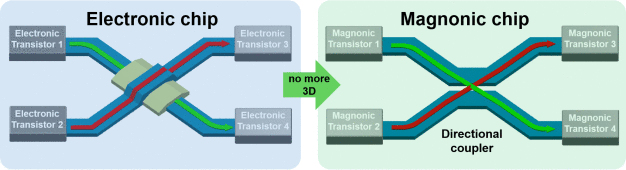
The graphic shows a conventional circuit (left) and a magnonic circuit that uses a two-dimensional wiring. Photo: AG Hillebrands
Smartphone, calculator or dialysis machine – no electronic device is complete without a chip and its electronic circuits. The individual switching elements are often wired through three-dimensional so-called bridge structures. Physicists at the Technical University of Kaiserslautern (TUK) are currently working on a more powerful variant. Instead of electrons, they use certain quantum particles called magnons. In their model, they have demonstrated for the first time how current flows can be possible in an integrated magnonic circuit for these particles. They connect the elements only in two dimensions. The study was published in the journal Science Advances.
When American engineer Jack Kilby developed the integrated circuit in the 1960s, it marked a technological revolution: initially only used in a calculator, the technology soon enabled the rise of computers, which then operated with ever smaller processors. "These circuits form the basis of our current electronics," says Junior Professor Dr. Andrii Chumak, who researches at the Chair of Magnetism under Professor Dr. Burkard Hillebrands at TUK in the Department of Physics. For his work, Kilby, also known as the father of the microchip, received the Nobel Prize in Physics in 2000.
Physicists around Chumak and his doctoral student Qi Wang, the first author of the current study, are working on a new generation of circuits. They use spin waves. "These can transport information in the form of intrinsic angular momentum in magnetic materials," continues Chumak. "The quantum particles of such waves are magnons." Compared to electrons, they can carry significantly more information, consume much less energy, and produce less heat. This makes them interesting for faster and more powerful computers.
In the newly published study, the scientists describe for the first time a so-called integrated magnonic circuit in which information is transmitted via these particles. As with conventional electronic circuits, wiring and so-called crossing points are necessary to connect the individual switching elements. In their simulation, the researchers have now succeeded in developing such a crossing for magnons. "We included a phenomenon in our calculations that is already known in physics and is used for the first time in magnonics," says Qi Wang. "When two magnonic waveguides are placed very close together, the waves essentially communicate with each other, meaning the energy of the waves is transferred from one waveguide to the other." This has long been used in optics, for example, to transfer information between optical fibers.
The "Nano-Magnonics" team, part of Professor Hillebrands' chair, including Chumak and Wang, is also exploiting this to wire circuit elements on a magnonic chip in a new way. The special feature here: they do so at the crossings without a three-dimensional bridge structure. In classical circuits, this is necessary to ensure electron flow between multiple elements. "In our circuit, we use a two-dimensional flat wiring where the magnonic waveguides only need to be placed close together," says Wang. The researchers call this "directional coupler." Using this model, the scientists now aim to build a first magnonic circuit.
For future production of computer components, these novel circuits could save material and thus costs. Moreover, the size of the simulated components is in the nanometer range, comparable to modern electronic components. However, the information density with magnons is many times greater.
Junior Professor Chumak received an ERC Starting Grant in 2016 for his work in the field of magnons, one of the highest research awards in the EU. The physicist and his doctoral student Wang work at the State Research Center for Optics and Material Sciences (OPTIMAS), funded by the state of Rhineland-Palatinate.
The study was published in the renowned journal Science Advances: "Reconfigurable nanoscale spin-wave directional coupler" DOI: 10.1126/sciadv.1701517
Technische Universität Kaiserslautern
67663 Kaiserslautern
Germany