- Translated with AI
Silicone and thermoplastics – successful symbiosis in micro-injection molding
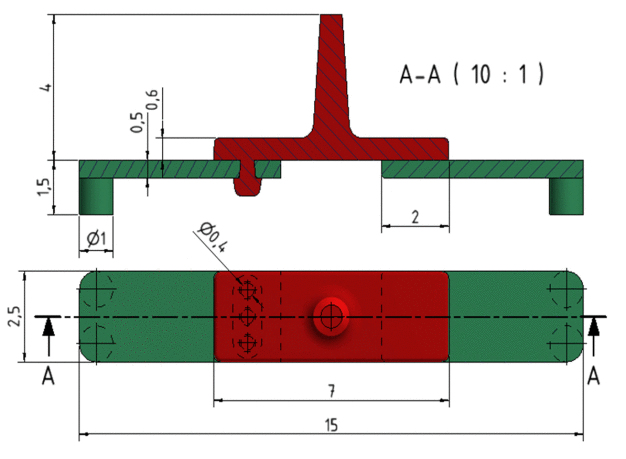
2K Micro Demonstration Mold Parts - in the picture, both demonstration mold parts are shown within a single mold part (FT). Left half of the FT with undercut (variant: rivet), right half of the FT without undercut (variant: adhesion).
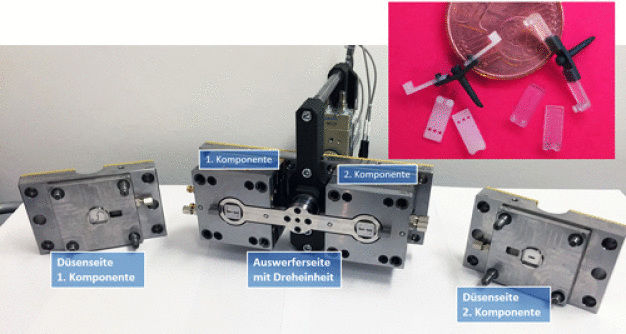
2K micro-injection molding tool with demonstration parts.
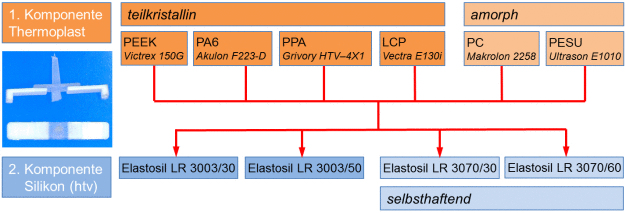
Tests of the liability of thermoplastics and silicone (HTV) – combinations of the 2K demonstration test parts.
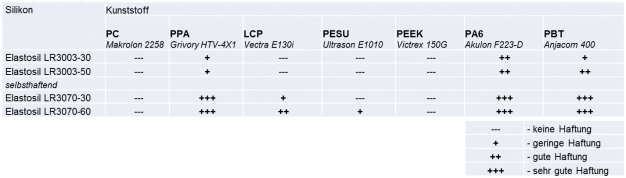
Liability between silicone and thermoplast.
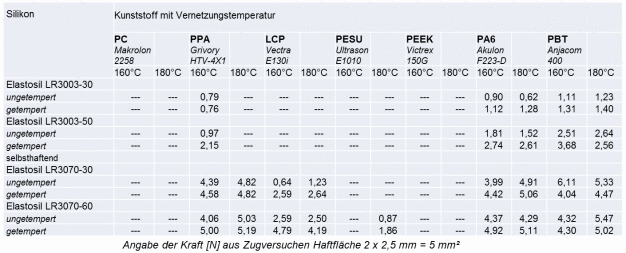
Adhesives between silicone and thermoplastics.
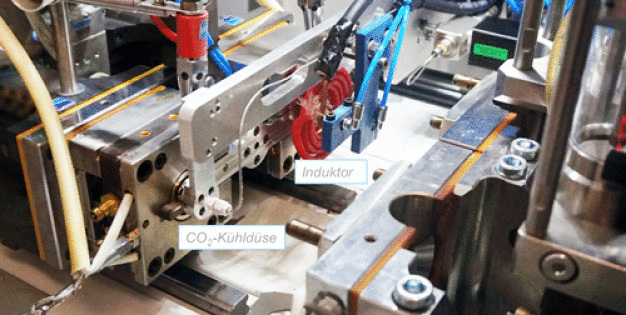
Tool room with retracted handling for dynamic tempering.
In many areas and products of daily life, ranging from automotive manufacturing, electronics to medical technology, silicones have been able to conquer a wide range of applications due to their unique combination of properties.
Also, the combination of a thermoplastic with a liquid silicone rubber in an injection molding cycle, to realize material substitutions or to avoid subsequent assembly steps, is gaining increasing importance.
This material combination has already established itself in standard injection molding, but still needs to be implemented in micro-injection molding.
Objective of the Development
The research project "Development of technological and structural solutions for micro-injection molding of 2K micro-precision parts in combination with thermoplastics – silicone" at the Plastics Center in Leipzig (KUZ) addressed this challenging topic. The goal was to realize a molded part connection between thermoplastics and silicone in a single injection cycle without additional assembly steps through new technical and technological solutions in 2K micro-injection molding. Short cycle times, typical for micro-injection molding with its thin walls, should be achieved. The basis of the project is the modular machine platform with "2K-formicaPlast" plunger injection units, developed at KUZ for two-component micro-injection molding with an integrated indexing arm.
A key focus is the development of a concept for the thermal separation of the mold inserts in the rotary unit, as liquid silicone rubber requires significantly higher tool temperatures for vulcanization than the thermoplastic component for solidification. Furthermore, it must be ensured that after rotating the indexing arm, both mold inserts can quickly reach the required tool temperature. Targeted investigations aim to show which combination of the two components leads to an optimal bond in micro-injection molding.
Technological Development and Systematic Testing
The total scope of R&D work for this project included two main areas:
1. Structural and technological development of the tool design for processing liquid silicone rubber in combination with a standard plastic in a single injection cycle
2. Systematic investigation and optimization of the two components through variation of the liquid silicone rubber, the thermoplastic, and the injection parameters
As shown in Figure 1, the 2K micro-demonstration molds were developed according to the rules of plastics and injection molding design for micro-injection molding. It was important to note that Demonstration Mold Part A only has a material-to-material bond with an adhesion surface (variant: adhesion), and Demonstration Mold Part B is characterized by a form-fit connection with a undercut, which also allows the use and subsequent testing of non-adhesive liquid silicone rubber (variant: rivet).
For the realization of the 2K micro-injection process, which includes a component made of reactive material such as silicone, the design of the tool with the necessary thermal separation between the mold inserts is crucial. After extensive investigations, the corresponding tool concept was implemented (see Figure 2).
Injection Trials with Various Material Combinations
The change between the two demonstration mold parts is achieved by exchanging the mold inserts in the 2K tool. After completing the tools with the two variants of the demonstration part, injection trials were carried out with 6 selected thermoplastics and 4 liquid silicones. All thermoplastics were combined with the liquid silicones. Generally, the first component was made from a thermoplastic, and the second component from a liquid silicone rubber.
Figure 3 shows the combinations from the injection trials. Through experiments with the "rivet" variant, relevant combinations of thermoplastic and silicone for later tests with the "adhesion" variant could already be specified. This reduced the experimental effort for the adhesion variant to meaningful combinations.
Half of all mold batches were tempered after production (vacuum oven, 100°C, 24 hours) to compare the adhesion strength in tempered and untempered states.
The subsequent tensile tests were conducted on a Zwick material testing machine Zwicki Z2.5/TN.
Adhesion Strength – How Well Does the Bond Hold?
The adhesion forces could be more reliably determined in the tensile tests on the demonstration part in the "adhesion" variant than in the "rivet" variant. Figure 4 shows the suitability of the tested thermoplastics' bonding with silicones. The combination of self-adhesive silicone (LR3070) with PPA, PA6, and PBT shows the best results.
Due to the small geometric adhesion area of about 5 mm², the achieved adhesion forces are also very low. A problematic aspect was the effect of demolding forces of the silicone component on the thin side, which sometimes led to damage of the material-to-material bond between thermoplastic and silicone. Nevertheless, reproducible results for the adhesion of both components in the injection variations could be obtained.
It is very clear that tempered test specimens exhibit higher adhesion strength than untempered specimens. This indicates an influence of the bonding as a result of the formation of bonds with the thermoplastic. Only with the PBT combination was a slightly lower adhesion strength observed for the tempered variant. Consequently, a heat treatment after injection molding is generally recommended for higher adhesion.
Different Tempering for Material Mix
Good results were achieved with a combination of PPA, LCP, PA6, and PBT with self-adhesive silicone Elastosil LR3070. The prerequisite here is the dynamic heating and cooling of the mold cavities to prevent damage to the thermoplastic during overmolding with silicone on the hot side of the tool. A meaningful tempering method was demonstrated using induction heating and CO₂ cooling (see Figure 6). The thermal separation of the mold cavities with different process temperatures, which can differ by up to 100 K, also plays a significant role.
Future designs of the tempering system can be made even more effective with elements from generative tool manufacturing. For example, a contour-close water-cooled inductor made of copper, produced via selective laser melting (SLM), is conceivable, which allows higher dynamics in the heating process to reach the bonding temperature of the liquid silicone.
Application & Benefits
The investigations demonstrated that even with a very small available adhesion area, a combination of thermoplastic and silicone is possible using micro-injection molding. Adhesion forces of approximately 1.22 N/mm² were proven for the combination of PBT Anjacom 400 with Elastosil LR3070-30. This results in a bonding strength of 6.1 N for a available adhesion area of 5 mm² in the case of the demonstration part (variant: "adhesion").
The experiments showed that with adapted machine technology and peripherals, the production of 2K micro-precision parts in the combination of thermoplastics and liquid silicone is feasible. However, this requires greater care in designing the typically small tools for micro-injection molding, with the implementation of thermal separation in a very confined space.
One application of this technology is mainly in micro-parts with sealing functions, which are primarily found in medical technology.
The equipment (machines, tools, and peripherals) available at KUZ is now also available to interested customers for adhesion tests or test molding regarding their target application.
Kunststoff-Zentrum in Leipzig gGmbH
04229 Leipzig
Germany