


- Translated with AI
"Science" Study: Proteins Surf to Destination in Cells – Researchers Discover New Transport Pathway
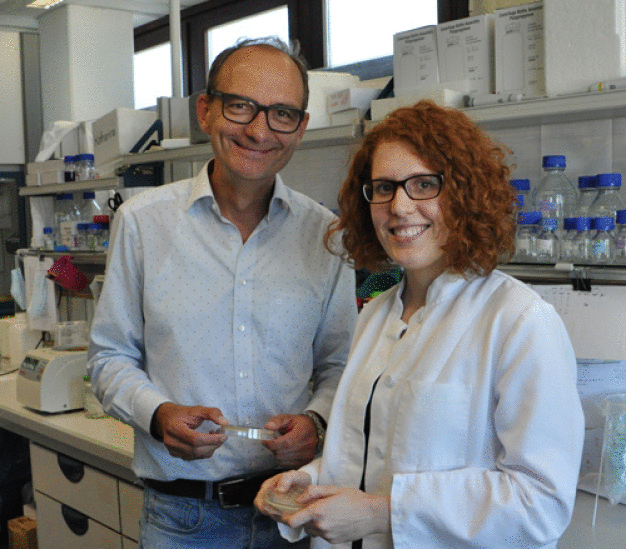
Professor Johannes Herrmann and his doctoral student Katja Hansen are researching the transport of proteins into the mitochondria. (Photo: AG Herrmann)
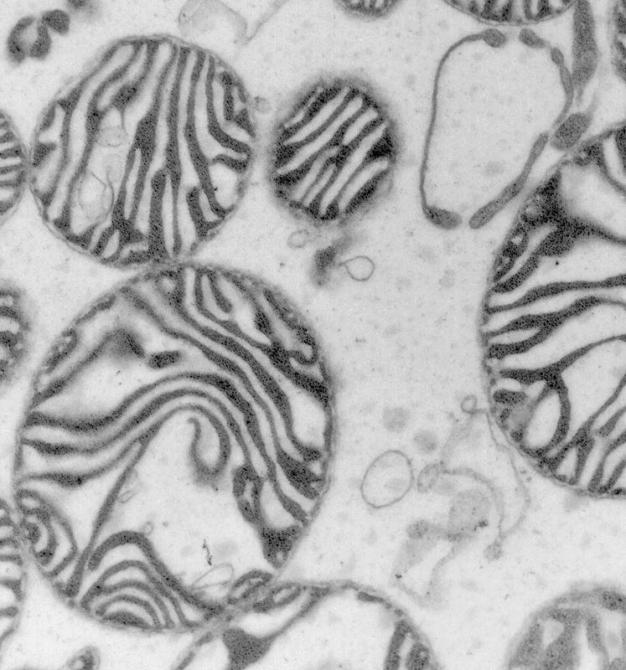
The microscope image shows mitochondria, also known as the powerhouses of the cell. (Photo: AG Herrmann)
Proteins are important building blocks of cells and their components, such as mitochondria, the power plants of the cells. Researchers from Kaiserslautern led by Professor Dr. Johannes Herrmann have now shown for the first time that proteins do not, as previously assumed, travel directly from their site of origin to the cell's power plants, but rather via an indirect route. They "surf" across the endoplasmic reticulum, another cell component, to reach them. In the renowned scientific journal Science, the researchers now present this mechanism. They suspect that this process helps prevent protein aggregation in cells. The mechanism could play a role in diseases such as Alzheimer's and Parkinson's.
For a long time, science assumed that proteins, after being produced in the cytosol, the cell's fluid, directly reach their destinations, such as the cell organelles. These small functional units of the cell include, for example, the mitochondria, where certain proteins produce the energy for the cells. Mitochondria have special receptors on their surface. "They recognize new proteins and ensure that specific transport pores take them up and bring them inside," says Professor Johannes Herrmann, who heads the Cell Biology department at TUK and has long researched protein transport into mitochondria. "But what happens to the proteins before that was completely unclear until now."
Together with Professor Maya Schuldiner, a recognized expert in genetics from the renowned Weizmann Institute in Rehovot, Israel, Herrmann's team discovered that the proteins initially reach the endoplasmic reticulum (ER). The ER is also an organelle and serves as a dispatch center. It sends various cellular components, mostly proteins, to where they are needed after their synthesis.
"We identified certain factors there that are necessary for the transport of proteins to the mitochondria," says Katja Hansen, doctoral student under Herrmann and first author of the current study. Hansen first developed a new molecular biology method. Using this technique, the Kaiserslautern research team was able to analyze the mechanism precisely. They named it "ER-Surf," "because the proteins surf across the surface of the ER," explains Hansen.
The ER acts as a kind of intermediate storage. "Sensitive new proteins are held here until they can be passed on to the mitochondria," says Herrmann. "This probably prevents the formation of protein clumps, so-called aggregates, which are harmful to cells and cause many diseases."
Herrmann's team now wants to investigate what role this mechanism might play in various diseases and how the formation of these aggregates can be reduced. "Especially neurodegenerative diseases like Alzheimer's and Parkinson's are triggered by such protein clumps that accumulate in aging cells," the professor continues.
If researchers understand these processes more precisely, they could serve as a basis for therapeutic approaches, for example, to prevent age-related diseases in the future.
Further studies are needed to determine the extent to which the ER-Surf mechanism also plays a role in proteins that migrate to other locations within the cell.
The study was published in the renowned journal Science: "ER surface retrieval pathway safeguards the import of mitochondrial membrane proteins in yeast." Hansen, K.G., Aviram, N., Laborenz, J., Bibi, C., Meyer, M., Spang, A., Schuldiner, M., Herrmann, J.M.
Technische Universität Kaiserslautern
67663 Kaiserslautern
Germany