


- Filter
- Translated with AI
Save energy with the right air filter
In an average commercially used building, around 50 percent of the energy costs are attributable to the HVAC system. This means that 35 percent of these costs are directly related to the building's air filters.
Camfil Total Operating Costs
The primary function of an air filter is to remove particles and pollutants from the air to ensure good indoor air quality and protect people's health inside buildings. Low energy consumption should never be more important than efficient air filtration and good air quality. However, one does not have to exclude the other. Camfil shows how you can ensure good indoor air quality, reduce the energy consumption of your ventilation system, and save costs at the same time.
We all know that air pollution can cause serious health problems. If outdoor air is not effectively filtered and cleaned, there is a risk that indoor air will contain a large amount of harmful particles that can enter the respiratory system and circulation of people inside buildings. These particles and other substances can combine with particles already present in the building's air, becoming even more harmful, making air pollution in enclosed spaces many times more dangerous than outdoors.
To avoid this, it is important to ensure a healthy indoor climate and make the right choice of air filter solutions. With rising energy prices and increasingly strict requirements to reduce CO₂ emissions, energy consumption through air filters is becoming a key concern in building management.
Consider Total Operating Costs
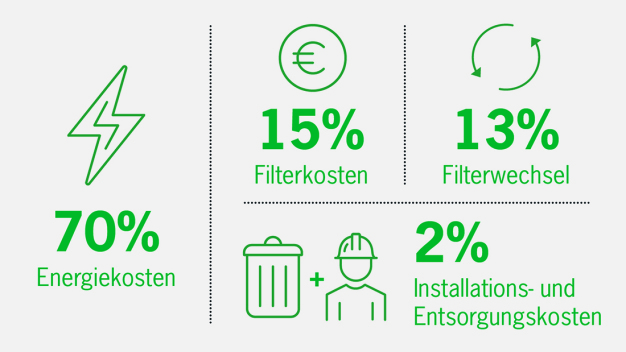
When choosing the right air filter, Camfil recommends considering the total operating costs (Total Cost of Ownership – TCO) of an air filter. The term total operating costs refers to a structured approach to calculating the costs associated with purchasing and using a product. When using an air filter, costs are distributed across energy consumption, initial purchase costs, reordering, labor, and disposal costs.
Only 15 percent of an air filter's operating costs relate to its purchase, while 70 percent are spent on its energy consumption. This energy is generated by the fan system of a ventilation system, which moves air into and through the building and the air filter. The air filter creates resistance in the ventilation system, resulting in a pressure drop. The higher the pressure drop, the more the fan has to work. Air filters that maintain low resistance throughout their lifespan positively impact energy consumption. When selecting suitable air filters, it is worthwhile to look at lifecycle and energy costs to reduce energy consumption and utilize energy-saving potentials.
Air filters are integrated into the building technology within the ventilation system and contribute to the optimal operation of the fan system. Unlike other components within the ventilation system, they are designed to be relatively easy to replace, so upgrading to low-energy-consuming air filters does not excessively burden the investment budget.
Energy Efficiency with Eurovent
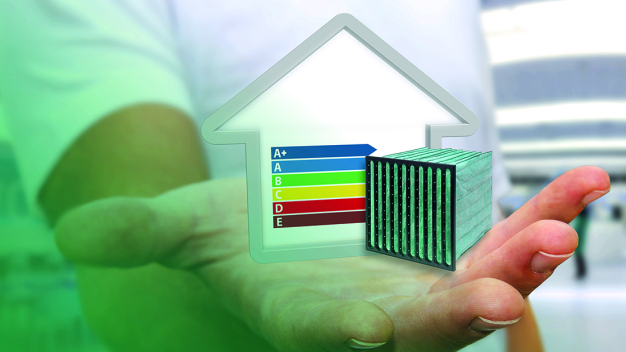
Thanks to Eurovent – the objective system for classifying air filters based on energy efficiency – it is easy to find the air filter with the lowest energy consumption depending on its filter efficiency according to ISO 16890. Depending on energy consumption over the lifespan, air filters are classified from A+ to E, with A+ representing the best rating with the lowest energy consumption. This standardized rating system allows users to compare different air filters on the market and find the best solution for their requirements.
The classification is based on the globally applicable ISO 16890 standard for air filters used in general indoor air technology. Air filters for general ventilation systems must provide a complete test report according to ISO 16890 to be rated by Eurovent. When selecting the right air filters, pay attention to the following:
– Is your supplier certified by Eurovent?
– Is the Eurovent label visible on all product packaging?
– Have all air filters been tested according to ISO 16890, and can the supplier provide test reports?
Lifecycle Costs Ensure Sustainability
To understand the impact of an air filter on the operating costs of a ventilation system throughout its entire lifespan, Camfil works with lifecycle cost analyses. Camfil uses specially developed software for calculating lifecycle costs, drawing on more than 20 years of experience and data analysis. Based on a series of high-quality analyses, Camfil demonstrates how air filters directly influence energy consumption in ventilation systems. As a result, Camfil provides detailed LCC (Life Cycle Cost) analysis reports.
By comparing different scenarios, such as using low-energy-consuming air filters, savings in energy costs, labor, and waste costs can be made immediately visible.
Energy-efficient Air Filters from Camfil
Camfil's air filters are the most energy-efficient on the market. Through efficient filter media and optimized design, Camfil's air filters exhibit low pressure differentials throughout their lifespan, so that the HVAC system's fans need to work less to maintain a constant airflow. Additionally, the frequency of filter changes is reduced. This means fewer air filters, less effort, less waste, and thus the lowest total operating costs.

Camfil GmbH
Feldstr. 26 - 32
23858 Reinfeld
Germany
Phone: +49 4533 2020
Fax: +49 4533 202202
email: info.de@camfil.com
Internet: http://www.camfil.com



