
- Cleaning as a Service
- Translated with AI
Gerhard Koblenzer
Safely develop and reliably implement demanding cleaning processes?
Contract cleaning under cleanroom conditions
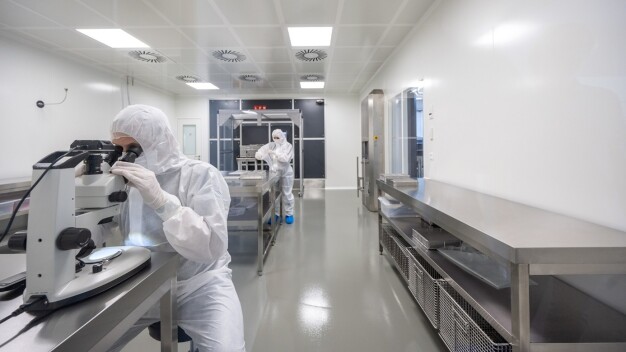
In addition to its in-house cleanliness analytics, LPW also works with external experts. Only the combination of monitored and traceable process technology and analytics creates the basis for a reliable assessment of technical feasibility. (Photo: LPW)
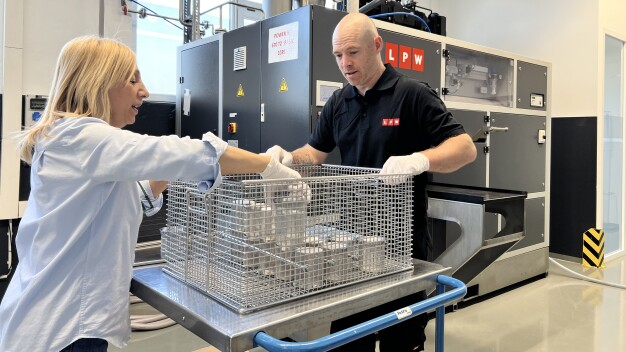
Professional contract cleaning requires human expertise – and automated processes, the sensor-monitored integration of cleaning systems, media supply and ambient conditions, as well as qualified monitoring. (Photo: LPW)
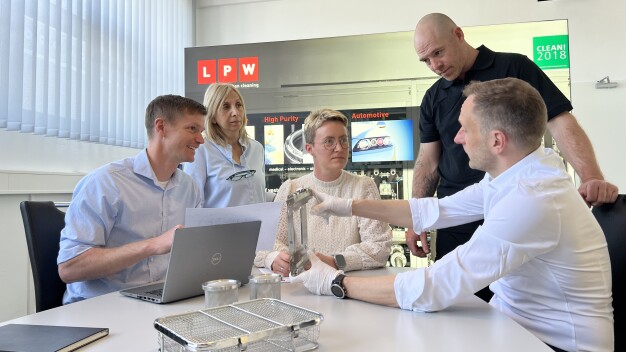
No component is like another. Therefore, the LPW Application Engineering team carefully examines the material properties, geometry, and cleanliness requirements for each contract cleaning order. (Photo: LPW)
More complex component geometries, shorter development cycles and more demanding production processes. As a result, industrial contract cleaning is also becoming increasingly important. It offers far more than additional capacity, particularly where special tasks, smaller quantities or new production ramp-ups need to be handled. However, this requires a high-performance infrastructure, qualified personnel and the ability to develop cleaning processes reliably, evaluate them analytically and implement them consistently over the long term.
Anyone wishing to offer industrial contract cleaning under controlled cleanroom conditions needs more than high-performance cleaning systems. What is crucial is the interaction between suitable cleaning technology, a controlled environment, cleanliness analytics and documented process management. Depending on the component, type of contamination and required level of cleanliness, different methods and process parameters must be capable of being investigated. Particularly in the case of complex geometries or especially high cleanliness requirements, a standardized procedure is often insufficient. Rather, an infrastructure is needed that enables both the development of individual processes and their practical testing.
One example of this is LPW’s cleanroom-based Test and Service Center (TDZ) at the company’s site in Riederich. Customer trials, contract cleaning orders and research projects are carried out on around 380 square meters. This is supplemented by further systems and a test environment at the LPW technical center, as well as a network of certified external service providers for cleanliness analytics, complementing the in-house component cleanliness evaluation. What is particularly noteworthy about this high-tech setting is that cleaning results can not only be achieved, but also evaluated in a traceable manner. Only the combination of monitored, traceable process engineering and analytics creates the basis for a reliable assessment of technical feasibility.
Process expertise is not developed at the system alone
As important as the technical equipment is, the quality of a cleaning process begins with the people who develop it, understand it and continuously improve it. In addition to sound technical expertise, industrial component cleaning requires a pronounced understanding of processes and the right mindset for the complex interaction between component geometry, material, contamination, cleaning chemistry, process engineering and cleanliness requirements. Particularly in demanding applications, specialists are needed who recognize technological interrelationships, think holistically and develop suitable solutions.
However, the decisive factor is transferring this experience-based knowledge into standardized, transparent and reproducible processes that function as independently as possible of individual human intervention. After all, even qualified employees are not free from errors. Automated procedures, the sensor-monitored integration of cleaning systems, media supply and environmental conditions, as well as qualified monitoring, therefore form the basis for reliable process management. Continuous documentation additionally creates transparency and traceability, while enabling deviations to be identified at an early stage.
The role of people is therefore increasingly shifting from operational execution toward the development, monitoring and continuous optimization of technological processes. Particularly in view of advancing automation, the future of demanding contract cleaning lies in the systematic transfer of human expertise into intelligently monitored, largely automated process sequences.
In this regard, LPW’s expertise has grown over decades in demanding special-purpose system engineering. As an internationally sought-after partner for industrial component cleaning, the specialists in Riederich develop customized systems for a wide range of industries – from the automotive industry and medical and semiconductor technology to aerospace. LPW was an early technological pioneer, particularly in the high-purity environment. Complex component geometries, specific contaminants and the highest cleanliness specifications repeatedly require individual solutions. Process development is therefore not an additional service offering, but an integral part of the company’s DNA. The cross-industry expertise that has emerged from this also forms the technological basis for contract cleaning – from assessing cleanability and developing processes to analytically assuring reproducible results.
Specialization instead of mass production: special tasks, prototypes and small batches
However, not every cleaning order is equally suitable for external processing. Contract cleaning becomes particularly interesting where high technological requirements meet manageable quantities, special component geometries or projects of limited duration. Prototypes are one example. Here, the primary focus is on fundamental cleanability. Even in the early development phases, it is possible to investigate which methods are suitable and whether the desired cleanliness requirements appear technically achievable. The knowledge gained can be incorporated directly into further product and process development.
In the case of small batches, the focus often shifts toward cost-effectiveness. Establishing in-house cleaning capacities is not always worthwhile – particularly when special technologies are only required for limited quantities. Other applications arise in the event of unplanned contamination, short-term changes in customer requirements or a lack of internal testing capacities. The strength of specialized contract cleaning therefore lies less in processing the largest possible quantities than in its ability to solve individual tasks on a technically sound and flexible basis.
Pilot production and pre-validation
Supporting new production ramp-ups represents a particularly interesting field of application. In many projects, the requirements for component cleanliness have already been defined, while the system intended for this purpose is still being developed, built or commissioned. Cleaning can thus become a potential bottleneck during the production ramp-up. Contract cleaning can perform an important bridging function here. Based on the defined requirements, processes can be investigated at an early stage, process parameters developed and results analytically verified. Under suitable conditions, this makes it possible to gain important insights for the subsequent series process before the company’s own system technology is available.
At the same time, initial components or pre-series quantities can be cleaned externally. This gives companies the opportunity to prepare development and production steps without having to tie all activities to the delivery date of their own system. A clear distinction is essential here: Pre-validation of a cleaning process does not automatically replace the required qualification or validation of the later series-production system. However, it can reveal technical risks at an early stage and support the transfer to the subsequent production process. The combination of system engineering and contract cleaning opens up particularly interesting possibilities in this respect. Findings from process development can be taken into account when designing and subsequently commissioning the cleaning technology.
Practical example: From contract cleaning to the production process
A project from the medical technology sector demonstrates how contract cleaning can become an integral part of a production strategy. For a contract manufacturer of, among other things, miniature capillaries, the collaboration with LPW began in 2019 with initial CNp trials in the TDZ. The focus was on developing suitable cleaning parameters as well as a coordinated handling and packaging concept. Particular challenges arose from stringent particle-free requirements, complex component geometries and densely packed bulk and set goods. This was followed by almost three years of contract cleaning, during which the process was further developed together with the customer and integrated into the customer’s overall validation. This included defining quality-relevant parameters, developing a production-capable carrier concept and ensuring complete batch-related documentation. Integrated process monitoring with conductivity and particle monitoring supported continuous quality assurance.
In parallel with the ongoing contract cleaning, the concept for a customer-owned LPW PowerJet Ultra cleaning system was developed. The findings gained previously enabled extensive pre-validation, allowing the system to be delivered and installed with process parameters that had already been developed.
The example makes one thing clear: The focus is not solely on designing a cleaning system, but on jointly developing and implementing a high-cleanliness production process.
Contract cleaning as part of a comprehensive process strategy
In summary, demanding industrial contract cleaning is not an isolated service, but the result of a coordinated interplay between infrastructure, technology, qualified personnel and quality assurance. Its particular potential becomes apparent where standard solutions reach their limits – for example, with complex components, special cleanliness requirements, prototypes, small batches and new production ramp-ups. When process development, cleaning and analytics are closely interconnected, contract cleaning can help assess technical feasibility at an early stage, reduce development risks and create additional scope for action in production.
LPW Reinigungssysteme GmbH
Industriestraße 19
72585 Riederich
Germany
Phone: +49 7123 38040
email: info@lpw-cleaning.de
Internet: http://www.lpw-cleaning.de