



- Robot
- Translated with AI
Robots automate sterility tests in laboratories
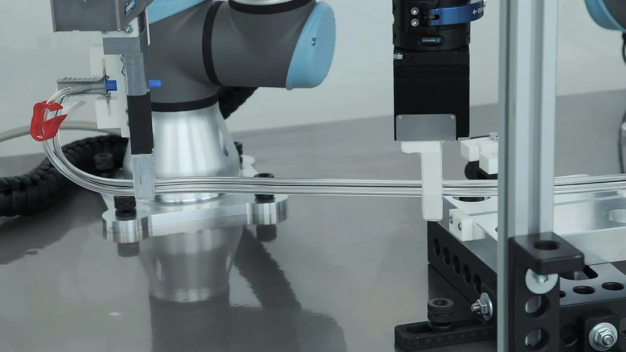
Two industrial robots, whose movements are semi-synchronized, recognize and grasp a hose and place it into a peristaltic pump. (Source: Fraunhofer IPA / Photo: Rainer Bez)
The demand for automation in laboratories is steadily increasing. However, the requirements for robot-assisted applications in this context are high. How they can still be implemented in a technically and economically sensible way is demonstrated by Fraunhofer IPA using a prototype in cooperation with SKAN.
Robots automate sterilization tests in laboratories
Handling objects has always been one of the tasks most frequently performed by robots. For many applications, this is already optimally solved and has been in continuous use in series production for years. The car body, which is lifted through the raw assembly line, is the most well-known example. But in many other environments, there is a strong demand for more automation with robotics. This includes laboratories in the life sciences and pharmaceutical industries.
In the laboratory environment, there are numerous non-ergonomic, repetitive, and consequently monotonous tasks that are unattractive for specialists. Additionally, in times of labor shortages, laboratory operators first need to find qualified laboratory professionals. Robotics can help relieve the available specialists so they can focus their capacities on more value-adding activities. Furthermore, efficient, repeatable, and process-safe work, as well as seamless and error-free documentation, are required in laboratories—areas where robotics are also well suited. If the robotic solution is designed to be modular, it can meet the flexible demands of this complex environment.
Robots handle hoses
An exemplary development for automated handling of sterilization tests as part of quality control in pharmaceutical production has emerged within two projects of Fraunhofer IPA with SKAN. While the first collaboration aimed to test the fundamental feasibility, a prototype handling solution has now been developed in the next step, which has already been patent-pending. Two industrial robots, whose movements are semi-synchronized, pick sterilization tests from the packaging, recognize and grasp a hose, and insert it into a peristaltic pump. The robot cell corresponds to the dimensions of a typical sterilizer at SKAN.
A challenge is that hoses are flexible and thus difficult to handle. Additionally, there is a risk that they could knot. However, in a feasibility study, the development team demonstrated that the prototype operates robustly and process-safely.
In general, robot-based applications for laboratories must be adapted to the requirements of this environment. The mentioned flexible parts such as hoses or bags are typical objects that a robot must handle with appropriate trajectory planning and gripping technology. Moreover, strict requirements regarding sterilization or cleaning processes in the production environment, such as those specified by Good Manufacturing Practice (GMP), must be met. Last but not least, the laboratory and pharmaceutical environment is highly regulated, so the processes and systems used must operate reliably.
Expertise in automation and laboratory processes
The development of the application was based on extensive knowledge of complex assembly, disassembly, and handling solutions, as well as around 50 years of experience with feasibility studies related to automation. These studies range from conceptual design to customer-specific tool and fixture construction, the setup and evaluation of the robot application, and finally to series production. For the collaboration with SKAN, experts from the specialized departments of robot and assistance systems, laboratory automation, and bioproduction technology at Fraunhofer IPA worked interdisciplinary, bringing the relevant industry knowledge into the application development. Currently, SKAN plans to further develop the prototype into a series product with the help of a system integrator or plant manufacturer. Fraunhofer IPA can continue to support this technology transfer extensively.

Fraunhofer-Institut für Produktionstechnik und Automatisierung IPA
Nobelstraße 12
70569 Stuttgart
Germany
Phone: +49 711 970 1667
email: joerg-dieter.walz@ipa.fraunhofer.de
Internet: http://www.ipa.fraunhofer.de