




- R+D & Community of Interest
- Translated with AI
Resilient of Artificial Intelligence
Fraunhofer IPA at the Hannover Messe
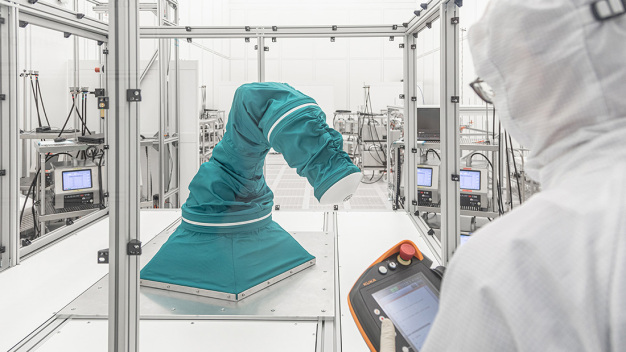
2ndSCIN® is a protective covering for robots and other automation components that mimics human skin. © Fraunhofer IPA, Photo: Rainer Bez
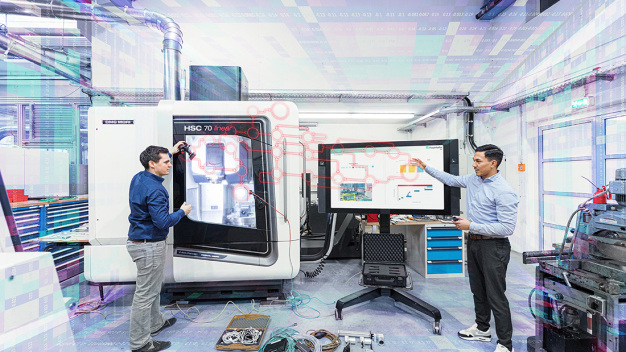
A research team led by Brandon Sai (right in the picture) has developed a tool that detects the causes of productivity losses in linked systems and enables quick troubleshooting of disruptions. © Fraunhofer IPA, Photo: Rainer Bez
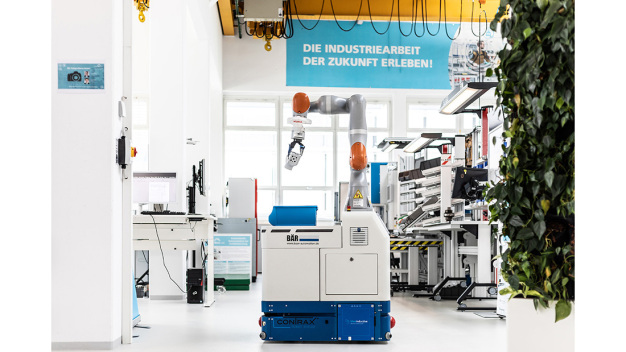
The Future Work Lab in Stuttgart houses Germany's largest collection of demonstrators that show what the production work of the future will most likely feel like. © Fraunhofer IPA, Photo: Rainer Bez
Artificial Intelligence (AI) optimizes processes and makes entire production more reliable, flexible, and resilient. How exactly this works will be demonstrated by researchers from the Fraunhofer IPA from April 12 to 16 at the Hannover Messe, which is taking place virtually this year.
Since the COVID-19 crisis, the term "resilience" has become very popular. Originally from materials science, it describes the property of a body to return to its original shape after deformation. Transferred to entire societies, the economy, individual companies, or their production lines and facilities, resilience refers to the ability to overcome crises and disruptions without lasting impairments.
How AI can make industrial production more resilient and optimize processes will be demonstrated by some exhibits presented by scientists from the Fraunhofer Institute for Production Technology and Automation IPA from April 12 to 16, 2021, at the Hannover Messe, which is held virtually this year.
The name says it all: Maximize Overall Equipment Effectiveness
A research team led by Brandon Sai from the Department of Factory Planning and Production Management has developed a tool that detects the causes of productivity losses in linked systems and enables quick troubleshooting. With "Maximize Overall Equipment Effectiveness" (MOEE), implemented algorithms automatically analyze the behavior of a system and create a customized process model. The various process steps of a production cycle are visualized and evaluated.
"The algorithms calculate, for example, which processes occur when and in what order, and how long they each take. If process steps do not occur at the desired speed and are not optimally coordinated, this indicates something about the system's performance," explains Sai. Furthermore, the self-learning algorithms provide information on the quality achieved. "Through a combination of automatic process model creation and machine learning methods, we detect productivity losses at the moment they occur and thus contribute to rapid troubleshooting," Sai explains.
A look into the future: The Future Work Lab
Similarly, the flexible data acquisition tools developed by a research team from the Department of Factory Planning and Production Management are noteworthy. The scientists combine a modular sensor system with AI algorithms for process recognition to automatically identify optimization potentials in production. This is just one of around 50 demonstrators set up by researchers from Fraunhofer IPA and the neighboring Fraunhofer Institute for Work Organization and Organization IAO in the jointly operated Future Work Lab.
"In the Future Work Lab, we showcase the potential of cognitive assistance systems and participatory implementation methods for use in operational production systems," says Simon Schumacher, project manager of the Future Work Lab at Fraunhofer IPA. Germany's largest collection of demonstrators showing what future production work will most likely feel like is now accessible at the Hannover Messe.
Stronger together: Network AI4DT
A digital twin is a virtual replica of real machines, products, or systems such as factories or organizations, including their properties, status, and behavior. It serves as a data model that artificial intelligence evaluates, draws conclusions from, and derives action recommendations. However, especially small and medium-sized enterprises (SMEs) face significant challenges in designing, applying, and utilizing digital twins and AI.
To address these challenges together, the state of Baden-Württemberg and the Province of North Brabant joined forces in January 2021 to establish the Dutch-German field lab "Artificial Intelligence for Digital Twins (AI4DT)." This network of companies, experts, and technology providers aims to develop, test, and implement intelligent industrial solutions. The project leader of AI4DT is Professor Daniel Palm from Fraunhofer IPA, who will present it at the Hannover Messe.
Custom-fit for robots: 2ndSCIN®
Not only is autonomous and resilient production becoming increasingly important, but ultra-clean production is also gaining significance: "From battery manufacturing to biotechnology — only pure production environments enable the high-tech of the future," says Udo Gommel, head of the Reinst and Microproduction Department at Fraunhofer IPA. However, for many manufacturers, the cleanroom certification of robots and other automation components is a cumbersome, time-consuming, and costly process.
Therefore, Gommel and his colleagues developed 2ndSCIN®, essentially a suit for robots. This protective covering consists of a permeable, flexible, and multilayer textile that mimics human skin in its functionality. Depending on the application, two or more layers can be stacked, each separated by spacers. Air can be sucked in or expelled from the gaps. This allows particles originating from the environment or the automation component itself to be removed. The textile layers are also equipped with sensors that continuously measure parameters such as particle counts, pressure, or humidity. Using AI algorithms, these data can be analyzed to enable predictive maintenance strategies.

Fraunhofer-Institut für Produktionstechnik und Automatisierung IPA
Nobelstraße 12
70569 Stuttgart
Germany
Phone: +49 711 970 1667
email: joerg-dieter.walz@ipa.fraunhofer.de
Internet: http://www.ipa.fraunhofer.de



