



- Translated with AI
Researchers from Kaiserslautern and Saarbrücken find connection between cell metabolism and cell division
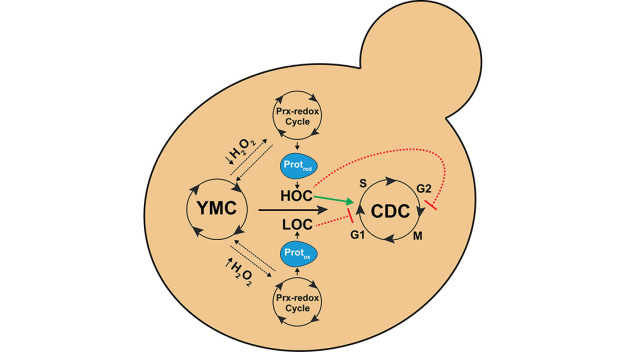
Peroxiredoxin-Hydrogen Peroxide (H2O2)-dependent Thiol Redox Relay (Prx Redox Cycle) docks onto the yeast metabolic cycle (YMC) to control entry/exit into/from the cell division cycle (CDC). HOC = high oxygen consumption, LOC = low oxygen consumption. (Dr. Prince Saforo Amponsah)
Many biological processes are subject to rhythmic changes. Well-known examples include the so-called circadian rhythm, an "internal clock" with approximately a 24-hour cycle, or the slightly shorter, ultradian rhythm. Cell division is often coupled with this rhythm. Researchers from Saarbrücken and Kaiserslautern have now discovered that this rhythm and its coupling with cell division are closely linked to hydrogen peroxide. The study was published in the renowned journal Nature Chemical Biology.
The processes in living organisms follow, down to the molecular level, a finely orchestrated choreography. Of great importance for these processes in the body are also strictly prescribed rhythms, which are followed by certain cycles. For example, the approximately 24-hour circadian cycle, a kind of "inner clock," plays an important role in metabolic and cell division mechanisms within cells.
Scientists from Saarbrücken and Kaiserslautern have now taken a closer look at a similar cycle, the slightly shorter ultradian cycle, in baker's yeast. "Not all details of the molecular mechanisms that control circadian rhythms have yet been researched and clarified," says Dr. Prince Saforo Amponsah, biochemist in the molecular genetics laboratory at TUK and first author of the study. "However, our research is an important part of solving this puzzle."
Under the leadership of Bruce Morgan, Professor of Biochemistry at the University of Saarland, the experts investigated what happens in the model organism baker's yeast when the cell metabolism is deliberately altered. It was previously known that metabolic processes and cell division cycles often run synchronously according to such rhythms in healthy cells. It was still unknown whether rhythmic changes in metabolism are the cause or the consequence of cell division.
Using innovative fluorescent sensors, the scientists were able to observe rhythmic changes in hydrogen peroxide levels. Hydrogen peroxide was long known mainly for stressing and damaging cells. "We examined the protein peroxiredoxin and its reaction with hydrogen peroxide, as well as the consequences on the cell division cycle," explains Bruce Morgan. The protein peroxiredoxin reacts very sensitively to hydrogen peroxide and is therefore particularly suitable for further understanding the complex mechanism of the cell's "inner clock."
The question of whether a change in this rhythm is the cause or consequence of a metabolic change could now apparently be answered by the researchers: "We found that the coupling between metabolism and cell division is disrupted when we inactivate peroxiredoxin in baker's yeast," explains biochemist Morgan, who was a junior professor at TUK before recently moving to Saarland. Cell division then proceeds decoupled from the cell's metabolism. Furthermore, the researchers were able to precisely control when cells enter and exit the cell division cycle by carefully regulating the metabolic cycles.
"We can now demonstrate for the first time that peroxiredoxins play a crucial role in cellular timekeeping by using hydrogen peroxide as fuel to fulfill their function as timers," says Amponsah, who conducted the research for his doctorate at TUK. "This is the culmination of about four years of hard work and one year of peer review. It was really enjoyable to work on this project because it produced many innovations and new insights."
These fundamental findings by the researchers could be important for better understanding uncontrolled cell division in tumor cells. It is known that cell division in cancer cells is often decoupled from the circadian clock. In the future, it will be particularly interesting to investigate whether disrupted regulation of hydrogen peroxide is involved.
Also involved in the research were Prof. Zuzana Storchová, who heads the molecular genetics laboratory at TUK, and Dr. Galal Yahya Metwally, Humboldt Fellow and visiting scientist in her research group. "This collaboration shows how combining different approaches can bring new insights into old questions," says Storchová. "We hope that our model system will provide further insights in the future into how the cell cycle is synchronized with the metabolic clock."
Technische Universität Kaiserslautern
67663 Kaiserslautern
Germany