

- Translated with AI
Researchers closely examine drops using 3D high-speed camera technology
Achema 2018
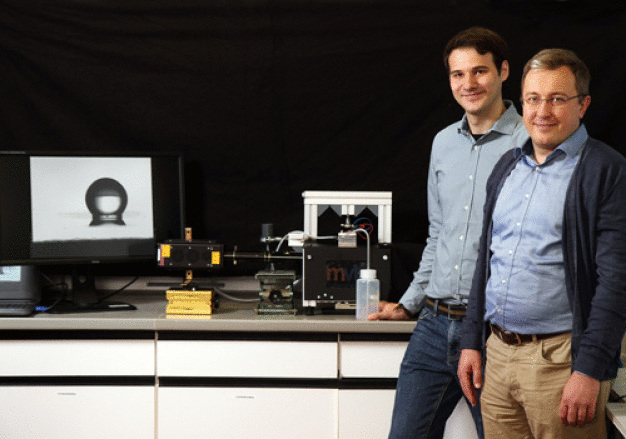
Fabian Krull (left) and Professor Antonyuk examine how droplets hit different surfaces. (Photo: TUK/Thomas Koziel)
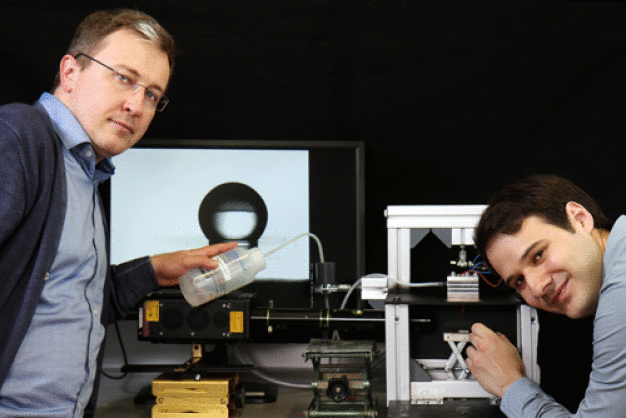
A 3D high-speed camera system is used. (Photo: TUK/Thomas Koziel)
Water droplets bead up on the lotus leaf, whereas they wet a concrete wall. The reason is the respective surface properties. Tiny structures cause, for example, that a droplet does not adhere. Researchers at the Technical University of Kaiserslautern (TUK) investigate these effects using a 3D high-speed camera system. This allows them to see what happens when droplets hit different surfaces. The findings can help reduce wear on machines or keep production facilities clean. They will present this technology at the Process Technology trade fair Achema in Frankfurt from June 11 to 15 at the Rhineland-Palatinate research booth (Hall 9.2, Stand A86a).
When a water droplet falls on a lotus leaf, it simply bounces off. This phenomenon, known as the lotus effect, is based on the surface of the leaves having tiny bumps (noppen), which ultimately cause droplets to roll off. These tiny structures were discovered in the 1970s by botanist Wilhelm Barthlott using a scanning electron microscope. The principle is now used, for example, on windowpanes or in wall paints.
Researchers at TU Kaiserslautern are also studying this phenomenon in the Department of Mechanical Engineering and Process Engineering. They investigate how droplets behave when they encounter surfaces with differently shaped microstructures, such as bumps, grid or trapezoid shapes. "This involves structures that are significantly smaller than, for example, the diameter of a hair," says Fabian Krull, who is working on his doctorate in the Chair of Mechanical Process Engineering under Professor Dr. Sergiy Antonyuk. They are roughly in the range between 100 nanometers and 10 micrometers, dimensions invisible to the human eye. Yet, these structures can influence how droplets impact a surface in different ways.
To observe this process in detail, three high-performance cameras are used. "They take images from different angles," says Fabian Krull. Software then compiles the data into a 3D image. "This allows us to observe step by step what happens when droplets hit different surfaces," says Professor Antonyuk. Additionally, the engineers simulate the fall of droplets in their computer models.
The research is part of the Collaborative Research Center 926 (SFB) "Component surfaces: Morphology on the microscale," funded by the German Research Foundation. The researchers' insights could help, for example, to reduce friction in machines or to design surfaces in industrial plants so that dust and dirt particles do not accumulate on machinery. They could also be used in hospitals to prevent microorganisms from adhering.
At Achema, the engineers will present their camera system and their research work.
Technische Universität Kaiserslautern
67663 Kaiserslautern
Germany