




- Translated with AI
Researchers at TU Kaiserslautern involved in quantum optical terahertz measurement of layer thicknesses
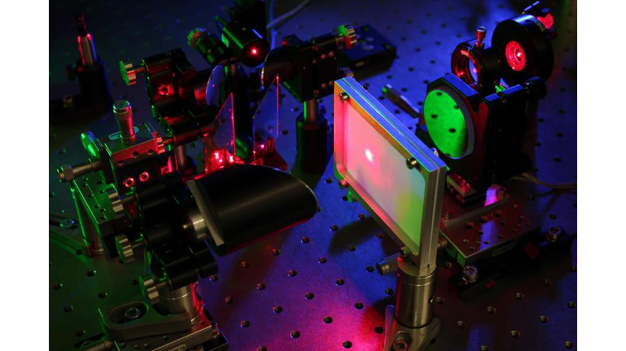
Experimental setup for quantum optical layer thickness measurement in the terahertz spectral range by measuring visible photons. (Photo: Fraunhofer ITWM)
Researchers from the Technical University of Kaiserslautern (TUK) and the Fraunhofer ITWM demonstrate for the first time the measurement of layer thicknesses using terahertz quantum interference. The flagship project QUILT of the Fraunhofer Institutes deals, among other things, with the detection of terahertz waves based on new quantum optical methods. First successes are reported by researchers from Fraunhofer ITWM and TUK in the March issue of the renowned journal "Science Advances," published by the "American Association for the Advancement of Science."
QUILT stands for "Quantum Methods for Advanced Imaging Solutions" and provides the basis for several Fraunhofer Institutes to jointly develop or further develop quantum-based measurement systems in various spectral ranges. At Fraunhofer ITWM, the properties of entangled photons are utilized in the still young research field of quantum sensing.
"Despite the continuous development of terahertz technology in recent years, capturing an image in this spectral range remains a major technical challenge," says experimental physicist Prof. Georg von Freymann, head of the Department of Optical Technologies and Photonics at TUK as well as head of the Material Characterization and Testing Department at Fraunhofer ITWM. "In contrast, today even cameras in smartphones or PCs are highly advanced, offering high resolution and detection efficiency at moderate costs." A new measurement method can provide a solution: using quantum optical techniques, the properties of photons in the terahertz spectral range can be transferred to more easily detectable visible photons, making it easier to analyze information about terahertz photons.
"Last year, we laid the groundwork for the measurement principle to be implemented; now we were able to observe quantum interference in the terahertz spectral range using visible photons," says Bjoern Haase, one of the involved doctoral students at TUK. His colleague Mirco Kutas adds: "For the first time, we managed to make the terahertz waves accessible for experiments on external samples." The experiments also benefited from the support of theoretical physicists from the Optimization Department of Fraunhofer ITWM. "The results of the simulations show very good agreement with the experiment," explains Dr. Patricia Bickert, who is primarily responsible for the theoretical modeling.
This made it possible to determine the layer thickness of various samples, which only interact with terahertz waves, by detecting visible light. These are the first investigations of their kind worldwide.
Further information can be found on the pages of Fraunhofer ITWM (https://www.itwm.fraunhofer.de/en/press-publications/press-releases/2020/2020_03_17-quantum-optical-terahertz-measurement.html) and in the journal "Science Advances": https://advances.sciencemag.org/content/6/11/eaaz8065.
Questions answered by:
Prof. Dr. rer. nat. Georg von Freymann
Department of Optical Technologies and Photonics
Email: georg.freymann@physik.uni-kl.de
Phone: 0631 205-5225
Technische Universität Kaiserslautern
67663 Kaiserslautern
Germany