




- Translated with AI
Research team from TU Kaiserslautern deciphers mechanisms of atomic energy transport in the quantum world
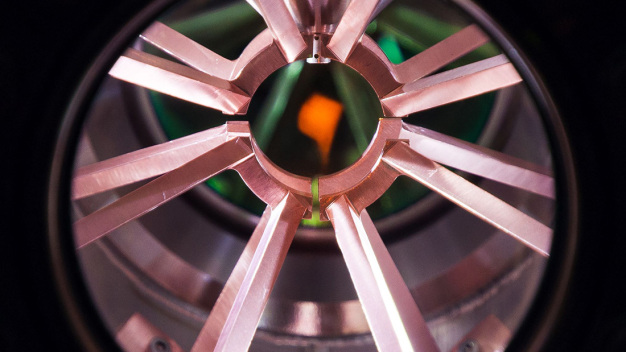
Ultracold atom cloud of rubidium atoms used in this experiment: The fluorescence produced during laser illumination is visible. (Photo: AG Ott/TUK)
The transport of energy between atoms and molecules is the foundation of all life. It is based on interatomic forces, known as dipole-dipole interactions. The research team led by Prof. Dr. Herwig Ott at the Technical University of Kaiserslautern (TUK) has now succeeded in simulating such a transport mechanism in a disordered system. To do this, the researchers experimentally observed the quantum mechanical interaction between different Rydberg atoms. This allowed them to understand the influence of disorder on the distribution and mobility of excitation energy between atoms. The results have been published in the journal Nature Communications.
How energy transport occurs between atoms and molecules is exemplified by photosynthesis: When light hits a cell, its energy is first absorbed by a molecule and then transferred between many other disordered molecules. When this energy packet finally reaches the so-called reaction center, it is stored permanently through a chemical transformation.
To better understand such transport mechanisms, the research team chose a special experimental approach and entered the quantum regime: "We have overcome several technological challenges," explains Carsten Lippe, the first author of the study. "This is evident from the necessary conditions: at an ambient pressure about 1000 times lower than in space around the ISS, and at temperatures close to absolute zero, some atoms are excited by laser irradiation and brought into a so-called Rydberg state. In this state, where an electron is placed in a far distant orbit around the nucleus, the atom is about 10,000 times larger than in its normal state."
Due to this enormous size, an atom in the Rydberg state is highly sensitive to other such atoms and thus allows for experimental investigation of interactions between atoms that would otherwise occur on much smaller length scales.
As part of their experiment, the researchers used different laser systems to sequentially generate two different types of Rydberg atoms and studied the energy transfer between them. They encountered quantum physical effects that contradict our everyday intuition. "Classically, such a transport process can be imagined as a hop process. The energy or excitation jumps back and forth between molecules. In quantum physics, due to the so-called superposition principle, it is different: the excitation can, for example, also simultaneously hop onto multiple molecules, making the transport much more efficient in the system. This is called coherent transport," says Ott.
The researchers were able to demonstrate that the proportion of classical hopping and coherent transport can be controlled in the experiment. This is achieved through tiny changes in the wavelength of the excitation laser used. "Normally, quantum physical effects are fragile and disappear when disturbances are present, such as those caused by atomic disorder in the gas in this system," says Thomas Niederprüm, who co-led the work with Ott. "The fact that these effects could be observed in this study can help to better understand other complex systems. The interaction between Rydberg atoms can be transferred to other areas of current research, such as the absorption and transport of light in molecules during photosynthesis. Recent studies have shown that quantum mechanical effects also play an important role in photosynthesis, and that energy transfer occurs surprisingly losslessly despite the disorder."
The work for this study was conducted within the framework of the Sonderforschungsbereich OSCAR ("Open System Control of Atomic and Photonic Matter"), in which TUK, together with the University of Bonn, is funded by the German Research Foundation. The results of the measurements and simulations, as well as a description of the experimental setup, have been published in the renowned journal Nature Communications:
"Experimental realization of a 3D random hopping model"; Carsten Lippe, Tanita Klas,
Jana Bender, Patrick Mischke, Thomas Niederprüm & Herwig Ott. The English-language article is available free of charge.
DOI: doi.org/10.1038/s41467-021-27243-2
Questions answered by:
Prof. Dr. Herwig Ott
Department of Ultracold Quantum Gases and Quantum Atom Optics / TU Kaiserslautern
Tel.: 0631 205-2817
Email: ott@physik.uni-kl.de
Technische Universität Kaiserslautern
67663 Kaiserslautern
Germany