




- Translated with AI
Research project on the development of a fluorocarbon-free hydrophobizing agent for textiles launched
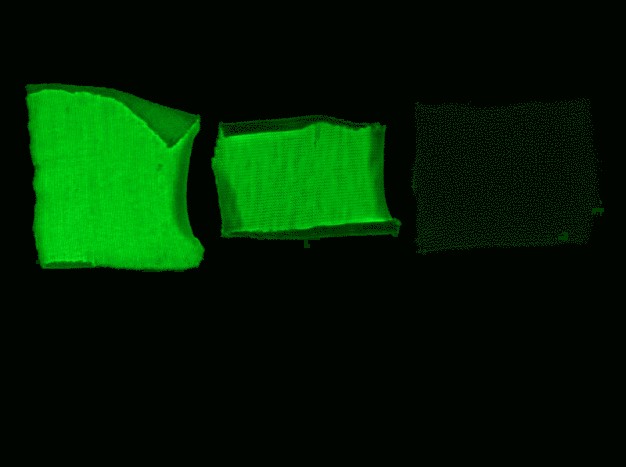
Fig. 1: Feasibility study – Textiles based on cellulose were equipped with a green-fluorescent marker protein to which a cellulose anchor was bound. Cotton (left), viscose (middle), negative control = green-fluorescent protein without cellulose anchor (right). © Hohenstein Institute
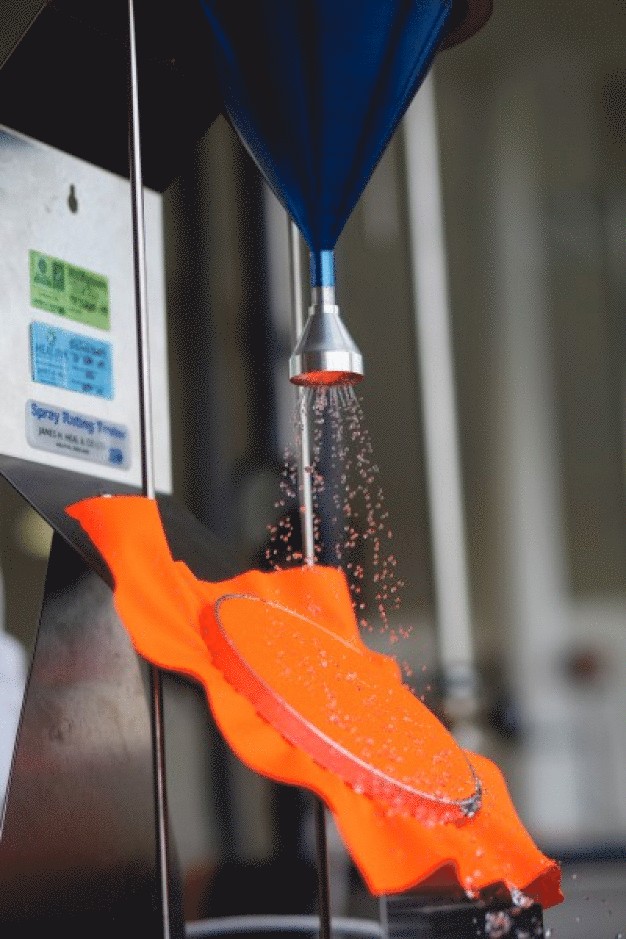
Fig. 2: Water-repellent (hydrophobic) textile. © Hohenstein Institute
The Hohenstein Institute in Bönnigheim and the Fraunhofer Institute for Interfacial Engineering and Biotechnology IGB in Stuttgart (with its BioCat division in Straubing) announce the launch of an interdisciplinary research project that aims to develop a novel textile finishing based on natural proteins with water- and dirt-repellent properties. This will serve as an alternative to the toxic and controversial hydrophobization using per- and polyfluorinated chemicals. The goal of the joint project (IGF No. 18884 N) is to achieve an economically and sustainably stable functionalization of textiles as a replacement for the currently still widely used fluorocarbon finishes. By specifically linking the field of biotechnology with textile science, the scientists expect a successful implementation of the project goal.
The approach targeted in the research project will be realized solely using water-repellent (hydrophobic) proteins, known as hydrophobins. These proteins naturally occur in the cell walls of fungi, where they serve a water-repellent function. During the course of the project, the researchers aim to biotechnologically produce the fungal proteins and subsequently apply them to textiles.
The principle is based on attaching an "anchor" to the hydrophobic proteins, which can bind selectively and stably to cellulose fibers as a linking element. Such "anchors" are also available in nature, for example in cellulose-degrading enzymes (so-called cellulases), which help many fungi and bacteria break down biomass to access nutrients.
In a feasibility study conducted by the Hohenstein Institute and the Fraunhofer Institute, the "anchor-protein finishing" principle has already been implemented. It has so far been possible to stably bind a green-fluorescent marker protein via a cellulose anchor to various textiles.
Water- and dirt-repellent properties of textiles are of great importance, especially for outdoor products, technical textiles, surgical textiles, but also for protecting fibers from microbial decomposition, such as in the automotive industry. Currently, these properties are mainly achieved through chemical fluorocarbon compounds, which are classified as persistent organic pollutants. Fluorocarbon compounds can be ingested by humans and animals via food and drinking water and accumulate in their organs. Due to the dangers for humans and the environment, there is increasing pressure from media and consumers for alternative textile finishes with the desired properties. Therefore, switching from fluorocarbon finishes to alternative substances and processes is a significant challenge for the textile industry. The protein-based textile finish represents an alternative hydrophobization process that is cost-efficient, sustainable, and health-safe.
The joint project is supported by a project advisory committee composed of various industry representatives from the textile and biotechnology sectors. The industrial feasibility and economic viability of the newly developed finishing method are thus considered from the outset.
The Fraunhofer IGB, BioCat division in Straubing, primarily focuses on biocatalysis systems and the fermentative production of biological substances. Currently, the corresponding fusion proteins made from water-repellent proteins and cellulose anchors are being produced there, suitable for finishing cellulose-containing textiles made of cotton, viscose, modal, or lyocell.
The Hohenstein Institute in Bönnigheim is one of the most significant independent research and testing facilities in the textile sector. The integrated Life Science division, called William Köster Institute for Hygiene, Environment, and Medicine, addresses numerous textile-related questions in the project—from selecting suitable cellulose-based textile samples, to finishing the textiles with proteins, to characterizing the finished textile samples. The researchers examine, on the one hand, the functionality and wash durability of the protein finish. On the other hand, they analyze additional aspects such as breathability, biocompatibility, environmental friendliness, and ultimately the biological degradability of the finished textile samples.
Hohenstein Laboratories GmbH & Co. KG
74357 Hohenstein
Germany



