



- Translated with AI
Research project de:karb aims to disclose the CO₂ footprint across the entire supply chain
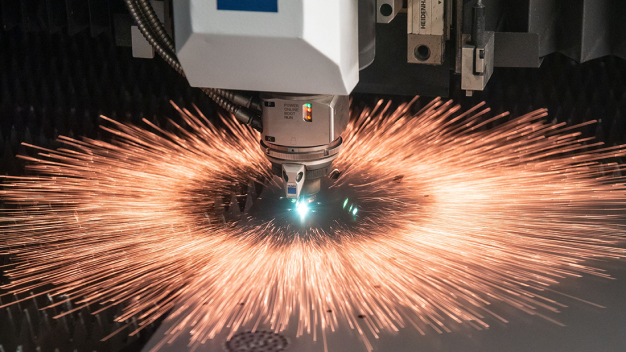
Energy-intensive processes such as laser cutting should take place when sufficient energy from renewable sources is available. © TRUMPF
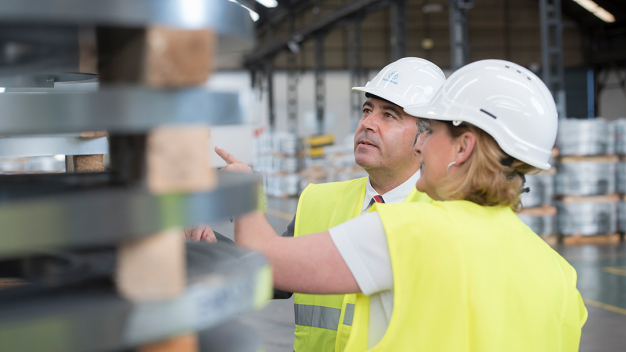
The Fraunhofer IPA and other partners are researching under the leadership of Trumpf in the de:karb project how to improve climate protection in sheet metal manufacturing. © Thyssenkrupp Materials Services
Ensuring more climate protection in sheet metal manufacturing through the research project de:karb, led by Trumpf, Thyssenkrupp Materials Services, and the Fraunhofer IPA. The goal of the collaboration is an open platform that allows users to accurately determine the CO2 consumption of their component. The Federal Ministry for Economic Affairs and Climate Action (BMWK) is funding the project with 8.3 million euros.
Led by the company Trumpf, Thyssenkrupp Materials Services, the Fraunhofer Institute for Production Technology and Automation IPA, and other partners are researching how to reduce CO2 consumption in sheet metal manufacturing. The aim is an openly accessible online platform that enables companies to precisely determine the carbon footprint of their components. "Digitalization is the key to more climate protection in industry. As a leading provider and user of digitally networked manufacturing, we have everything in place to make the sheet metal world more sustainable together with our partners," says Jens Ottnad, project manager at Trumpf. The project started in June and will run for three years. BMWK is funding it with 8.3 million euros.
Online platform makes emissions consumption transparent
The online platform aims to reveal which measures in which production steps would have the greatest CO2 savings effects. To do this, Trumpf and Thyssenkrupp Materials Services connect their IT systems to the platform. "To reduce emissions, companies need to know their own CO2 footprint. We want to create the necessary transparency through the online platform. This will simplify the implementation of regulations and also lay the foundation for a circular economy," says Sebastian Smerat, project manager at Thyssenkrupp Materials Services.
Across the entire supply chain, the project partners can evaluate measures for greater sustainability using machine and production data. This includes, for example, the specific CO2 savings when users extract additional components from a certain amount of metal or avoid unnecessary material transports. "A special feature of de:karb is the reduction of CO2 usage through optimizations along the entire value chain. Methods of artificial intelligence (AI) and machine learning play a central role here," explains Marco Huber, who is responsible for the project at the Fraunhofer IPA.
Technologies around AI and networking
According to the opening balance sheet on climate protection from the Federal Ministry for Economic Affairs and Climate Action (BMWK), German steel and sheet metal production accounts for about a quarter of industrial emissions in Germany. Producing raw materials is particularly energy-intensive. Improving material utilization in manufacturing is therefore a focus of the research project. Trumpf is working on new technologies for nesting to cut more parts from the sheet using AI.
Another aspect of the initiative is the optimization of scheduling procedures, i.e., the timing sequence in production. The Fraunhofer IPA is working on incorporating ecological conditions into manufacturing using AI. For example, it could be possible to schedule particularly energy-intensive steps like laser processing when the most renewable energy is available. At the same time, strategies should enable users to process orders flexibly.
Thyssenkrupp Materials Services' task is to orchestrate material, value, and data flows through a developing digital platform. This allows tracking of consumables and their key data. Uniform standards are intended to enable networking.
CO2 footprint as a competitive criterion
As the ecological footprint of manufacturing increasingly becomes a competitive criterion, the partners are already responding to the changing needs of customers and companies with this project. "Especially in Western markets, customers are paying more and more attention to companies' CO2 emissions. Those who can demonstrate particularly climate-friendly value chains secure competitive advantages," says Ottnad. Other project partners include consulting firms AEC and SES-Ingenieure, the Baden-Württemberg Cooperative State University, the AI startup Nash, and the sheet metal manufacturer H.P. Kaysser.
Project overview
Full name: de:karb – Decarbonizing Manufacturing Industry
Funding provider: Federal Ministry for Economic Affairs and Climate Action within the framework of GreenTech development of digital technologies
Duration: 01.06.2023 to 31.05.2026
Project partners: Trumpf (consortium leader), Thyssenkrupp Materials Services, AEC, SES-Ingenieure, Baden-Württemberg Cooperative State University, Nash, and H.P. Kaysser

Fraunhofer-Institut für Produktionstechnik und Automatisierung IPA
Nobelstraße 12
70569 Stuttgart
Germany
Phone: +49 711 970 1667
email: joerg-dieter.walz@ipa.fraunhofer.de
Internet: http://www.ipa.fraunhofer.de



