


- Universities
- Translated with AI
Research project "3D-Life" at Kaiserslautern University of Applied Sciences successfully launched
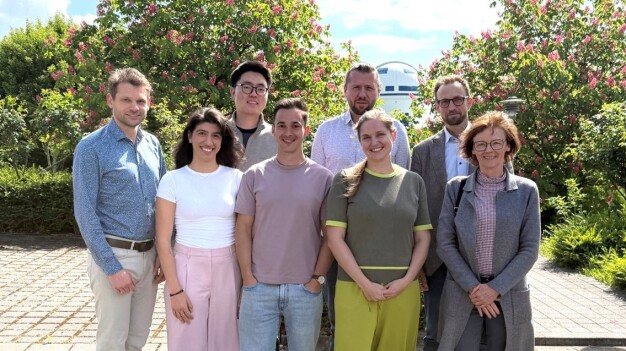
The project team at the kick-off meeting at the Zweibrücken campus of Kaiserslautern University of Applied Sciences. (Copyright: HSKL)
The comprehensive research into cancer, dementia, and immune diseases is only possible with precise and simultaneously cell-friendly diagnostic and analytical technologies. This is precisely where the new research project "3D-Life" at Kaiserslautern University of Applied Sciences comes in.
A strongly interdisciplinary project team consisting of six professors and five research staff members from the university locations in Zweibrücken and Kaiserslautern combines expertise from microsystem technology, electrical engineering, life sciences, and computer science. Together, the researchers are developing innovative 3D microstructures and switchable microfilters for applications in cell research and medical diagnostics.
The highly precise, biocompatible 3D components are manufactured in the cleanroom at the Zweibrücken campus using two-photon lithography (2PL), a laser-based 3D printing process at the micrometer scale. During the kick-off meeting in May 2026, the involved professors and staff came together for the first time to officially launch the project.
3D-Life is coordinated by Prof. Dr. Monika Saumer and her research associate Dr. Anette Britz-Grell. Together with a multidisciplinary team of five other professors from Kaiserslautern University of Applied Sciences, they represent the research focuses "Integrated Miniaturized Systems" (IMS), "Highly Efficient Technical Systems" (HTS), and "Interaction, Technology, Empirical Research, and Application" (ITERA) (see info box). The project benefits from the close networking of research activities within the university and creates new synergies between the involved disciplines.
In the implementation of the project, not only external companies and scientific partners are involved, but also students from various research-oriented bachelor’s and master’s programs, especially in microsystem technology, applied life sciences, computer science, and engineering sciences. This provides them with the opportunity to carry out their first independent research projects within the framework of the project. In addition to laboratory work, the project has a strong educational and Nachwuchsförderung component. With the new "3D-Life Research College," a format is being established that allows students, research staff, and other early-career researchers to work together on current issues in microstructuring, biosensing, and cell research. The research college connects the various activities of the project and specifically strengthens the training of young scientists.
Accompanying this, a digital technology platform is being developed with multimedia teaching modules and a virtual technology laboratory. There, learners will be able to digitally simulate complex microsystem processes and acquire practical skills.
The project, funded by the Federal Ministry for Research, Technology, and Space (BMFTR), runs until the end of 2029.
Hochschule Kaiserslautern
67659 Kaiserslautern
Germany