


- Translated with AI
Reproducible measurement results: Pamas SBSS – Proven reference instrument for particle analysis in the laboratory
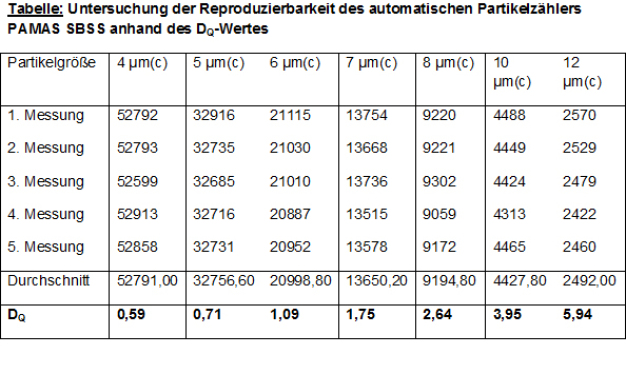
Based on the DQ value, the company examined the reproducibility of measurements with the particle analysis system Pamas SBSS. The table shows the measurement data from five measurements of the same sample and the corresponding DQ value.
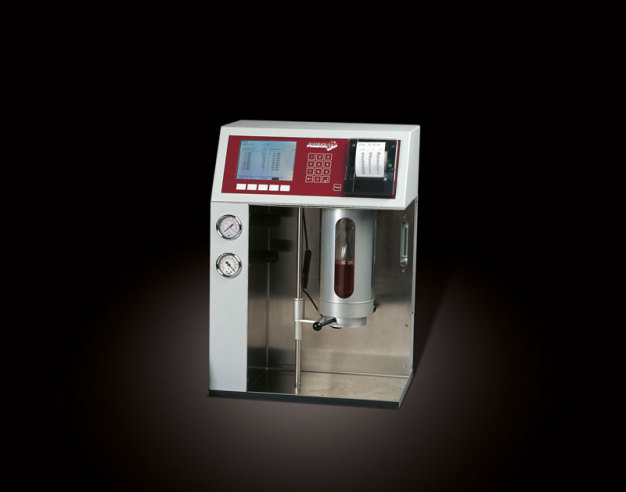
Due to its measurement accuracy and reproducibility, the Pamas SBSS particle analysis system is valued by renowned laboratories. As a reference device, it is also used by manufacturers of other particle counters to verify calibration.
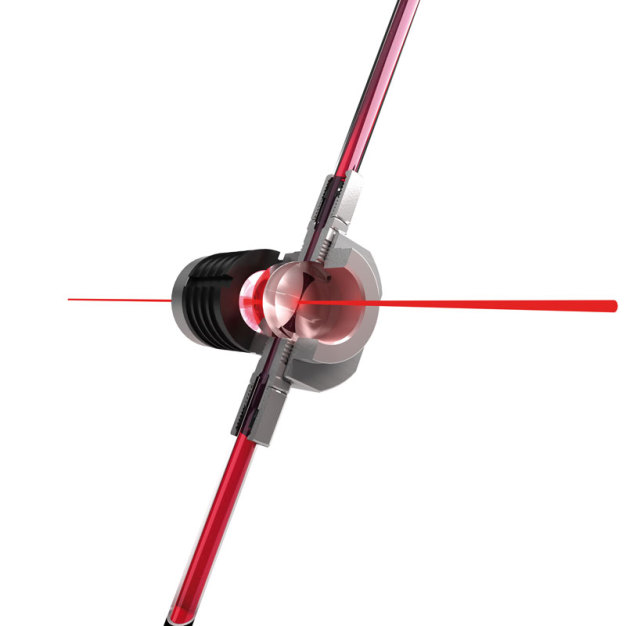
Automatic particle counting systems from Pamas use optical sensor technology methods for purity control of liquids.
The Pamas SBSS Particle Analysis System from Pamas Particle Measurement and Analysis Systems GmbH has proven to be a reliable measuring instrument for particle analysis in the laboratory. Based on practical measurement data, the company has examined the reproducibility of the particle counter's measurement results. The results show that the measurement results of different measurements of the same sample hardly differ from each other. The high measurement accuracy of the company's particle counters is appreciated by many reputable laboratories. Other manufacturers of particle counters also use the Pamas SBSS particle analysis system as a reference instrument for their calibration.
The reproducibility of measurement results is an important parameter for the precision of a measuring device. Especially in purity control of liquids such as water, oil, hydraulic fluids, or pharmaceutical solutions, an exact specification of the particle content is indispensable. The company specializes in particle analysis of liquids and develops, manufactures, and sells particle counters for laboratory, field, and online measurements. For the laboratory analysis of highly viscous liquids, the company offers the Pamas SBSS particle counting system.
Automatic particle counters are used for contamination analysis, i.e., for determining the particle size distribution and concentration in liquids. The measurement accuracy of particle counters is ensured through prior calibration. The international calibration standard ISO 11171 prescribes guidelines for a standard calibration of automatic particle counters, ensuring the determination of particle size distribution as well as high measurement accuracy.
Among other things, the calibration standard ISO 11171 also specifies requirements for reproducibility. All systems calibrated according to ISO 11171 must meet these requirements. The standard ISO 11171 defines the requirements for reproducibility via the percentage deviation DQ: this parameter can be used to determine the reproducibility of measurement results of an automatic particle counter. The deviation DQ is calculated according to the formula DQ = 100*((max-min)/average). Once more than 10,000 particles are counted in a specific size channel during a measurement, the DQ deviation of all measurement values may not exceed 11 percent (i.e., plus/minus 5.5 percent) from the average value according to ISO 11171. The permissible limit is higher for a lower number of particles per measurement. At 100 particles per measurement, the permissible limit for the DQ deviation is 27.5 percent (+/- 13.75%).
Based on practical measurement data, the company has examined the reproducibility of the laboratory analysis system Pamas SBSS. For the calculation of the DQ deviation, a hydraulic oil sample was measured five times according to standard sample preparation. The measurement was performed in size channels > 4 µm(c), > 5 µm(c), > 6 µm(c), > 7 µm(c), > 8 µm(c), > 10 µm(c), and > 12 µm(c). Subsequently, the particle counts of the five measurements in each size channel were compared.
Calculations of the DQ deviation yielded percentage values between 0.59% and 5.94%. These values are well below the maximum permissible limit of 11 percent. For the particle size > 4 µm(c), the percentage DQ deviation was only 0.59%, which is just 54‰ of the permissible limit according to ISO 11171. As the investigation clearly showed, measurements with this particle analysis system are thus very highly reproducible.
Due to its above-average measurement accuracy and reproducibility, this particle analysis system is used as a reference device by renowned laboratories. Other manufacturers of particle counters also use the proven and reliable Pamas particle analysis system as a reference for calibrating their systems.
In addition to its measurement accuracy, the laboratory analysis system is characterized by its simple and user-friendly operation: it features an integrated sample feed, allowing the sample to be analyzed directly from the sample container without the need for decanting before measurement. An additional filling process would increase the risk of external contamination and distort the measurement result. Thanks to the integrated sample feed, the operational effort is very low and can be reduced — with proper pre-setting — to just changing the sample bottles.
Another advantage of this laboratory instrument is its pressure vessel. This is a sample chamber in which both overpressure and vacuum can be generated. Overpressure is created to transport highly viscous liquids through the sensor for measurement. The vacuum function is used to remove gas bubbles from the sample liquid.
This provides the user with full flexibility, as almost every measurement parameter can be varied and adapted to the specific measurement.
PAMAS Partikelmess- und Analysesysteme GmbH
71277 Rutesheim
Germany