

- Translated with AI
Reduced susceptibility to interference due to particle-free properties: Injection molding expert responds to growing demands in the circuit board industry
Technical cleanliness in plastic manufacturing - Integration of clean manufacturing into existing processes through enclosure
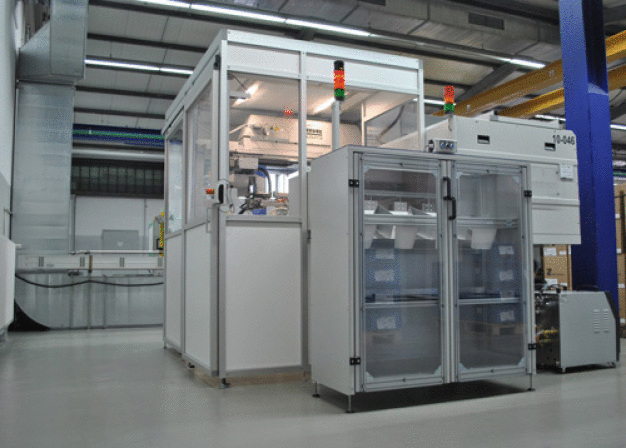
To prevent malfunctions in electronic components, increasingly higher cleanliness standards are being imposed on manufacturers as well as suppliers. The injection molding expert Hans Geiger Spritzgießtechnik GmbH, whose products are used, among other things, in circuit boards, is now responding with a self-developed, enclosed production line that efficiently meets all the criteria of a cleanroom in a compact space. (Source: Hans Geiger Spritzgießtechnik GmbH)
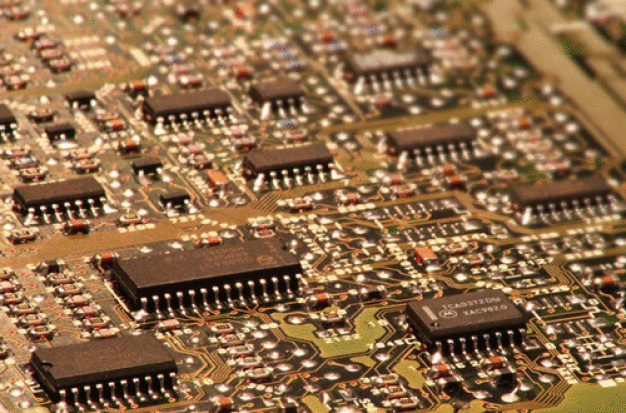
Particle contamination poses an increased risk, especially for electronic assemblies: The Central Association of Electrical Engineering and Electronics Industry e.V. (ZVEI) lists nine possible disturbances such as short circuits or electrical insulation failures in its guide "Technical Cleanliness in Electrical Engineering" that can lead to malfunction. (Source: Tomizak/pixelio.de)
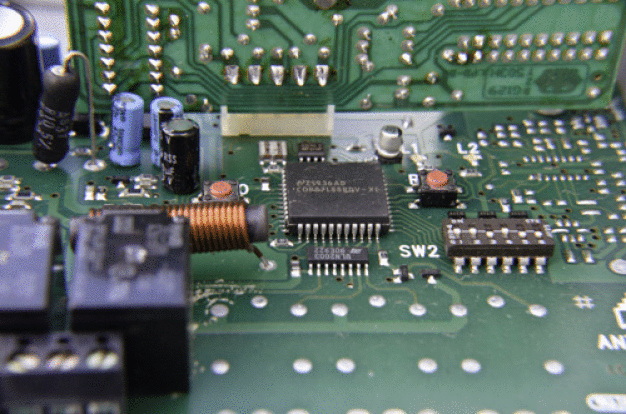
Particle contamination poses an increased risk, especially for electronic assemblies: The Central Association of Electrical Engineering and Electronics Industry e.V. (ZVEI) lists nine possible disturbances such as short circuits or electrical insulation failures in its guide "Technical Cleanliness in Electrical Engineering" that can lead to malfunction. (Source: Thomas Wolter/pixabay.com)
Contamination particles pose an increased risk, especially in electronic assemblies: The Central Association of Electrical Engineering and Electronics Industry e.V. (ZVEI) cites in its guideline "Technical Cleanliness in Electrical Engineering" nine possible disturbances such as short circuits or electrical insulation failures that can lead to malfunction. The causes are easily overlooked everyday phenomena, such as deposits on electrical contacts—hair, skin flakes, pollen. To prevent this, ever higher cleanliness requirements are imposed on manufacturers, but also on suppliers like the injection molding specialist Hans Geiger Spritzgießtechnik GmbH. Its products are used, among other things, in circuit boards that must meet the highest quality standards. The company is now responding with a self-developed, enclosed production line that efficiently meets all cleanroom criteria on a small footprint. This allows for clean manufacturing according to individual specifications without incurring additional costs or time for customers due to extra part cleaning.
"Particulate-free quality has long been standard in many industries. In electrical engineering, this is not a new criterion, but the requirements for components installed with circuit boards have increasingly intensified in recent years," explains Eva Söhnlein, management of Hans Geiger Spritzgießtechnik GmbH. "As more circuit board connectors are used, the demand for particulate-free components now also applies to our parts. Because only by processing nearly particle-free components can a high-quality end product be produced." The main source of contamination in the injection molding process is ambient air. Depending on the environment, different particles and fibers can be present, such as dust, hair, pollen, or skin flakes. Another possible source of foreign matter is the tool itself, as metallic shavings can form through abrasion. If these particles deposit on the parts, they can cause significant malfunctions, such as altered friction or shortened air and creepage distances. To prevent this and produce injection-molded parts in cleanroom quality, Hans Geiger Spritzgießtechnik GmbH has expanded its production with a clean manufacturing line since October 2017.
Clean manufacturing without increased time expenditure
The idea was conceived as early as 2016: "Initially, our sales team, together with the process engineering department, analyzed the increase in applications for technically clean components over the past years. During this process, many future application fields for this type of manufacturing were identified. Therefore, investing in this technology was the next logical step," notes Söhnlein. Essentially, several options for producing technically clean products were considered: for example, converting entire building parts into a clean or sterile room. An industrial part cleaning connected to production is also among the preferred variants. However, Geiger chose to enclose a production line in Plexiglas: "We rejected the usual approaches because setting up an entire building would have been very complex, and washing would add an extra process step that would ultimately cost our customers time," explains Söhnlein.
Two laminar flow boxes mounted on the fully enclosed enclosure prevent particles from settling in the clean area through a constant overpressure and uniform airflow. "Since the system is closed and equipped with its own filter units, no special requirements need to be observed during ongoing production," explains Söhnlein. Only at the start of production and during tool changes is a comprehensive cleaning of the system necessary. To further prevent the formation of disruptive particles—such as through abrasion—all sliding and moving elements of the tools are specially coated and run completely without lubricants.
Implementation of individual customer requirements possible
The system comprises a complete, compact production line: an injection molding machine, a removal robot, and a packaging station. This setup allows the injection-molded parts to be produced within the enclosure, removed by the robot without risk of contamination, and placed on the cooling conveyor. Subsequently, the finished products are automatically counted and packed, ensuring they arrive clean at the customer. "The manufacturing process on the existing system is controlled, reproducible, and audit-proof," the management team states with satisfaction.
Overall, a cleanliness level comparable to ISO Class 7 cleanroom standards can be achieved. However, Geiger decided against a standardized classification because many major customers have their own requirements for technical cleanliness. "We carefully review our customers' individual criteria with each inquiry and assess their feasibility within our facilities," describes Söhnlein. Once a contract is signed and production begins, each batch is tested by an external testing laboratory to ensure compliance with the specified values before the parts are shipped to the customer.
Since commissioning last year, the system has proven itself many times: "We are pleased to present a result after an approximately 18-month development process that we are proud of," concludes Söhnlein.
HG Hans Geiger Spritzgießtechnik GmbH
90431 Nürnberg Kleinreuth bei Schweinau
Germany