


- Lasertechnology
- Translated with AI
RAYLASE starts its cleanroom production
Opto-mechanical deflection units manufactured in cleanrooms increase stability and reduce costs in laser material processing.
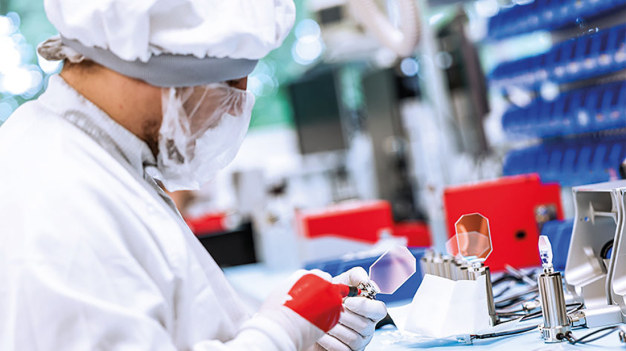
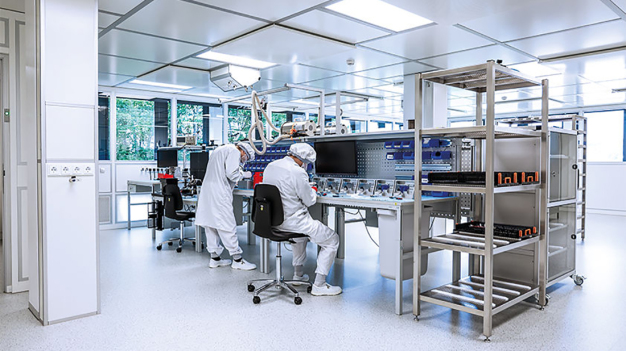
Two RAYLASE employees during the assembly of the deflection units.
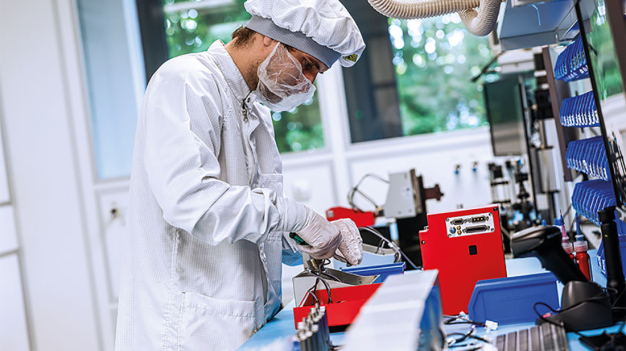
The vacuum cleaner is used multiple times in the RAYLASE cleanroom.
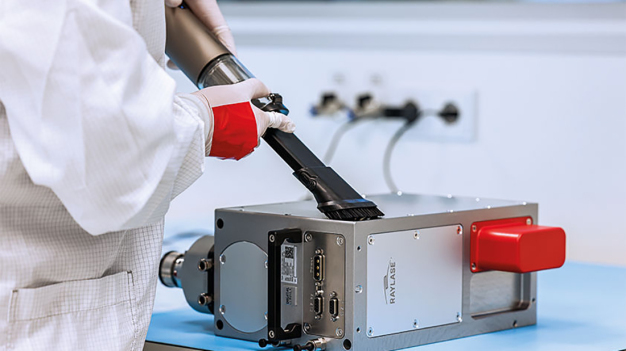
An employee is cleaning an opto-mechanical deflection unit.
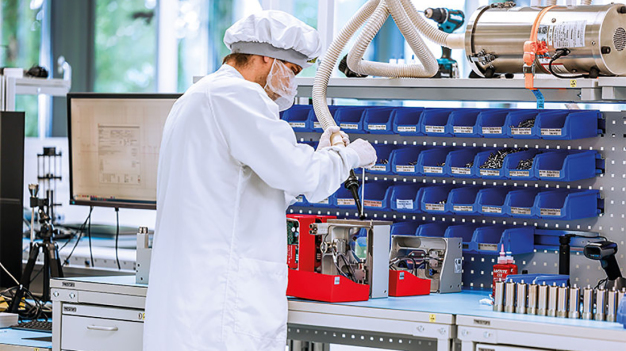
Producing in the cleanroom requires patience and high precision.
RAYLASE once again offers a unique selling point that the industry has been waiting for. The laser system provider from the Five Lakes region near Munich has been producing particle-free deflection units in ISO Class 7 cleanrooms since spring, for controlling and modulating laser beams. The futuristic-looking "Art of production" offers many advantages: Complex laser systems with numerous optics, sensors, and axis systems are protected from contamination and thus from burn-in at high kilowatt laser power, and the spot size in the short-wavelength range remains very small. In electromobility and additive manufacturing, cleanroom-produced products offer higher process stability and lower maintenance and scrap costs, enabling more sustainable, CO2-reduced production.
Two market trends fueled the entry into cleanroom processes at RAYLASE. On the one hand, customer demand for high-performance lasers in the 1-8 kW range, which requires as particle-free a manufacturing process as possible. To our eyes, some particles are barely visible, but tiny and minuscule particles accumulate in the increasingly complex deflection units, which ultimately resemble a closed system. Especially on scanner optics, tiny particles can cause significant damage. They burn in, rendering the lenses unusable. Troubles, failures, and costs are inevitable! The rising demand for laser systems in the short-wavelength range of 532 nm and below, mainly used in surface treatment of metallic building materials, also prompted RAYLASE to invest in the "cleanroom." Because the shorter the wavelength, the easier the laser beam is scattered by particles. "Measurements of beam quality before and after the deflection unit showed us that many small particles significantly deteriorate the process, meaning the beam or the minimal achievable focus becomes larger due to scattering. The industry’s requirement, however, is quite the opposite: the beam should have as small a spot as possible to generate as little heat in the workpiece as possible," explains Berthold Dambacher, CTO at RAYLASE, about the detrimental effect of tiny contaminant particles. In the short-wavelength range, particle-free optics are virtually a fundamental prerequisite for the quality of the entire laser process.
One and a half years were necessary for planning and implementing the cleanrooms and all necessary steps. "Our goal was not only to keep the air there absolutely 'clean,' but everything that is introduced. For our employees working there, this is a major challenge because they have to align their entire behavior accordingly. Additionally, we had to rethink all our processes—from product development, purchasing, production, storage to sales," emphasizes the CTO, who is responsible for the latest innovation at RAYLASE.
Assembly in the cleanroom: A demanding awareness process
Manufacturing in the cleanroom is no child's play but requires additional effort. The topic goes far beyond its technical approach. Essentially, it is a consciousness process that leads to broad insights. All steps must be internalized and improved to create a particle-free environment. The more complex the products, the more care must be taken during assembly to keep each component clean step by step. Because hidden particles cannot be eliminated afterward. But what actually leads to the greatest contamination? "We humans, all of us, are practically contaminated. For example, each of us loses about 40 grams of skin flakes per day," emphasizes Dambacher, highlighting humans as a real particle launcher.
Therefore, the central pivot is the employees themselves. They are the decisive factor in whether a cleanroom remains permanently clean. This naturally also includes the proper clothing: "We wear, for example, special socks, shirts, pants, shoes, a hairnet plus cap, possibly a beard cover, and then a lab coat over it. Everything except part of the face and neck is fully covered," states Matczak-Johannsen, the cleanroom officer at RAYLASE. Putting on cleanroom clothing is therefore akin to gymnastics! Because neither should the clothing touch the floor, nor should employees touch the clothing from outside with their hands, but only slip it on from the inside "clean." "We had to train this thoroughly. Not everyone immediately had the required flexibility. And so, there were numerous 'sporty' trainings to learn the correct behavior," chuckles Matzcak-Johannsen.
Technology in the cleanroom: Only the best
To enter the cleanroom, employees step over a personnel lock. The cleanrooms already impress with their sheer size of 220 square meters, but also with their sophisticated technology: "All important systems of our cleanrooms are fully digitized and can be operated from the office or from home," says Berthold Dambacher. The rooms are always kept under positive pressure, and the air is filtered 60 times per hour. The rooms that must remain the cleanest have the highest positive pressure of at least 25 Pascals, while the airlocks have slightly lower positive pressure, ensuring the air continuously expands outward and pulls no particles in. In winter, the air is humidified, and in summer, dehumidified accordingly. This creates a as comfortable an environment as possible and ensures ESD protection. Through a weather station, the blinds can be controlled, reducing solar radiation and, consequently, the cooling load of the system in summer. The cleanroom is surrounded by the so-called service corridor. "Through this, we ensure the supply of media, as in a cleanroom, all media such as cooling water, electricity, LAN, and compressed air are supplied only through the walls and ceilings. The floor remains completely free and accessible so it can be cleaned 100%," emphasizes Berthold Dambacher. And last but not least, the measurement of airborne particles can be performed remotely. Additionally, two cameras monitor all activities in the cleanroom. On the ground floor, there is also an energy-efficient parts cleaning system, because, of course, all individual parts of the deflection units are cleaned before assembly and only enter the cleanroom via a material lock.
Products from the cleanroom: Unique market quality
"We offer manufacturers of lasers and machine builders products they can trust blindly in the future. Because our deflection units built under cleanroom conditions are of unique quality and process stability," says Dr. Philipp Schön, CEO of RAYLASE GmbH.
Particle-free deflection units not only have a longer lifespan and thus require less maintenance but also enable certain market requirements in highly automated production processes such as electromobility, photovoltaics, solar industry, additive manufacturing, and fuel cell technology. "And thus, all the effort we put in, for our customers and the challenges of new markets, is worth it," is what CTO Berthold Dambacher is convinced of.
RAYLASE GmbH
82234 Weßling
Germany