



- Translated with AI
Rapid cooling for the further development of quantum nanotechnology
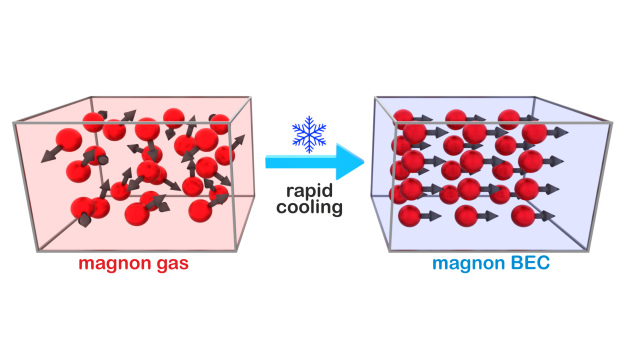
The rapid cooling of magnon particles proves to be an surprisingly effective method to generate a elusive quantum state of matter, a so-called Bose-Einstein condensate. This insight can help advance quantum physics research and is also a step toward the long-term goal of room-temperature quantum computing.
An international team of scientists has found an uncomplicated approach to induce an extraordinary state of matter, a so-called Bose-Einstein condensate. The new method, recently described in the journal Nature Nanotechnology, aims to promote research and development of room-temperature quantum computing.
The team, led by physicists from the Technical University of Kaiserslautern (TUK) in Germany and the University of Vienna in Austria, produced the Bose-Einstein condensate (BEC) through a sudden temperature change. The quasi-particles are initially slowly heated and then quickly cooled back to room temperature. They demonstrated the method using quasi-particles called magnons, which represent quantum magnetic excitations of a solid.
“Many researchers investigate different types of Bose-Einstein condensates,” explains Professor Burkard Hillebrands from TUK, one of the leading researchers in the field of BEC. “The new approach we developed should work for many systems.”
Mysterious and spontaneous
Bose-Einstein condensates, named after Albert Einstein and Satyendra Nath Bose, who first hypothesized their existence, are a mysterious kind of matter. They consist of particles that spontaneously behave identically at the quantum level and essentially become a single entity. Originally used to describe ideal gas particles, Bose-Einstein condensates have been formed with atoms as well as quasi-particles such as bosons, phonons, and magnons.
The creation of Bose-Einstein condensates is a tricky task because they must form spontaneously by definition. Creating the conditions for the condensates means not inducing any order or coherence that encourages particles to behave similarly; the particles must do this independently.
Currently, Bose-Einstein condensates are produced by lowering the temperature close to absolute zero or by injecting a large number of particles at room temperature into a small volume. The room-temperature method, first reported by Hillebrands and his team in 2005, is technically complex, and only a few research teams worldwide possess the necessary equipment and expertise.
The new method, however, is much simpler. It requires a heat source and a tiny magnetic nanostructure, which is a hundred times smaller than the thickness of a human hair.
“Our recent advances in miniaturizing magnonic structures to the nanoscale allowed us to view the BEC from a completely different perspective,” explains Professor Andrii Chumak from the University of Vienna.
The nanostructure is slowly heated to 200°C to generate phonons, which in turn generate magnons at the same temperature. The heat source is then turned off, and the nanostructure cools rapidly within about one nanosecond to room temperature. During this process, phonons escape to the substrate, but the magnons are too slow to react and remain within the magnetic nanostructure.
Michael Schneider, the lead author and doctoral student in the magnetism research group at TUK, explained the reasons: “When the phonons escape, the magnons want to reduce their energy to stay in balance. Since they cannot decrease the number of particles, they must reduce their energy in another way. Therefore, they all fall into the same low energy level.”
By spontaneously all occupying the same energy level, the magnons form a Bose-Einstein condensate.
“We never forced coherence in the system,” explains Andrii Chumak, “so this is a very pure and clear way to produce Bose-Einstein condensates.”
Unexpected results
As is often the case in science, the team made this observation entirely by chance. They initially wanted to investigate a different aspect of nanoswitches when strange things happened.
“At first, we thought there was really something wrong with our experiment or data analysis,” explains Michael Schneider.
After discussing the project with partners at TUK and in the USA, some experimental parameters were optimized to determine whether the unusual phenomenon was indeed a Bose-Einstein condensate. This verification was carried out using spectroscopic techniques.
The results will primarily interest other physicists studying this state of matter. “However, publishing information about magnons and their behavior in a kind of macroscopic quantum state at room temperature could influence the development of computers that use magnons as data carriers,” says Burkard Hillebrands.
Andrii Chumak emphasized the importance of collaboration within the Landesforschungsinitiative OPTIMAS of TUK and the Sonderforschungsbereich “Spin+X” together with the University of Mainz to solve the puzzle. Combining his team’s expertise in magnonic nanostructures with Hillebrands’ expertise in magnon Bose-Einstein condensates was essential. Their research was significantly supported by two grants from the European Research Council (ERC).
Original publication:
M. Schneider, et al., Bose-Einstein Condensation of Quasi-Particles by Rapid Cooling, Nature Nanotechnology, DOI: 10.1038/s41565-020-0671-z, (2020).
Scientific contact:
Univ.-Prof. Dr. Andrii Chumak
Nanomagnetism and Magnonics, Faculty of Physics, University of Vienna
Boltzmanngasse 5, 1090 Vienna
Email: andrii.chumak@univie.ac.at
Phone: +43-1-4277-73910
Mobile: +43-664-60277-73910
Website: https://nanomag.univie.ac.at/
Prof. Dr. Burkard Hillebrands
Magnetism Working Group, Department of Physics, Technical University of Kaiserslautern
Erwin-Schrödinger 56, 67663 Kaiserslautern
Email: hilleb@physik.uni-kl.de
Phone: +49 631 205-4228
Website: https://www.physik.uni-kl.de/hillebrands/home/
Technische Universität Kaiserslautern
67663 Kaiserslautern
Germany