




- Translated with AI
Radial fans for HVAC units are usually the better choice
Overall Application in Focus
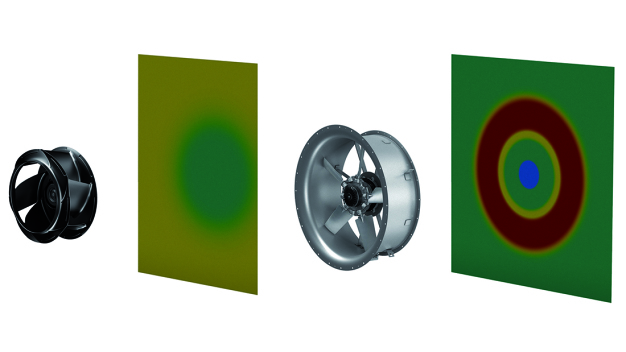
Radial fans (left image) provide a more uniform distribution of the downstream components (filters, heat exchangers) than axial fans (right image). The color here indicates the axial velocity. (Image: ebm-papst)
With fans, it is not easy to decide which one truly has the best efficiency and operates with maximum energy efficiency. The complex flow machines respond to every change in installation situation, speed variations, or altered pressure conditions. For HVAC units, radial fans are still the better choice. But why?
The energetic efficiency describes, by definition, the ratio of usable to input energy. Simply multiplying the individual efficiencies of the various fan components at the optimal point is often practiced. However, it is not to be expected that all components operate at their efficiency optimum when assembled. For realistic information on efficiency, the fan unit as a whole must be measured. Instead of efficiency percentages, the comparison should therefore be based on the expected power consumption for a defined air conveying task.
Axial fans are efficient at low counter-pressure
In principle, radial and axial fans can be used in ventilation systems (HVAC units). Axial fans are most efficient when they convey air into the open at low counter-pressure, with the flow parallel to the axis. The flow behavior of an axial fan is very focused, which is disadvantageous when downstream filters or heat exchangers are subjected to the flow.
Radial fans: the better choice for HVAC
In radial fans, the air predominantly flows outward in a radial pattern from the center. Radial impellers are inherently less sensitive to influences on the inlet and outlet sides than axial fans. Since radial fans exert pressure on a pressure chamber (pressure plenum) with air, connection to a duct network in all directions is possible with minimal losses. The specially designed RadiPac radial fans from ebm-papst, intended for use in HVAC systems, have not only optimized impeller, motor, control electronics, and housing for energy efficiency and noise emission but also taken into account the actual installation situation in HVAC units. As a result, no large margins need to be added for installation losses when selecting the fan.
Interaction in the installed state is decisive
When considering the interaction with the environment of the fan in the installed state, axial fans perform significantly worse than radial fans. Measurements by ebm-papst have shown that even the best axial fans available on the market do not achieve the overall efficiencies, i.e., the efficiency, of radial fans. Also unattainable for axial fans are the low noise levels, even with pressure-side mounted silencers.
ebm‑papst Mulfingen GmbH & Co. KGaA & Co. KG
74673 Mulfingen
Germany