




- Refrigeration
- Translated with AI
R469A tested for Danfoss valves
Hearing test passed
(Source: Weiss Technik GmbH)
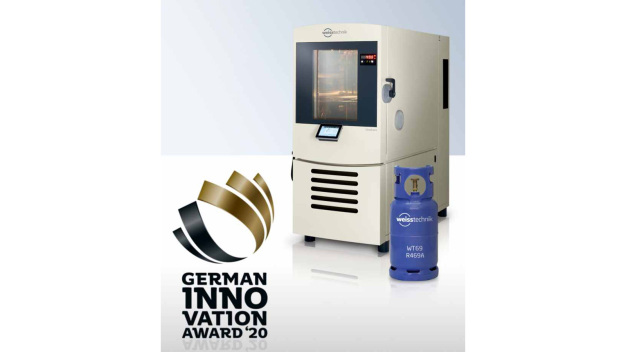
Weisstechnik tested Danfoss expansion valves for compatibility with the low-temperature refrigerant R469A. The results were so convincing that Danfoss has incorporated R469A into its calculation software for refrigeration systems. At the same time, Weisstechnik can now access a thoroughly tested class of valves for its systems.
Weisstechnik successfully tested the electrically controlled AVK expansion valves from Danfoss for use in environmental simulation chambers. Weisstechnik tested the durability of the valves under continuous load as well as their stability when operating with R469A. This is a refrigerant developed by Weiss as a replacement for R23 for very low temperatures. This product introduction was necessary because R23 no longer meets EU regulations on greenhouse gases.
The test results were convincing: On Weisstechnik's test benches, the Danfoss valves operated flawlessly until the end of testing. They also worked trouble-free with R469A. These results were so impressive for Danfoss that the manufacturer has included R469A in its calculation program for the design of refrigeration systems.
Valves from Danfoss with R469A successfully tested
Weisstechnik conducted an intensive investigation of the AVK expansion valves from Danfoss because its experts saw potential for improvement in climate and temperature test chambers. Notably, Danfoss claims a long service life of 50 million switching cycles. At the same time, these electronic valves enable quick and precise temperature changes. The control is achieved through pulse width modulation, meaning rapid sequences of different opening pulses. This allows the valve to respond quickly to changes in flow rate. Ultimately, this valve automatically closes in a power-off state. A separate shut-off valve for safety shutdowns is therefore unnecessary.
On paper, the AVK valves have all the prerequisites to regulate the flow of refrigerants in climate chambers. But would they prove themselves in practice? That’s what Weisstechnik aimed to demonstrate on test benches. First, Weisstechnik conducted some field tests. For this purpose, powerful devices with cooling speeds of up to 25 K/min were selected. No valve-related failures occurred after extended operation.
Following the successful field tests, Weisstechnik's technicians conducted intensive tests on test benches. They mainly examined whether the AVK expansion valves would meet the requirements for operation in Weisstechnik's climate chambers. The key requirements were:
- - Controllability with an accuracy of < ± 0.1 K
- Fast regulation after temperature changes
- Ability to handle temperature ramps, jumps, and constant temperatures within tight tolerances
- High number of switching cycles: after an initial 12 million cycles without defects, 120 million cycles were subsequently tested
The tests were carried out in systems of various sizes, from small devices with 100 liters volume to walk-in test chambers with 21 m³ volume. Temperatures ranged from -85 °C to +200 °C. As a result, these stresses showed no impact on the valves. They exhibited no wear and maintained all parameters throughout the entire test period. With this, the electrically controlled AVK expansion valves from Danfoss successfully passed all tests — and qualified for use in Weisstechnik's environmental simulation systems.

Weiss Klimatechnik GmbH
Geräte- und Anlagenbau
Greizer Str. 41-49
35447 Reiskirchen
Germany
Phone: +49 6408 846500
email: info@weiss-technik.com
Internet: http://weiss-klimatechnik.com