

- Translated with AI
Quantum heat engine
Kaiserslautern researchers develop high-performance miniature motor
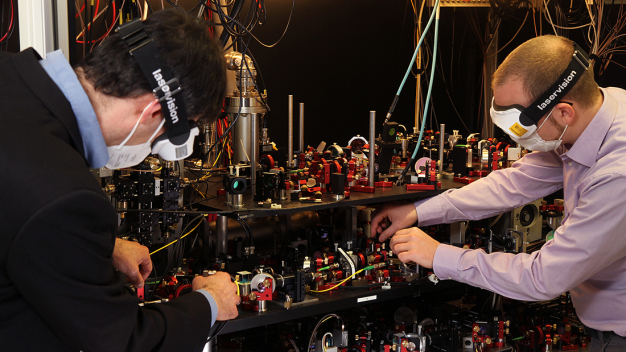
The Kaiserslautern researchers are developing a powerful miniature motor. (Photo: Thomas Koziel/TUK)
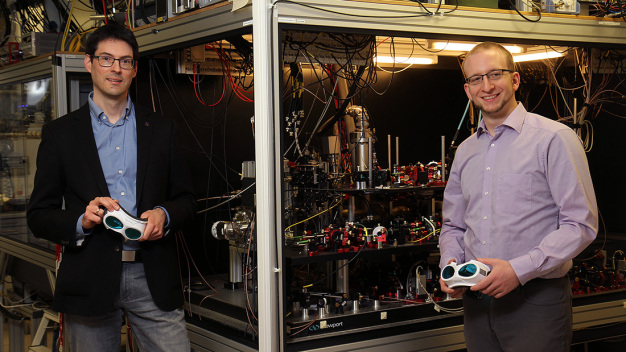
Professor Dr. Artur Widera (left) and first author of the study Jens Nettersheim. (Photo: Thomas Koziel/TUK)
Classical engines convert one form of energy, such as heat, into mechanical work. Can these laws also be applied to a miniature machine made from a single cesium atom, which could operate more efficiently? A research team from TU Kaiserslautern, led by physics professor Dr. Artur Widera, has proven this. Additionally, using a trick from the quantum toolbox, the scientists managed to operate the machine stably despite the fluctuations ubiquitous in the quantum world. The related research paper has now been published in the journal Nature Communications.
A traditionally operated engine follows the laws of thermodynamics. For example, gasoline is ignited, and heat energy is converted into kinetic energy through pistons. The research group led by Widera has transferred these fundamental principles into the quantum realm in collaboration with Prof. Dr. Eric Lutz from the University of Stuttgart, addressing fundamental questions of thermodynamics in quantum mechanics.
But how can such a quantum heat engine actually be built? For this, the researchers chose a special experimental setup: a gas of rubidium atoms, cooled to nearly absolute zero to exclude thermal fluctuations. The fuel in the system is the spin of the rubidium atoms, which is their intrinsic angular momentum. The miniature machines consist of individual cesium atoms; the necessary heat exchange occurs during collisions between cesium and rubidium atoms.
"The spin can be oriented in two directions, up or down, which in our system represent hot and cold, and thus the temperature difference," explains Jens Nettersheim, doctoral student and first author of the study. "When the so-called spin exchange collisions occur, the rotational movements of the colliding cesium and rubidium atoms flip to the other direction. At ultracold temperatures, we can control the direction of the spin change in individual collisions. The movement of the piston, which converts energy, has been replaced in the system by a changing magnetic field." Using these analogies to heat exchange and piston movement, the physicists succeeded in realizing a Carnot cycle in the quantum world.
In doing so, the research team overcame a challenge previously considered insurmountable: "The properties or states of quantum particles generally cannot be determined unambiguously," explains Widera. "That is, we can measure them, but can never predict the measurement result of a single measurement with certainty. I can only determine the probability that the observed properties will occur." These very "uncertainties" or fluctuations in measurement results have so far led science to doubt whether a quantum heat engine can deliver a constant performance with high efficiency at all. "I fundamentally want to exclude the possibility that a motor fluctuates uncontrollably between different performance levels," says Widera.
During the spin exchange collisions, these fluctuations also occurred, but the research team found: "Over time, the spin of the cesium atoms saturates," says Widera. "That is, they remain in a certain state after a while, so fluctuations become controllable. Compared to 'classical' thermal machines, the atoms reach a higher excitation state. This is precisely the key to operating a quantum heat engine efficiently. In addition to the advantage of suppressed fluctuations, these quantum machines can convert even more energy in a cycle than thermodynamics allows with hot and cold baths."
The quantum heat engine developed by the researchers runs reliably and simultaneously delivers a constant high performance with very high efficiency. With this, Widera's group has successfully brought thermodynamics into the experimental quantum realm and, together with theoretical support from Prof. Lutz, has opened the door to applications of quantum thermodynamics.
The study has been published in the renowned journal Nature Communications:
"A quantum heat engine driven by atomic collisions"
https://rdcu.be/ch9OV
https://doi.org/10.1038/s41467-021-22222
Questions answered by:
Prof. Dr. Artur Widera
Department of Individual Quantum Systems
Tel.: 0631 205-4130
E-Mail: widera(at)physik.uni-kl.de
Technische Universität Kaiserslautern
67663 Kaiserslautern
Germany