



- Translated with AI
Albert Borucki
Quantum and Space-Time Research
Per Einstein elevator into weightlessness
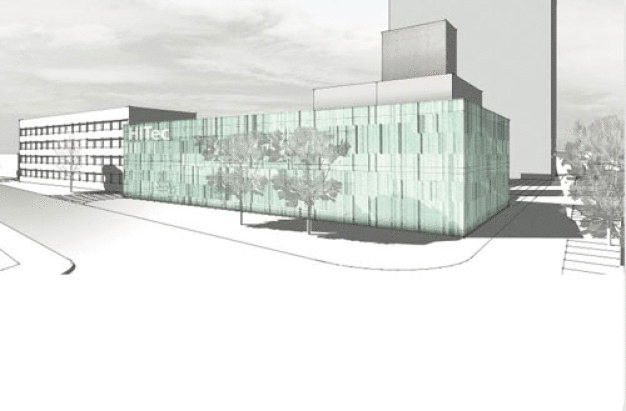
Hannover Institute of Technology - Sketch (© Jörg Stanzick)
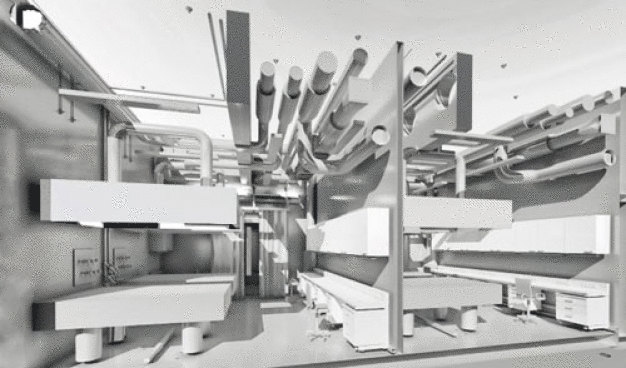
3D Section Laboratory
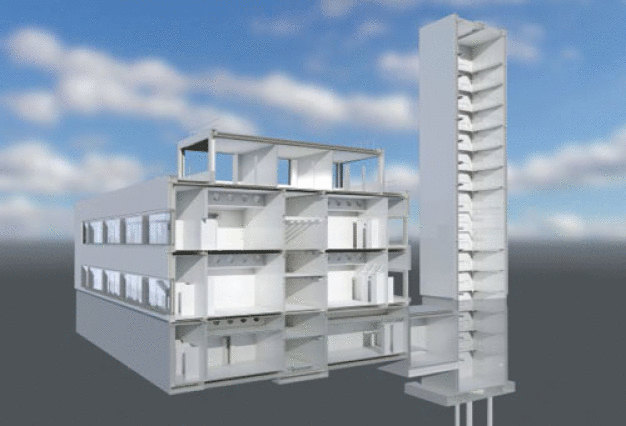
3D Cross-Section Einstein Elevator

Albert Borucki - Carpus+Partner
The pioneering HITec laboratory building at Leibniz University Hannover offers space for interdisciplinary research at the highest level. Turbulence-free cleanroom air, absolute temperature stability across multiple floors, and increased requirements for vibration-free operation – usually simultaneously – posed significant challenges for architects, cleanroom planners, and specialists in technical building equipment.
The researchers and institutes of the Excellence Cluster QUEST (Centre for Quantum Engineering and Space-Time Research) at Leibniz University Hannover are world leaders in quantum engineering and space-time research. The scientists here develop, for example, laser measurement instruments that detect length changes of a fraction of an atomic nucleus, investigate Earth's gravitational field with highly precise sensors, or verify Einstein's theory of relativity through laser measurements to the Moon.
To further improve the research conditions at the Hannover site and to establish the international top level, the state-of-the-art Hannover Institute for Technology – abbreviated HITec – is currently being built. Adjacent to the existing buildings in the university area Callinstraße/Appelstraße, it stands for a forward-looking research infrastructure that – for the first time in Europe – combines basic research, applied research, and technology development under one roof interdisciplinary. Up to 120 scientists from the fields of quantum physics, solid-state physics, geodesy, laser development, and space technology will work together here.
The new two-story, partially basemented building houses exclusively physical laboratories where optical instruments are developed, manufactured, and tested, as well as some of the most powerful research facilities in Europe and worldwide: for example, a highly specialized fiber drawing system for space equipment across three floors, an atom fountain where the trajectories of atoms are precisely measured, and – as a highlight for scientists – the Einstein Elevator, a free-fall simulator for experiments in zero gravity. This is housed in a 40-meter-high tower located next to the building.
“Hannover researchers require a particle-free cleanroom environment and the highest temperature stability for their complex optical setups and equipment. However, the necessary TGA (technical building equipment) would, due to vibrations caused by ventilation systems or pumps, influence the experiments,” explains Albert Borucki, project manager at the architecture and planning firm Carpus+Partner, responsible for HITec. “This was a major challenge in the realization.”
Even the scientific large-scale equipment, some of which must be housed in the laboratories, posed difficult tasks for the planners. For example, the twelve-meter-high draw tower for optical specialty fibers, which is used to produce laser-active fibers for space applications. Particulate inclusions must be strictly avoided, as they would adversely affect the optical properties of the fibers and render them unusable. “Therefore, the system is housed in a cleanroom of class 7 according to EN ISO14644-1, spanning three floors,” says Borucki.
Not an easy task: the air must be introduced on multiple levels into the room, because otherwise temperature fluctuations would reduce the quality of the hollow fibers. “However, high flow velocities must absolutely be avoided, as they would induce vibrations in the fibers and damage them,” adds Bernd Weiskopf, project manager at the engineering firm Wolf + Weiskopf, responsible for ventilation and cooling. “To still achieve the required air volumes, air is supplied via textile air outlets arranged in a ring around the system. The air flows through micro-perforated textile hoses and exits evenly and without drafts over the entire surface.”
To protect the laboratories from vibrations caused, for example, by ventilation and cooling systems or compressors, the planners installed them in a vibration-isolated manner at two locations: For systems that require spatial proximity to their application, HITec has a central technical backbone that runs along the entire length of the building and is easily accessible from each laboratory. These systems are mounted on elastomer bearings. Central facilities of the TGA, on the other hand, are located in the so-called technical backpack, which is fully decoupled from the laboratory part in terms of vibration technology. It also houses the freight elevator needed for transporting heavy research instruments to the measurement facilities on the building roof. This ensures that the laboratories are also protected from vibrations emitted during the raising and lowering of equipment.
Also decoupled from the main building structure is the 40-meter-high tower, which houses the free-fall simulator for fundamental research in quantum physics – called the Einstein Elevator. Unlike conventional drop towers, of which there are no more than ten of this size worldwide, it contains a gondola that can be vertically accelerated and decelerated using three electromagnetic linear drives. Thanks to this drive concept, experiments lasting several seconds under zero gravity, as well as those under gravitational forces similar to those on the Moon or Mars, can be conducted.
Although the gondola does not operate under cleanroom conditions, it can be filled with a protective gas or evacuated to create a vacuum, depending on the experiment's needs. This distinguishes the simulator from other drop towers, where the entire fall shaft must be evacuated to eliminate air resistance. Up to 100 experiments can be performed per day – a multiple of the otherwise possible number.
Two challenges arose in the planning of the tower for the Einstein Elevator: First, a constant temperature must be maintained throughout the nearly forty-meter height to prevent the highly precise guidance of the gondola from warping. Otherwise, it could block the elevator and damage the drives. There are also air supplies on multiple levels here.
“But mainly, the acceleration and deceleration processes generate impulses that would transfer as vibrations to the laboratory rooms,” explains Borucki. “Therefore, the tower and its control and experiment preparation room are completely isolated from the rest of the building by a separation joint in terms of vibration technology.” The two rooms are located, like about a third of the tower, beneath the ground surface and can be accessed via the basement of HITec.
There, as well as in the non-basemented area of the ground floor, are the cleanroom laboratories with the highest vibration decoupling. They meet the criteria according to VC-E, meaning the permissible vibration level here is only 3.1 μm/s. For comparison: the human perception threshold is around 100 μm/s. The rooms equipped with access airlocks and air showers correspond to ISO classes 5 to 7. Among other things, they produce the blanks for the fiber drawing system. Additionally, a cryo-laboratory for low-temperature experiments is available. Air supply is via laminar flow units. An important criterion in designing the laser and optical laboratories is the avoidance of daylight and protection against laser beam escape into the environment. Therefore, the architects from Carpus+Partner arranged all laboratories within the building so that they are additionally shielded from outside by a surrounding corridor. Their access airlocks can only be entered from this corridor, which completely encloses the laboratories. This corridor also serves as a buffer to maintain temperature stability in the rooms.
Access to HITec is via a bridge that connects the new laboratory building to an existing structure. There, additional research, office, and communication rooms are housed. The direct connection between the buildings with short pathways promotes interdisciplinary exchange among the research groups.
“The laboratories, testing environments, and large-scale equipment of the institute do not exist in this quality and bundling at any German or international research institutions,” says Prof. Dr. Ertmer, head of the Atomic Optics and Quantum Sensors division at the Institute for Quantum Optics and Vice President of the German Research Foundation (DFG). “With this new research building, we are making a significant step forward in our efforts to establish not only Leibniz University but also the entire research location Hannover in the fields of quantum physics, optical technologies, and geodesy at an international top level,” adds Prof. Dr.-Ing. Erich Barke, President of Leibniz University.
Other involved specialist planners:
- EHS consulting engineers for construction GmbH
- Engineering firm Wolf + Weiskopf GmbH
- IKL + Partner Engineering Company mbH
- Raible + Partner GmbH & Co. KG
- m+p consulting Nord GmbH / IKM Engineering Office / Möller + Partner PartG
Carpus+Partner AG
52074 Aachen
Germany