


- Translated with AI
Quality testing and material development
Fraunhofer IMWS supports in the fight against the Corona pandemic
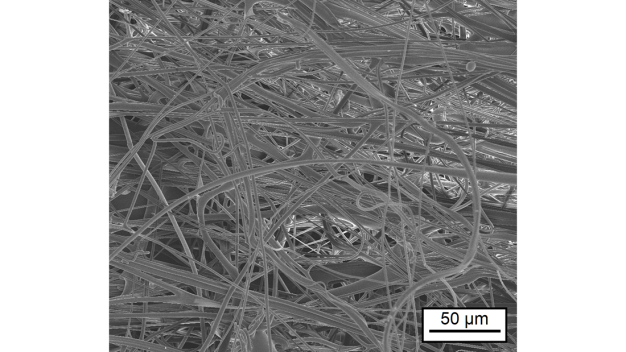
The microstructure of protective masks (here the scanning electron microscope image of the middle layer of a surgical mask with a schematic representation of a coronavirus) plays an important role in comfort and filtration effectiveness. © Fraunhofer IMWS
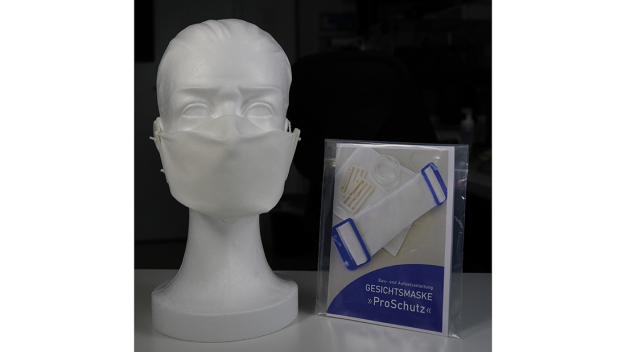
Change carriers for breathing masks were produced by Fraunhofer IMWS in the project "ProSchutz". © Fraunhofer IMWS
The Fraunhofer Institute for Microstructure of Materials and Systems IMWS supports the fight against the COVID-19 pandemic with its material expertise. The institute is currently working together with nine other Fraunhofer institutes across Germany to develop innovative protective textiles. This involves pursuing new approaches to protective effectiveness while simultaneously optimizing wearer comfort. As early as spring, the research facility supported clinics and the crisis management team of the city of Halle (Saale).
"It is a pressing concern for us to contribute to overcoming the COVID-19 pandemic with our competencies and capacities. Since the emergence of the first coronavirus cases, we have been supporting the development of suitable protective materials to help especially vulnerable people and thus reduce the impact of the crisis," says Prof. Matthias Petzold, acting head of Fraunhofer IMWS.
The institute, specialized in materials research with around 300 employees, is involved in various projects and solutions. During the first wave of infections in spring, researchers from Fraunhofer IMWS examined various fabric masks produced as semi-professional mouth-nose protection in local textile factories for the crisis management team of the city of Halle (Saale). The institute also developed and produced changeable carriers for respiratory masks, which are distributed through a partner. These plastic changeable carriers can hold fabrics with different filtration effects, which can also be reused. Together with the University Hospital Halle and the Merseburg University of Applied Sciences, experts from Fraunhofer IMWS investigated how protective equipment for medical personnel, such as splash protection masks, can be manufactured via 3D printing.
Close collaboration with St. Elisabeth and St. Barbara hospitals in Halle was particularly important to determine actual needs in the clinics and to test innovative approaches in practice. "Especially during the initial acute phase of the pandemic, when there was a shortage or imminent shortage of protective gear such as surgical masks or disposable gowns, we spontaneously developed many good ideas and implemented them flexibly. Many of these approaches have also led to promising further developments that we now want to pursue together," says Dr. Sven Seeger, chief physician of the Department of Obstetrics at the hospital.
Intensive discussions within this collaboration and with other partners made it clear that for the infection protection of medical personnel and vulnerable individuals during the pandemic, optimized protective gear is needed that offers both high wearing comfort (low breathing resistance, long usage times) and high barrier effectiveness against pathogens. Fraunhofer IMWS aims to address this need in a project launched in November together with other Fraunhofer institutes, in which new antiviral protective textiles are being developed and evaluated.
"We want to lay the groundwork for better solutions, especially to protect currently highly exposed professional and risk groups, but also for possible future pandemic situations. We are particularly contributing our expertise in material evaluation," says Dr. Christian Schmelzer, head of the "Biological and Macromolecular Materials" division at Fraunhofer IMWS. "In a very short time, we have built up many additional competencies for new material diagnostic questions and also found that the established testing procedures are not always suitable for the rapid, function- and application-oriented characterization of material and functional properties during a pandemic. In addition to developing improved materials, we are therefore also working on new methods." These include, for example, the evaluation of sterilization procedures, new methods for material modification using coatings, or the use of laser scattering measurement, acoustic microscopy, and 3D fluorescence microscopy to assess optimal function as well as safety and health requirements for protective textiles.
Within the "Fraunhofer vs. Corona" program, numerous other Fraunhofer institutes across Germany are also developing aid measures to combat the pandemic using their technological expertise, alongside Fraunhofer IMWS.
Fraunhofer Institut für Mikrostruktur von Werkstoffen und Systemen IMWS
06120 Halle
Germany