




- Translated with AI
Qualify lightweight construction through computed tomography
Make fibers, bubbles, and density visible through X-ray radiation
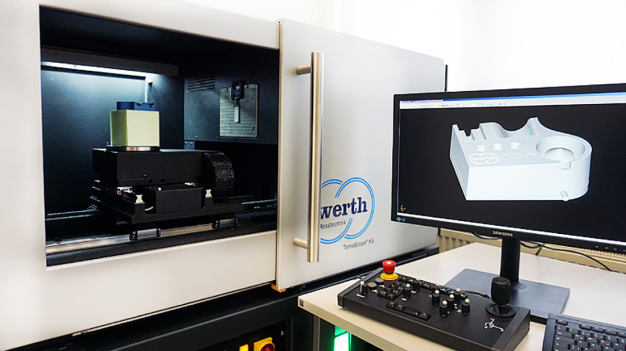
Fig. 1: The KUZ has the Computed Tomography (CT) Werth TomoScope® XS available.
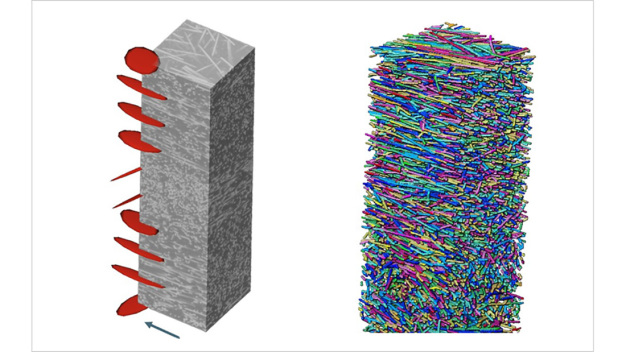
Fig. 2: CT scan of a PP long-fiber composite. The red ellipses indicate the fiber orientation distribution. The wall thickness of the sample was divided into 10 layers from 2 mm. The blue arrow points in the flow direction during injection molding. / Fig. 3: From the CT scan of the PP long-fiber sample, the fibers are selected here. This allows, among other things, the determination of the local fiber volume fraction.
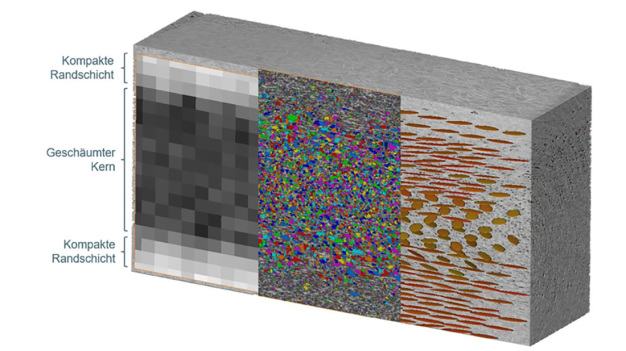
Fig. 4: In this longitudinal section through a PA6GF30 sample, the density distribution, bubble structure, and fiber orientation are shown (from left to right).
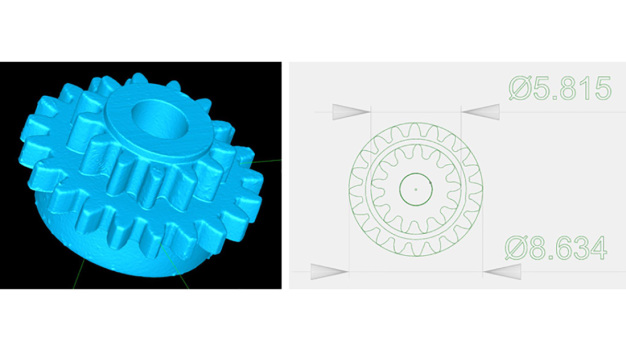
Fig. 5: left: point cloud (STL file); right: precise measurement (deviation approx. 3 µm)
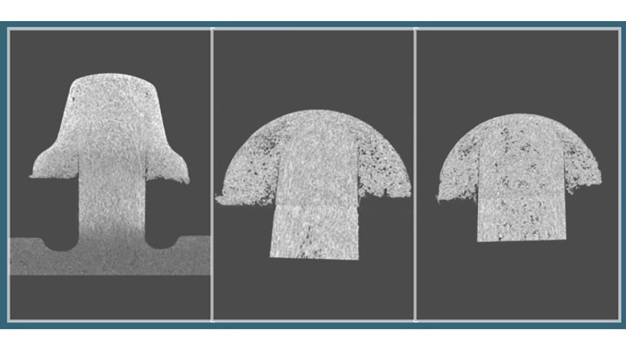
Fig. 6: Rivet connections with different rivet head shapes. Porosity in the rivet head (left). Binding seams in the contact area between the rivet head and the pin (middle and right).
Plastics are predestined materials for lightweight construction applications. To optimally utilize the lightweight effect of the material, their potentials must be purposefully harnessed.
The mechanical properties are direction-dependent. Foremost among these is fiber orientation. In thermoplastic foam injection molding (TSG), local differences such as density and bubble geometry are also important for the mechanical behavior of the part. When these factors are considered, very lightweight and stiff components can be produced. To better understand the influences and correlations in the TSG process, the Plastics Center in Leipzig (KUZ) investigates the parts using computed tomography (CT). This allows for detailed imaging and analysis of fibers, bubbles, and density distribution within the parts.
Tracking the fibers
Using a high-performance CT (TomoScope® XS by Werth) and state-of-the-art analysis software (Avizo by FEI), CT scans with a resolution of 2 µm can be segmented and measured into the components of the scanned parts. This enables, for example, the determination of fiber orientation and their volume fraction. Figure 2 shows a scan of a polypropylene long-fiber sample. The fibers are visible in light gray tones, while the polypropylene matrix appears in dark gray tones.
The sample was divided into 10 equal-thickness layers over a wall thickness of 2 mm. In each layer, fiber orientation was determined with Avizo and represented by a red ellipsoid. The longest axis of the ellipsoid indicates the average fiber preferred direction. The two other axes of the ellipsoid are perpendicular to this preferred direction. The more fibers are oriented in a particular direction, the longer this axis appears. If all fibers were aligned in the same direction, the ellipsoid would become a line. If the fibers are evenly distributed in all directions, the ellipsoid becomes a sphere.
The arrow in Figure 2 points in the flow direction. It can be seen that, typical for injection molding, fibers at the edge (shear zone) are predominantly oriented in the flow direction, while fibers in the center are perpendicular to it. In Figure 3, the fibers are segmented as volume. This allows for the local determination of fiber volume fraction and consideration of differences within the part.
Taking a closer look at the foam
TSG parts are characterized by compact outer layers and a foamed core. As a result, foamed parts have a high weight-specific bending stiffness. Figure 4 visualizes the three most important structural properties. It shows a longitudinal section through a polyamide 6 sample with 30% short glass fibers. The compact outer layers are visible at the top and bottom, with the foam core in between. On the left in Figure 4, the density is shown. Light gray tones indicate high density in the outer layers. Dark gray tones represent areas of lower density within the foam. In the center of Figure 4, the bubbles are segmented. The geometry of each bubble can be measured individually and further processed. Finally, on the right, the visualization of the fiber orientation distribution, as described above, is displayed.
With this information, comparisons can be made, for example, with results from injection molding simulations. Additionally, mechanical simulations with anisotropic, i.e., direction-dependent material properties, can be qualified.
Further potentials of computed tomography
Beyond that, CT can be used to investigate other important questions in plastics technology. Similar to the analysis of bubbles and fibers, functional additives such as metal particles can also be examined.
Through contactless and non-destructive testing, CT enables 3D measurement of external contours and inaccessible internal features, as well as the inspection of positions within assemblies and comparison of actual versus CAD models. Figure 5 shows a gear with the relevant sections measured.
CT also demonstrates its strengths in damage analysis. It makes it possible to detect inhomogeneities such as voids, cavities, cracks, or weld lines. With the extensive expertise at KUZ, strategies for defect correction and process improvement can be derived.
Kunststoff-Zentrum in Leipzig gGmbH
04229 Leipzig
Germany



