

- R+D & Community of Interest
- Translated with AI
Push everything in
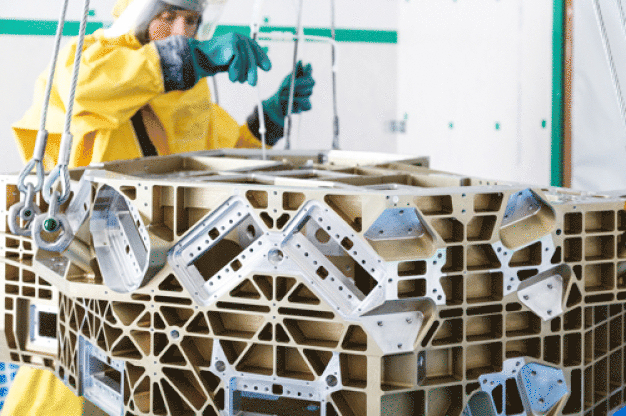
The scientists regularly prepare instruments for space missions in their cleanroom laboratories – here: pre-cleaning of a satellite component. (Source: Fraunhofer IPA, Photo: Rainer Bez)
Components used in a space mission must be meticulously cleaned. Researchers from the Fraunhofer Institute for Production Technology and Automation IPA have designed a cleanroom, in which even contaminants at the nanometer level can be removed. Together with partners, the experts clean and sterilize the ExoMars Mars rover, which is scheduled to launch in 2018.
Space missions are associated with enormous costs. Since an unmanned spacecraft, once launched, cannot be repaired, no component or device must fail – otherwise, all efforts would be in vain, and scientists would have to wait many years for a replacement mission. Therefore, no dirt must block the mechanics, cause a short circuit, or disturb the electronics. Spacecraft that are searching for traces of life on another planet must be especially meticulously clean. This is exactly the goal of the European Mars mission ExoMars, whose launch is planned for 2018. A lander will then touch down on the neighboring planet and send a rover about the size of a Smart car. To ensure that its sensors, which are searching for life, work reliably, no organic material from Earth may be introduced. This could lead to false alarms.
Sterile Components
Researchers from the Fraunhofer Institute for Production Technology and Automation IPA, commissioned by the European Space Agency ESA, ensure that all components are absolutely germ-free and that not even remnants of dead microbes stick in crevices. To reliably sterilize the Mars rover and remove contaminants at the nanometer level, the Stuttgart experts designed a cleanroom for ESA and set it up in Noordwijk, the Netherlands, at the headquarters of the European Space Research and Technology Centre (ESTEC). The approximately 70-square-meter, cleanliness-controlled area meets the highest requirements of ISO Class 1. This means that one cubic meter of air contains no more than 10 particles of 0.1 micrometers in size. For comparison: normal city air contains about 10^10 particles per cubic meter, and even more in smog.
The experts from IPA not only planned the cleanroom but also took over quality assurance, implementation, acceptance testing, and commissioning. "Basically, we created a comprehensive care package. We determined how the space is dimensioned, selected the purity and cleaning technology, the equipment and ventilation systems, the floor coatings, filtration systems, and sterilization equipment, and provided recommendations for industry partners who will build the space," says Udo Gommel, head of the Reinst and Microproduction Department at Fraunhofer IPA in Stuttgart. To maintain the highest level of cleanliness, ESA staff must pass through several airlocks and an air shower and wear high-purity suits. Inside the cleanliness areas, a slight positive pressure is maintained to prevent unfiltered air from entering. Additionally, a laminar airflow, which flows from ceiling to floor, ensures that no dust particles remain in the room. With an airflow velocity of 50 centimeters per second, the entire room air is exchanged within seconds. Particles generated, for example, when an ESA engineer rubs his gloves together, quickly disappear into the perforated floor.
Cleaning with Carbon Dioxide Snow
For sterilizing the Mars rover, a process has proven effective, which was further developed at IPA and patented. Originally, this method was used in the USA to remove paint from aircraft fuselages. A strong jet of frozen carbon dioxide crystals, about the size of rice grains, literally blasts the paint off the metal. The Stuttgart team has significantly refined this rough instrument. Instead of ice crystals, they now use carbon dioxide snow. The clever part: the jet coming out of the nozzle is accelerated with a surrounding nitrogen jet. This allows it to penetrate all crevices and remove even the smallest contaminants. When the tiny snowflakes hit the relatively warm surface, they vaporize. Their volume expands explosively by a factor of 800. The detonation pressure completely blows away any dirt. Even fingerprints can be removed this way. "The CO2 snow jet cleaning is a dry process that does not cause surfaces to swell," explains Gommel, highlighting the advantage of this method. Depending on the nature of the components, the researchers combine this process with other methods such as plasma or wipe and rinse cleaning. The cleanroom is already operational, and the experts from IPA continuously optimize and equip it with adapted cleanliness and cleaning technology, improve material flow, and advise ESA on operational costs. Besides ESA, other national facilities such as Thales Alenia Space Italy, an Italian aerospace company, also use the space for their space missions. Other space agencies like NASA also seek advice from Gommel and his team. "We are a sought-after and recognized cooperation partner for this research focus," says the engineer. The Stuttgart scientist sits on the relevant committees responsible for standardizing cleaning methods. Gommel is active both for ISO, the International Organization for Standardization, and for ECSS, the European Cooperation for Space Standardization. When it comes to the role of IPA in aerospace, Gommel often speaks of the "Hidden Champion." Because "Hidden Champion" not only stands for a secret winner but also for an unknown global market leader.

Fraunhofer-Institut für Produktionstechnik und Automatisierung IPA
Nobelstraße 12
70569 Stuttgart
Germany
Phone: +49 711 970 1667
email: joerg-dieter.walz@ipa.fraunhofer.de
Internet: http://www.ipa.fraunhofer.de