

- Systems
- Translated with AI
Purity testing via fluorescence
Accurately identify organic residues
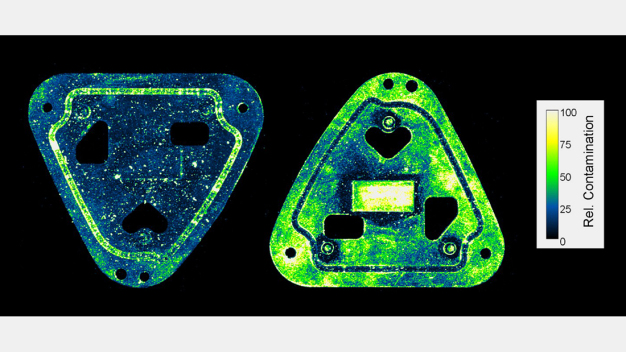
Fluorescence image of a component in false color representation - black areas are clean, white areas are heavily contaminated. © Fraunhofer IPM
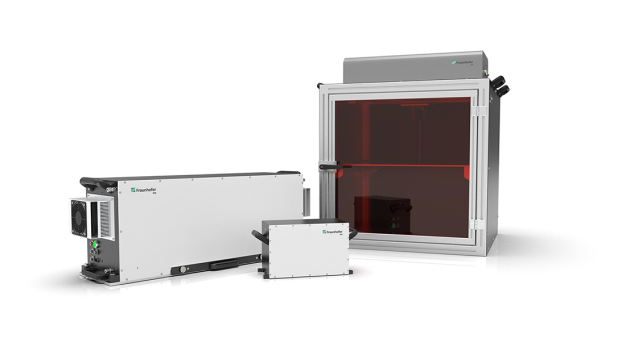
The F-Scanner family: F-Scanner 1D, F-Scanner 1Dmin, F-Scanner 2D. © Fraunhofer IPM
Many modern manufacturing processes require clean component surfaces. Fraunhofer IPM develops state-of-the-art fluorescence measurement systems such as the F-Scanner or the F-Camera, which can assess the cleanliness of entire components on the production line or in the laboratory. Current solutions are presented by Fraunhofer IPM at the parts2clean 2023 trade fair in Stuttgart. As part of two recently launched joint projects, researchers are developing additional specialized systems, for example, for controlling the application of release agents in lightweight construction.
The cleanliness of the component surface – especially with regard to organic contaminants – is crucial in many modern manufacturing processes for the quality of the finished component: This applies, for example, to bonding, sealing, and welding processes, as well as coating and vacuum processes. To monitor and document surface cleanliness, Fraunhofer IPM is developing cutting-edge fluorescence measurement systems such as the F-Scanner or the F-Camera. These systems can thoroughly check the cleanliness of surfaces – on the entire component, for each individual part. They minimize resource use and waste, reduce machine downtime, and maximize the quality and lifespan of components. Such systems pave the way for more sustainable, data-based cleaning and coating processes.
Detecting Organic Substances via Fluorescence
By combining the highly sensitive method of laser-induced fluorescence detection with the concept of laser scanning, Fraunhofer IPM has developed the F-Scanner. It can inspect nearly any part from less than one square centimeter up to several square meters in size with high resolution for cleanliness – on the production line, in the technical center, or in the laboratory. The violet or ultraviolet laser beam of the F-Scanner causes organic residues such as lubricants, corrosion protection oils, release agents, fluxes, and fingerprints to emit fluorescence light. The detection limit for most organic species is in the range of 1 to 10 milligrams per square meter, corresponding to a layer thickness of only a few nanometers.
Two Current Research Projects
Fraunhofer is currently developing new applications for purity testing together with partners in two ongoing projects. The InMoDie project focuses on purity aspects in the manufacturing of lightweight components: a team is developing inspection systems for aluminum and magnesium die casting processes, ensuring that necessary mold release agents are applied optimally during the process and that residues are detected immediately after. As part of the Qual-Clean project, Fraunhofer IPM is developing a quality assurance system that can be integrated into the cleaning process, guaranteeing and documenting targeted cleaning of critical component areas. For this, Fraunhofer IPM’s F-Scanner technology is combined with the CO2 snow jet cleaning technology from industry partner acp systems AG.
Fraunhofer-Institut für Physikalische Messtechnik IPM
79110 Freiburg
Germany