


- R+D & Community of Interest
- Translated with AI
Dr.-Ing. Udo Gommel, Dipl.-Ing. Guido Kreck
Purity Technology at Fraunhofer IPA
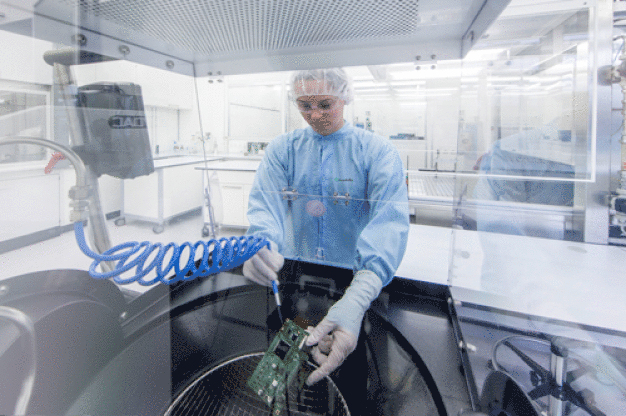
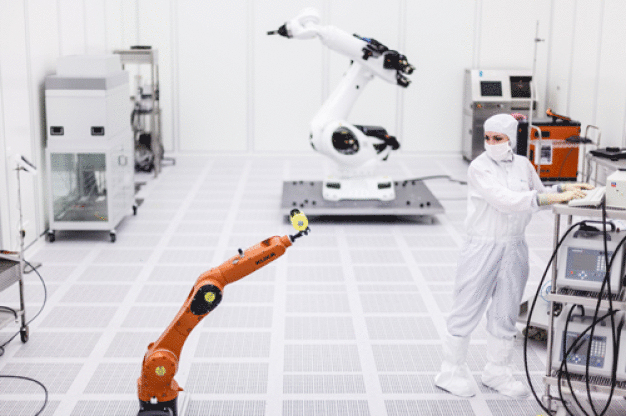
30 years ago, the Stuttgart Fraunhofer Institute for Production Technology and Automation IPA set purity technology on its agenda. Since then, its commitment in this field has steadily grown. Today, it is one of the leading institutions worldwide. It not only has the largest test cleanroom of ISO Class 1, 200 square meters large, 6.50 meters high, but also highly precise devices for validating cleanliness. This positions it excellently. "The combination of cleaning and purity testing as well as -assessment is unique," says the head of the "Reinst and Microproduction" department, Udo Gommel. The institute covers the entire spectrum of purity technology, from purity concepts for manufacturing facilities and clean production environments to their implementation. It cleans individual components or even entire satellites using different techniques, traditionally with ultrasound or ionized gas, wet or dry, or with self-developed, unique CO2 cleaning processes. Training and certification are also part of its services.
"Fraunhofer TESTED DEVICE"
The IPA even has its own quality seal. The logo "Fraunhofer TESTED DEVICE" is known and protected worldwide. Customers can have individual parts or entire machines, from cables to robots, tested and certified for their suitability for cleanrooms. Depending on the issue, criteria such as particle emission or outgassing, chemical resistance, or cleanability are considered. The customer receives, in addition to the certificate, a detailed test report. The IPA has examined more than 1,700 products from numerous industries, from electronics to food technology. At least 100 new products are added each year.
Manufacturing under Cleanroom Conditions
When the institute entered purity technology three decades ago, semiconductor manufacturing was the focus. Over time, other industries have joined, from automotive production to medical technology. For an internationally active auto supplier that must produce its electronic components under cleanroom conditions, the IPA developed a purity concept. The rejection rate then decreased by 55 percent, which, given the high volume, resulted in cost savings of around one million euros per year.
CO2 Cleaning Processes
It was by chance that the IPA has been involved in space since 1999. The European Space Agency ESA inquired whether the Stuttgart experts could sterilize components of a Mars probe. Since traditional sterilization methods leave behind dead microorganisms, but the thorough CO2 cleaning at the IPA even completely removes microorganisms from surfaces, the department was awarded the contract. Since then, the space division has significantly advanced its research, as the requirements here are particularly strict. Currently, nearly two dozen projects with different focuses are underway. Highlights include "ExoMars" by the European Space Agency ESA and the "EnMap" satellite mission. With a reliable industry partner, a strategic partnership for the coming years is even planned.
The institute has cleaned almost all 13,000 parts of the Earth observation satellite "EnMap." The Mars project was even more demanding because it involves searching for traces of life on the neighboring planet. Therefore, no organic substances from Earth may be carried along, which further increases the purity requirements. A very gentle cleaning process developed in Stuttgart has proven effective: the CO₂ snow jet process. Originally used in the USA to remove paint from aircraft fuselages, the IPA experts refined it by replacing hard CO₂ pellets with smaller, softer snow crystals. Contaminants are dislodged by the temperature shock, dissolve, and can be vacuumed away. To increase effectiveness, surrounding nitrogen accelerates the jet to supersonic speeds. Another innovation is the use of supercritical carbon dioxide. In closed cavities, hoses can be flushed with it by applying a pressure of 70 bar, allowing it to penetrate deeply.
The Fraunhofer IPA not only cleans and monitors success but also properly packages the cleaned components so they do not become contaminated again through abrasion or outgassing of the packaging material. Gommel describes this as a "comprehensive care package." Especially in spaceflight, such elaborate packaging is mandatory, whether with stainless steel or aluminum-coated foil. This is because components often need to be stored for years before assembly and launch.
Cleanliness Standards and Guidelines
Another area of work is assisting in the development of standards and guidelines. Many committees at home and abroad that deal with cleanliness are supported by IPA staff, regardless of whether it concerns the design of a cleanroom or the classification of surface cleanliness. Sometimes, the IPA even forms consortia of industry and research partners to translate requirements from the production environment into national and international regulations.
One of the newer initiatives concerns consumables used in cleanrooms, such as coveralls, gloves, or wipes. Although these disposable items can cause contamination through abrasion or outgassing, reliable regulations on their specifications are currently lacking. The industry alliance "Cleanroom Suitable Consumables" aims to change that. Another industry alliance started in 2015 deals with medical products such as implants and surgical instruments. Through uniform and sensible specifications discussed within the "MediClean" alliance with affected medical technology companies, safety can be ensured both for the companies, which are liable for the safety of their products, and for patients.
Training
Finally, the Fraunhofer IPA shares its expertise through training sessions. Since 2005, around 2,500 people have been introduced to cleanliness techniques, partly at the Stuttgart institute premises, partly through on-site training at respective companies. Since 2011, successful graduates receive a QMC certificate (Quality Management Center), awarded by the VDA.
IPA expert Gommel is convinced: "Miniaturization is making cleanroom technology increasingly important and is leading to ever higher requirements." "We see no end to this development." The challenges associated with Industry 4.0 cannot be tackled without the help of the "cleaners."

Fraunhofer-Institut für Produktionstechnik und Automatisierung IPA
Nobelstraße 12
70569 Stuttgart
Germany
Phone: +49 711 970 1667
email: joerg-dieter.walz@ipa.fraunhofer.de
Internet: http://www.ipa.fraunhofer.de