


- Cleanroom
- Translated with AI
Purity Law for the Analytical Laboratory
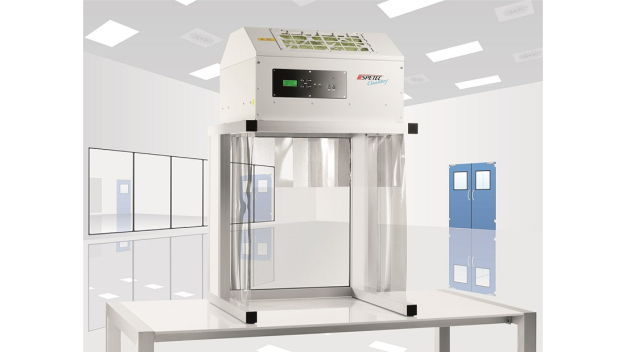
The requirements for cleanliness or purity of laboratory environments have increased significantly, especially in analytical laboratories and research. Particulate-free conditions are often a must here, becoming even more important as the sensitivity of instrumental analysis systems improves, so that not only the analysis system but also the purity of the chemicals and tools used can become limiting factors. It is often forgotten that humans and the laboratory environment itself can contaminate the sample and thus influence the analysis result. Humans can be easily trained, workflows optimized, and the laboratory environment can be adapted to new challenges with minimal effort, for example by using laminar flow cabinets or, in extreme cases, by installing or converting cleanrooms. In a study with a device manufacturer, Spetec examined what blank values can be expected in a normal laboratory, in a laminar flow cabinet, and in a cleanroom.
In this experiment, sample analyses were stored in PFA vessels for 12 hours in a cleanroom, in a standard analysis laboratory openly, and in the same room in a laminar flow cabinet [10 mL, 1% v/v HNO3]. A modern ICP-MS device (Plasma Quant MS Elite S; Analytik Jena, Jena, Germany) was used for analyzing these samples. The measured and calculated detection limits are in ng L-1 for a total of 18 elements, and it was shown that detection limits can be significantly reduced compared to a "standard" laboratory when samples are stored in a cleanroom or in a flow box and protected from particles in the ambient air. The differences between storing standards and blank solutions in a cleanroom and using a flow box in a "standard" laboratory are rather marginal. Only with a sufficiently clean laboratory environment can the ultimate detection limits, enabled by the modern ICP-MS technology used here and reaching down to the low pg L-1 range, be truly exploited in routine analysis, thus fulfilling the purity requirements for ultra-trace analysis. The module size of the flow box or the cleanroom size can be adapted to the respective sample throughput or the available space in the laboratory. Precisely for such applications, Spetec GmbH has developed its Laminar Flow Box FBS, which creates cleanroom conditions exactly where they are actually needed. The Spetec® Flow Box FBS uses H14 type filters to remove at least 99.995% of all particles from the air (size 0.12 μm, MPPS), thereby improving the air quality in the airflow used by at least 10,000 times compared to ambient air. ISO Class 5 without elaborate construction measures.
The purity of chemicals, laboratory tools and vessels, the laboratory environment, and the use of modern, highly sensitive multi-element methods are fundamental prerequisites for high-performance ultra-trace analysis.

Spetec Gesellschaft für Labor- und Reinraumtechnik mbH
Am Kletthamer Feld 15
85435 Erding
Germany
Phone: +49 8122 959090
Fax: +49 8122 9590955
email: info@spetec.de
Internet: https://www.spetec.de