




- R+D & Community of Interest
- Translated with AI
Pure laser research
When building the world's strongest laser, the highest level of cleanliness is mandatory
(Source: Fraunhofer IPA; Photo: Martin Salajka)
(Source: Fraunhofer IPA; Photo: Martin Salajka)

(Source: Fraunhofer IPA)
(Source: Fraunhofer IPA)
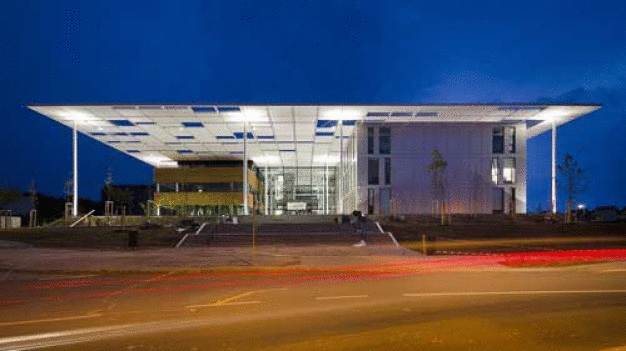
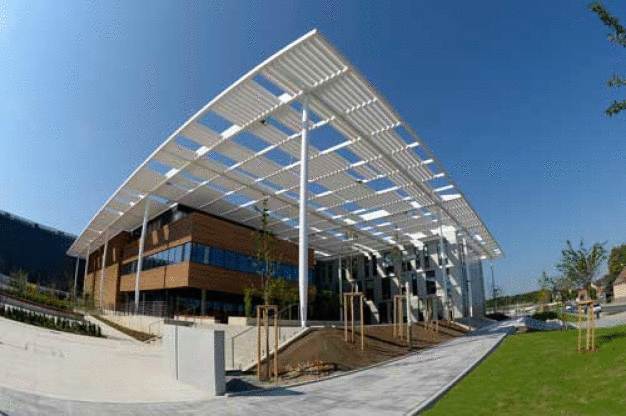
Near the Czech capital Prague, the world's strongest laser center is currently being built with EU funds: "Extreme Light Infrastructure" (ELI). It is expected to be available to scientists from around the world in a few years for fundamental research.
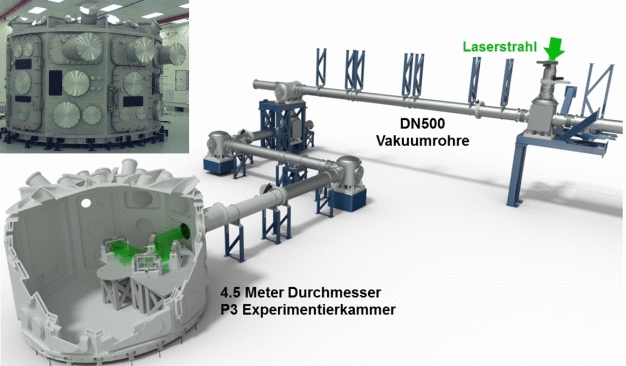
What CERN means for particle physicists, ELI aims to become for laser research. Even the construction of the facility, which will cost several hundred million euros, presents experts with challenges previously unknown. The problem: The apparatus, the size of a football field, reacts very sensitively to contaminants. The high-energy laser beams, which travel through an ultra-high vacuum, would burn particles and gases into the walls or sinter them, transforming them into substances that deposit like a coating. The deflection mirrors would become blind, and the entire facility would become unusable. Cleanliness is therefore of the utmost importance. The requirements are strict: Only 100 nanograms of organic dirt per square meter may adhere to the interior surfaces—that's just a few molecular layers. Complicating matters, dozens of different companies from across Europe supply the individual components, from flooring to rust protection, from steel supports to insulation materials. All must meticulously adhere to the specified purity standards. "That is a huge effort," says Markus Keller, an expert in cleanliness at Fraunhofer IPA.
Fraunhofer IPA supports
Many companies have now turned to IPA—and the number is increasing. Because the Stuttgart institute not only has the world's largest cleanroom of the ISO 1 class of air cleanliness, but its experts also possess the necessary know-how in all questions of purity. And for this project, led by Keller, all facets are required, from cleaning to validation, from sterile packaging to training. It concerns both organic contaminants and particles. And it is about ensuring that no materials outgas, like plastics in a new car. The approach is accordingly versatile. Some parts, such as a vacuum valve weighing half a ton, are cleaned in Stuttgart, carefully packed, and shipped. The Swabian cleanliness experts use a special foil for packaging, produced specifically for the IPA in a cleanroom by the manufacturer. For other components, transportation would be too complicated. For example, more than 100 stainless steel pipes are needed, each 6 meters long and 40 centimeters in diameter. These pipes will later carry the laser beams through the ultra-high vacuum. They can only be connected on-site, requiring a provisional cleanroom. This means: wall coatings, flooring, rust protection—all in this environment must not outgas. The IPA searches for optimal building materials through laboratory tests. The differences are significant: a typical industrial floor emits about 10,000 times more gas than a cleanroom floor.
Analyses from Stuttgart
The greatest challenge, however, is the interior spaces—the pipes and distribution chambers through which the laser beams will later pass. They must meet the highest standards. This means: the manufacturer must clean them, hermetically pack them, and assemble them cleanly in Czechia. Without inspection, this is impossible. Cleaning is done with a solvent mixture that sprays the parts. Then comes the IPA—and a continuous transport back and forth across Europe. The institute first sends extremely clean containers to the manufacturing company, which fills them with samples of their rinsing fluid. They are then returned to Stuttgart for analysis. Here, Keller and his team filter the liquids and count the particles afterward. This allows him not only to determine whether the particle count meets the standards but also to optimize the cleaning process. Because the analyses show how cleanliness improves during cleaning and how long rinsing must last.
In addition to particles, organic substances can also adhere to the walls, such as fingerprints. Further inspections are necessary for this. The IPA also has the necessary high-purity equipment: for small surfaces, SWABs are used, a type of high-end cotton swab; for larger surfaces, WIPEs, high-purity cloths. The small containers in which the cloths are shipped may not look like high-tech products, but they involve a lot of know-how and years of work. Because contaminants could lurk everywhere, potentially contaminating the cloth or container. The IPA has even conducted transport tests, sending containers across land in all weather conditions to exclude changes during transit. The procedure is similar to that for particles: an employee of the manufacturing company opens the transport container, takes out the wiping medium, wipes over a specified area, and quickly packs everything back into the container, which also contains a solvent. The Stuttgart team is again responsible for analysis. They allow a certain amount of the solvent to dry and then determine the level of organic contamination. "We can even measure a molecular layer," Keller says.
Post-cleaning is not possible
One of the tasks of the IPA experts is also to train the employees of the involved companies. Because hardly anyone knows how to behave to avoid contamination—especially since there is no specialized degree for this field. And the superlaser does not forgive mistakes. In any case, everyone involved in this project is venturing into new territory. The project leaders from ELI Beamlines fear nothing more than a blackout during startup. Two scenarios are possible: the necessary vacuum might not be achieved because materials outgas, or the deflection mirrors could suddenly fog up. Post-cleaning is not possible. Once the apparatus is in place, it remains hermetically sealed.
Contact:
Dr.-Ing. Markus Keller
Phone +49 711 970-1560
markus.keller@ipa.fraunhofer.de

Fraunhofer-Institut für Produktionstechnik und Automatisierung IPA
Nobelstraße 12
70569 Stuttgart
Germany
Phone: +49 711 970 1667
email: joerg-dieter.walz@ipa.fraunhofer.de
Internet: http://www.ipa.fraunhofer.de



