


- R+D & Community of Interest
- Translated with AI
Pure Industry 4.0: Melodious Future Music
The Fraunhofer Institute IPA advances digitalization in the cleanroom
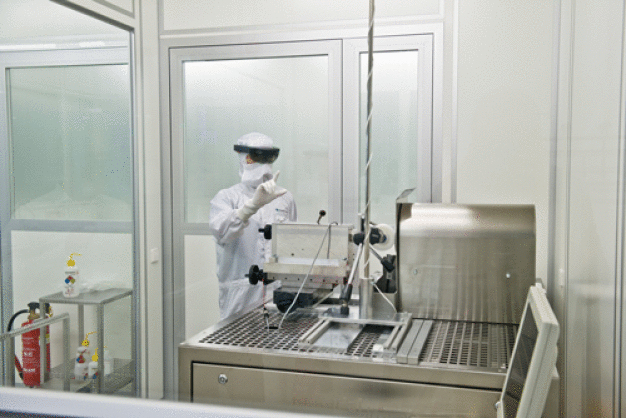
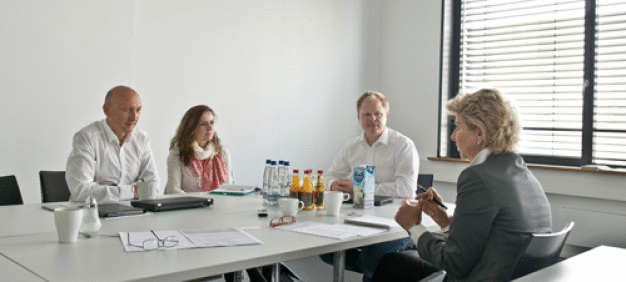
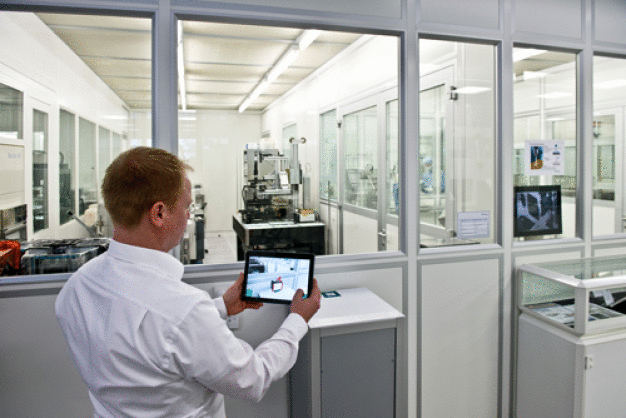
At the 2nd Industry 4.0 Live Summit in July 2017, the Fraunhofer Institute for Production Technology and Automation IPA presented a series of applied solutions for the digitalization of production. Some of the showcased use cases relate very specifically to the cleanroom environment. This prompted the editors of cleanroom online to follow up with individual interviews and to take a closer look at the topic and its applications.
Industry 4.0, Digitalization, Digital Transformation, Internet of Things, Smart Products, Smart Services, IoT, Virtual Production – there is certainly no shortage of buzzwords for the latest developments in the world of manufacturing. However, with the variety of terms, one might wonder: do all those who use these beautiful words actually know what they mean? There is reason to doubt this, as even among professionals and recognized experts, there are significant differences in opinion and conceptual divergences.
And after the Fraunhofer IPA has introduced terms like Pure Industry 4.0, Cleanroom-Compatible Production, and Purity-Specific Automation Systems into the scene, we wanted to ask the Stuttgart-based scientists what they specifically understand by these. As Dr. Udo Gommel, head of the Reinst- and Microproduction department, explained, this cannot simply be explained in two sentences. The responsible project manager, Dr. Tim Giesen, also sees the variety of terms more as a source of confusion than as a helpful differentiation.
Terminology Confusion – an Attempt at Clarification
So, we first attempt a clarification of the terms, without claiming completeness or absolute validity, of course. As mentioned, everyone in this field interprets these terms differently, and new buzzwords are emerging daily.
Industry 4.0, often abbreviated as I4.0, is currently extremely trendy. The term is not only very broad but has also become somewhat overused and is increasingly used as a buzzword to describe the trend towards the digitalization of manufacturing processes and to paint a picture of the factory of the future. However, what exactly is meant by this often remains unclear. As a concept, Industry 4.0 stands for the fourth industrial revolution, following mechanization (Industry 1.0), mass production (Industry 2.0), and automation (Industry 3.0). Now, the Internet of Things and Services is entering production. First steps have already been taken, and the possibilities seem limitless. Industry 4.0 affects many value creation levels and, according to unanimous expert opinion, holds enormous potential for productivity increases on one hand and cost reductions on the other. Forecasters estimate that up to 30 percent of these improvements could bring significant growth opportunities and competitive advantages.
While machinery and electrical engineering have historically intersected in mechatronics, Industry 4.0 now also integrates the third discipline, information and communication technology, creating a highly interconnected environment. This results in factories where intelligent machines exchange information and organize themselves independently. Workpieces are connected to the machines in the factory of the future, controlling production. This makes manufacturing more flexible and efficient, especially since machines communicate directly with the company's IT systems, ensuring continuous information flow. Mass-produced components increasingly become unique items, aligning with the trend toward product personalization. Each part, each product, receives a data-based "identity" in the digital production world, allowing it to navigate the intelligent factory independently, be located at any time, and be controlled remotely.
The Internet of Things, often called IoT or Internet of Things, describes the world that emerges when devices, objects, and products are equipped with microchips or sensors and automatically send information—such as usage data or fill levels—to information processing systems. These devices and objects are called Smart Objects.
Smart Objects carry data about their own operational and production states or their current location, which can be collected, updated, and analyzed depending on the purpose. Machines can independently transmit information about usage, fill levels, maintenance needs, etc., or even provide data during production about the remaining steps (keyword: customer-specific manufacturing).
Just like Smart Objects, there will increasingly be Smart Services. This means that intelligent products, after delivery to the customer, remain connected to the internet during their usage, storing vast amounts of data about their operational and product status in a data cloud. This enables offering customers individualized data-based services, which in turn opens up many new business models.
The factory of the future also includes the ability to connect all machines within a company, as well as with suppliers and customers. This allows deviations and failures to be responded to optimally and in real-time. Humans also play a central role in the Smart Factory, where an "Augmented Operator" monitors and controls manufacturing processes using IT-based assistance systems such as data glasses.
Naturally, all these developments increasingly concern the cleanroom sector, as today and increasingly in the future, more and more production processes must take place under cleanroom conditions or at least in a controlled environment. Therefore, the Fraunhofer IPA has established a new organizational unit within the Reinst- and Microproduction department called "Purity-Specific Automation Systems," which is interdisciplinary and content-heterogeneous, developing application solutions for "Cleanroom-Compatible Production." Here, pilot projects for Industry 4.0 are underway, characterized by a close integration of science and practice on one hand and hardware and software on the other, shaping the future.
What Does Industry 4.0 Mean in the Cleanroom?
The scientists at IPA are convinced that the development toward "Clean Intelligence," i.e., the path to the intelligent cleanroom of the future, will proceed in three stages. Project manager Dr. Tim Giesen explains: "Currently, we are still at the lowest level of this pyramid. This involves increasing transparency through access to data in the cleanroom, automated documentation and data collection, and automated reporting at the shop floor level." In the second stage, called Interconnection, real-time communication of information and data streams via cyber-physical systems during production will be established. The third stage, called Clean Intelligence, aims for full process availability as services, generating enormous amounts of data (Big Data) and employing pattern recognition to manage all processes and coordinate workflows.
Regarding the application examples developed at IPA for the Reinraum 4.0, Giesen further explains: "The new applications help better understand the cleanroom as a production site in terms of transparency, enabling not only the identification of potential error sources but also the optimization of process flows." For example, by capturing all relevant values, sending them to the cloud, and storing them there, precise information can be obtained about the states and fill levels of machines and devices operating in the cleanroom, the current occupancy, the product being manufactured, which personnel are present, and whether certain limit values are exceeded, among other things.
According to the scientist, this ultimately contributes to greater transparency of ongoing processes and thus clearer insights into causes of defects, allowing targeted elimination of error sources. It is also of great importance for productivity if material fill levels are communicated in real-time, enabling early replenishment without interruption. Department head Dr. Udo Gommel adds that there is a very broad application potential, serving many different needs—all over the same network.
An example of a currently developed application "from the near future" is the "Cleanroom Scout" at IPA. It is a small decentralized monitor that protects and supervises either the product or personnel in the cleanroom, in terms of occupational and product safety. The "Predictive Maintenance" area, which involves the preemptive maintenance of equipment based on current usage and wear data, is expected to bring major changes to manufacturing. For example, sensors in the axis of a production machine will collect data such as temperature. An increase indicates higher friction and signals the need for maintenance. This ability to detect wear and address it at the right time ensures precise capacity planning aligned with maintenance cycles, preventing failures and increasing productivity. In the cleanroom, filter systems are particularly suited for these predictive models, along with all consumables.
Roadmap to the Future Cleanroom
At IPA, Dr. Gommel's department has developed a fairly concrete roadmap that shows where we currently stand and where the journey is headed. Project manager Dr. Giesen explains that, for example, condition monitoring systems already available today—providing comprehensive information about equipment states—will become standard in cleanrooms in the future. The paperless cleanroom also plays a major role in future visions, where efforts are underway to eliminate paper as a contamination source by using mobile devices like tablets and connecting analysis equipment to them. While today data is mainly managed centrally, the future of the cleanroom will involve decentralized approaches, with smart components communicating across locations and coordinating in real-time.
An equally promising technology is the Track-and-Trace system, where smart "things" in the cleanroom provide information about their location and condition, according to IPA scientists. Additionally, there is potential to equip personnel PPE with sensors to monitor contamination and wear, and even to use this for access control. The increasing ability of smart components to fully self-describe, including integration with higher-level information systems, opens up enormous application fields. The cleanroom will thus become a kind of self-managed guardian, coordinating, managing, and orchestrating all units operating within it.
One already concretely developed "application of tomorrow" at IPA is an Augmented Reality (AR) system, where the operator in the cleanroom views a complete digital replica of the machine via Hololens glasses, which displays contextual information such as current machine status, components present, materials being tested, and remaining test duration. This allows process control without physical contact with the equipment.
Another exciting approach, called "Inside-Out Technology," which may remain future-oriented for now, enables a machine inside the cleanroom to be "brought outside" via a tablet application. The operator does not need to enter the cleanroom; instead, they target a marker attached to the machine from outside, and an exact digital replica appears on the screen. Control commands are then issued through this replica based on displayed contextual information. Additionally, all relevant data and information about parts, devices, sensors, processes, and even customer service contacts can be displayed as needed.
The future has already begun, although much development work remains, and it will take time before these new technologies find their way into cleanrooms. Cleanroom online will closely monitor and regularly report on the further steps toward Cleanroom 4.0.

Fraunhofer-Institut für Produktionstechnik und Automatisierung IPA
Nobelstraße 12
70569 Stuttgart
Germany
Phone: +49 711 970 1667
email: joerg-dieter.walz@ipa.fraunhofer.de
Internet: http://www.ipa.fraunhofer.de