


- Battery
- Translated with AI
Production technology for solid-state batteries
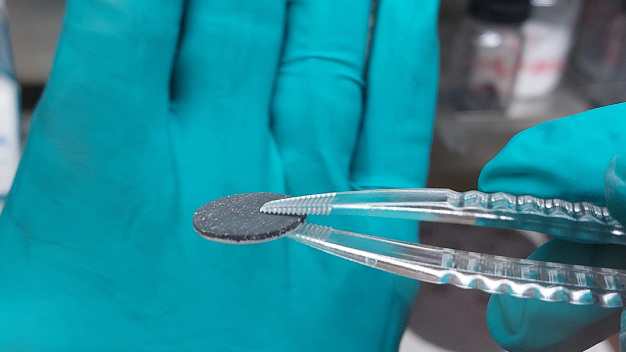
Multilayer ceramic solid-state cathode for initial functionality tests. © Fraunhofer IPA / Photo: Inga Landwehr
At the Center for Digitized Battery Cell Production at Fraunhofer IPA, process technology for the batteries of the future is being developed together with medium-sized companies Dr. Fritsch Sondermaschinen GmbH and Dr. Fritsch GmbH & Co KG. The state of Baden-Württemberg is funding the research project with over one million euros.
"Solid-state batteries have the potential to replace current battery technology," says Carsten Glanz with conviction. The group leader for application technology of functional materials at the Fraunhofer Institute for Production Technology and Automation IPA aims, together with a team of scientists and two medium-sized companies from Baden-Württemberg, to create the prerequisites for the automated production of high-quality energy storage devices.
Compared to today's common lithium-ion batteries, solid-state batteries have several advantages: Higher safety — because no liquid electrolyte is needed, so nothing can leak or ignite. Additionally, they offer higher energy density and longer lifespan.
However, the technology is still in its infancy. "Solid-state batteries with a ceramic electrolyte layer, for example, have so far only been produced in the laboratory scale. The scalability — that is, transferring the results to large-scale production — is still completely unclear," explains Glanz.
In the project "Research of new mixing and sintering technologies for graded ceramic solid-state electrolytes" (EMSig), the engineer now aims to develop and optimize a process chain for the large-scale manufacturing of batteries with ceramic solid-state electrolytes together with two industry partners: "At IPA, through the Center for Digitized Battery Cell Production, we have extensive experience with automation in battery manufacturing, and our cooperation partners possess profound know-how regarding the production and functionalization, handling, and sintering of powders."
"Dr. Fritsch GmbH & Co KG will provide and modify the ceramic raw powder needed for manufacturing ceramic electrolytes," informs Ute Wilkinson, Managing Director of Dr. Fritsch. "Here, we have the competence to produce and analyze custom materials." The second partner is Dr. Fritsch Sondermaschinen GmbH, an internationally leading manufacturer of machines for mixing, dosing, and sintering powders. The company has a long tradition of innovative powder handling and sintering technology. This allows new production methods to be immediately implemented on the necessary machines. The focus of the production process will be the further development of innovative FAST / SPS sintering systems. Dr. Fritsch is the world’s leading manufacturer of such FAST / SPS machines, with over 1,000 installed sintering systems.
Smooth transition instead of rigid boundaries
A particular challenge in the manufacturing of solid-state batteries is the material transitions: Sharp boundaries between the individual layers of the battery can lead to poor ion conduction. Due to different thermal expansions, there can even be fractures along the interfaces.
The solution: flowing boundaries. "Laboratory experiments have shown us that stresses can be prevented by gradual transitions between the ceramic solid-state electrolyte and the electrodes," reports Glanz. "However, it was previously unclear how to technically realize these stress-reducing transitions."
The goal of the EMSig project is to build a demonstrator system in which solid-state batteries are constructed layer by layer from ultra-thin, homogeneous powder layers, which are then sintered, with the composition of the powder changing with each layer: For example, at the transition between electrode and electrolyte, more ceramic powder is gradually mixed in — 25, 50, 75, and finally 100 percent.
Within two years, the entire production process should be mature enough to be used by industry for large-scale battery manufacturing. The EMSig project is supported by the state of Baden-Württemberg with 1.164 million euros.
Fact sheet
Project: "Research of new mixing and sintering technologies for graded ceramic solid-state electrolytes (EMSig)"
Project partners: Dr. Fritsch GmbH & Co KG, Dr. Fritsch Sondermaschinen GmbH, Fraunhofer Institute for Production Technology and Automation IPA
Project duration: September 15, 2021, to September 14, 2023
Funding amount: 1.164 million euros
Funding agency: State of Baden-Württemberg
Funding code: BW1_0163/03

Fraunhofer-Institut für Produktionstechnik und Automatisierung IPA
Nobelstraße 12
70569 Stuttgart
Germany
Phone: +49 711 970 1667
email: joerg-dieter.walz@ipa.fraunhofer.de
Internet: http://www.ipa.fraunhofer.de



